
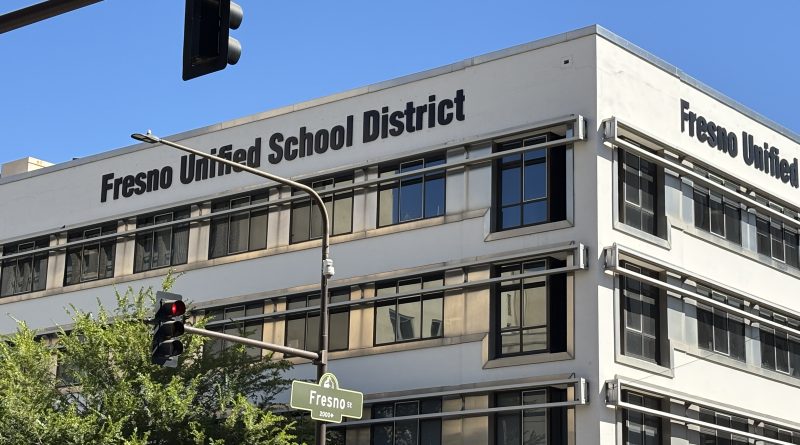
Fresno Unified School District — Photo: Jengod — CC0, via Wikimedia Commons
Fresno State Professor Calls Out Schools for Failing to Address Racist Incidents as Cultural Problem
A Fresno State education professor is pushing Central Valley schools to stop treating racist incidents as isolated “bad apples” and start confronting the culture that produces them.
David E. Low, who researches humor and wrote a 2024 book examining racist incidents at Bullard High School, points to a pattern: homophobic slurs on clothing at Visalia’s Redwood High in February 2026, students sharing images of themselves in blackface at Bullard in 2019, and a student photographed in Klan attire at Bullard in May 2022 that triggered district-wide walkouts.
“It’s not enough to point fingers or remove a few bad actors,” Low wrote in an op-ed. “Schools must dig deep to confront the beliefs, policies and practices that allow hate to grow.”

Low’s op-ed cites a Bullard senior who said they weren’t surprised by the 2022 Klan photo — they’d witnessed racism at the school before. Another student said it was part of the school’s history, something their grandmother experienced as a student there.
The professor calls out a specific failure: when student groups issue formal demands for cultural sensitivity training, enforcement of antiracist policies, and funding for social justice initiatives after these incidents, “districts rarely concede.”
He points to Thomas Stewart, a Fresno-area teen who published an op-ed in 2023 calling for education about systemic disparities in the community, as understanding what school boards miss — that racism isn’t an individual problem but “historical, structural and local.”
Low argues English and social studies teachers should teach students to examine what makes something funny to some and not others, and that students should learn research showing hateful humor leads to “multiple types of harm, including genocide and political violence.”
“Schools should ask, ‘How have we been complicit in enabling the values and ideas that surfaced on our campus?'” Low wrote. He calls for professional development, critical reflection on local history, and “real steps to reshape their culture.”
His bottom line: “Hateful humor depends on the existence of hate. Our schools reflect the beliefs of the community at large.”
The Breakdown
- Low documented a pattern of racist incidents at Bullard High School spanning from students’ grandparents’ generation through 2022, when a student in Klan attire triggered walkouts.
- He argues schools focus on “managing controversy” rather than addressing harm to targeted students.
- Student groups have demanded cultural sensitivity training, enforcement of antiracist policies, and funding for social justice initiatives — demands districts “rarely concede,” according to Low.
- Low proposes schools ask how they’ve been “complicit” in enabling hateful values, expand professional development, and examine local history.
- He suggests curriculum changes: teaching students to examine humor through the lens of cultural context, history, power dynamics, and research on harm caused by hateful humor.
What This Means for You
Low’s piece names a specific accountability gap: student groups make formal demands after these incidents, and districts don’t act on them. The pattern Low documents at Bullard — racist incidents spanning from students’ grandparents’ generation through 2022 — shows the same problems recurring across decades.
What You Can Do
If your student’s school has experienced incidents like the ones Low describes, you can ask your district directly what policy changes they’ve made in response to student demands for cultural sensitivity training and antiracist resolutions.
What to Watch
Low’s call for schools to ask “how have we been complicit” is the real test here. Actually examining why the same patterns keep showing up across decades, as Low documents at Bullard, means asking whether districts’ own policies and inaction are part of the problem. That’s uncomfortable.
The gap Low identifies — student groups make formal demands, districts don’t act — raises a legitimacy question. If a district treats student walkouts as a PR problem to manage rather than addressing the underlying issues, whose interests is that district actually serving?
The other question is curricular. Low proposes teaching students about the documented harms of hateful humor, including its connection to political violence. That’s a specific ask — not vague “sensitivity training” but actual classroom content. Whether districts treat that as reasonable education or as something too controversial to touch tells you how seriously they’re taking the problem Low names.