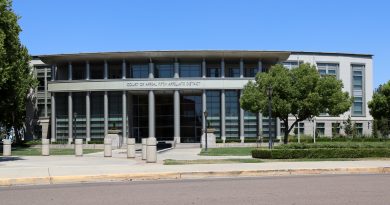

Fresno City Hall — Photo: Nightryder84 — CC BY-SA 3.0, via Wikimedia Commons
Fresno judge grants Native American man discovery in racial bias case against DA’s office
A Fresno County Superior Court judge ruled that Douglas Stankewitz — a Native American man who has spent nearly 50 years in prison — has met the threshold to obtain evidence from the Fresno County District Attorney’s Office that could support claims the office prosecuted him with racial bias.
Judge Alvin M. Harrell III granted Stankewitz’s request for discovery under the California Racial Justice Act, saying the defense had established “good cause” to access decades of prosecutorial records. The ruling does not determine whether discrimination actually occurred. It means the defense can now obtain evidence to build that case.
Stankewitz was originally sentenced to death in Fresno County before being resentenced to life without parole in 2019. His attorneys are now arguing that racial bias shaped how he was charged and sentenced.

At the hearing, Deputy District Attorney Jamie Kalebjian argued the defense had not shown enough evidence of racial disparities affecting Native Americans specifically. She pointed to what she called a “1.16 rate of disparity” and said the defense was conflating broader statistics about people of color with data specific to Native Americans.
“I just don’t think that they’ve raised a significant enough disparity in alleging that American Indians were disproportionately represented among LWOP and death penalty cases,” Kalebjian told the court.
Defense attorney Curtis Briggs responded that prosecutors were trying to litigate the merits of the case before the discovery phase had begun — exactly what the Racial Justice Act is designed to prevent.
“What we’re saying, based on the limited information we do have, is it is plausible, it could have happened,” Briggs said. “I only have to show a plausible justification that it could have happened.”
Judge Harrell sided with the defense, explaining that the Racial Justice Act’s discovery standard is intentionally broad.
“Good cause equates to a plausible factual foundation based on specific facts that a violation of the Racial Justice Act could have occurred in the case,” Harrell said. “I think we all can agree that that language tells us that this is a fairly low bar to gain access to the requested discovery.”
The judge cited several factors that satisfied that standard: Stankewitz is Native American and the victim was white. Prosecutors allegedly excluded the only Native American prospective juror during Stankewitz’s second trial. Historical evidence showed discrimination against Indigenous people in Fresno County, including Ku Klux Klan activity during the 1970s and 1980s and a Fresno County Sheriff’s Department employee who held a leadership position in the organization during that period. Native Americans in Fresno County were incarcerated at significantly higher rates than white residents.
Harrell also referenced a Fresno County District Attorney’s Office press release in an unrelated case that used the term “Squaw Valley” — a name that has since been changed to Yokuts Valley because the former name was derogatory toward Native women.
The DA’s office had argued that press release was irrelevant to Stankewitz’s claims. The judge disagreed.
The Breakdown
- The California Racial Justice Act, enacted in 2020 and expanded in subsequent years, prohibits criminal convictions and sentences obtained through racial bias.
- The law gives defendants broad discovery rights to uncover evidence of discrimination in charging, sentencing, jury selection, and other parts of criminal proceedings.
- To obtain discovery, a defendant must show “good cause” — a plausible factual foundation that a violation could have occurred, not proof that it did.
- Judge Harrell ruled Stankewitz met that threshold based on his Native American identity, the victim’s white identity, allegations prosecutors excluded a Native American juror, historical evidence of discrimination in Fresno County, incarceration-rate disparities, and the DA office’s use of a derogatory term in another case.
- The ruling allows the defense to obtain decades of prosecutorial records — including murder prosecutions, special-circumstance charging decisions, death penalty cases, life-without-parole sentences, jury selection materials, training materials, and internal sentencing policies.
- The defense says public-records requests for this information were denied or incomplete, leaving court-ordered discovery as the only option.
What This Means for You
The Racial Justice Act allows defendants to challenge patterns of bias in how prosecutors make charging and sentencing decisions. This ruling does not yet prove bias occurred. It says the threshold for asking the question has been met.
Whether the patterns Stankewitz’s attorneys have raised can be explained by the DA’s office will depend on what the records show.
What to Watch
The next phase will determine what records the DA’s office must actually turn over and whether any can be withheld or redacted.
Watch whether the patterns Stankewitz’s attorneys have cited — Native Americans incarcerated at higher rates, a Native juror allegedly excluded, historical ties between law enforcement and the Klan, a press release using a slur — turn out to be isolated incidents or part of a broader record. The DA’s office says those facts don’t add up to a disparity worth investigating. The judge disagreed. The records will show which view is grounded in evidence.
If the discovery does reveal disparities in how Native defendants were charged or sentenced, the question becomes whether the DA can explain them. This case is about whether Stankewitz’s prosecution and sentencing involved racial bias.