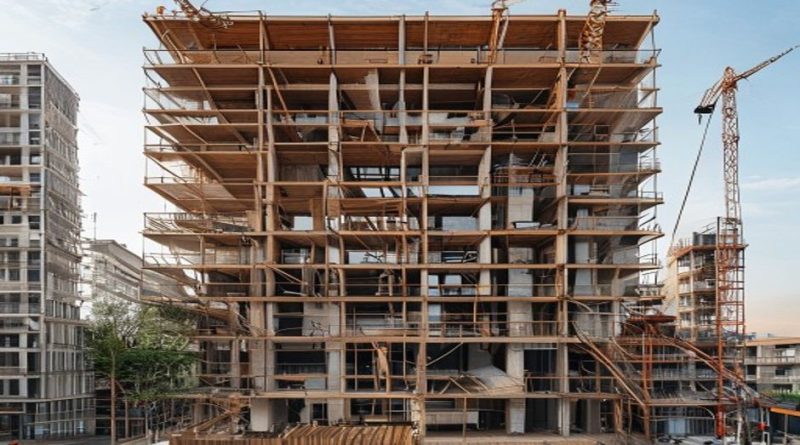
Generic illustration of an apartment building under construction — AI-generated illustration — no photo of the actual groundbreaking event was available from any reachable source; this is a generic representation, not a depiction of the real project.
City breaks ground on 54-unit farmworker housing complex in Southwest Fresno with $5 million public investment
Mayor Jerry Dyer stood at the corner of Ventura Avenue and Eighth Street on Friday morning to break ground on the Ventura Family Apartments, a 54-unit affordable housing complex for agricultural workers and their families in Southwest Fresno.
The project adds to what Dyer announced would be 2,500 total affordable housing units currently underway in the city. “It’s an opportunity for stability for families and an opportunity for people just to say we have a home,” Dyer said at the ceremony.
The development is for families who work in Fresno County’s agricultural industry — people Dyer described as essential to feeding the country. “We cannot put food on the table across the United States, and we cannot put food on our own table without dedicated agricultural workers in the community and we are so fortunate to have them,” he said.

Councilmember Brandon Vang, who represents District 5 where the project is located, shared his own experience growing up in a family that worked in the fields. “During the school year, I would hit the books, but I was one of those kids who worked in the field, and here I am today standing in front of you,” Vang said, expressing hope that children living in the new apartments would feel secure enough to reach for big goals.
The Fresno City Council approved the project’s funding and ground lease agreements on June 4, 2026, on a consent calendar vote. The city is contributing $5 million through its Local Housing Trust Fund and leasing the city-owned land to the developer, 3720 E. Ventura Ave., L.P., for $1 per year under a 55-year ground lease with two optional 10-year extensions. The total project cost is $40 million, with the remaining $35 million coming from sources other than the city’s direct cash contribution.
Dyer acknowledged that rising material and labor costs make projects like this increasingly difficult to finance. The site was determined by city staff to qualify as infill development exempt from California Environmental Quality Act review.
The Breakdown
- The Fresno City Council approved four agreements on June 4, 2026, to enable the Ventura Family Apartments affordable housing project at Ventura Avenue and Eighth Street in District 5.
- The city is providing $5 million in cash from its Local Housing Trust Fund and leasing city-owned land to the developer for $1 per year over 55 years (with two optional 10-year extensions).
- The 54-unit complex is designated for agricultural workers and their families — a population Dyer and Vang framed as essential to Fresno’s economy and deserving of stable, affordable homes.
- The total project cost is $40 million; the remaining $35 million beyond the city’s contribution comes from other financing sources not detailed in the public record.
- The project was classified by city staff as infill development exempt from state environmental review.
What This Means for You
This project shows you how your city council chooses to spend public dollars and public land — $5 million in cash and a city-owned site leased for practically nothing over more than half a century. That’s a choice made by Mayor Dyer and the council about what kind of housing gets built in Fresno, who it’s for, and what role taxpayers play in making it happen.
If you’re a voter weighing how officials prioritize affordability, economic development, or the needs of farmworker families specifically, this is a concrete example of that priority in action. The 2,500 affordable units Dyer mentioned as underway represent a significant public investment — you have a right to know whether these projects deliver the stability officials promise and whether this approach to affordability is the most effective use of limited public dollars.
What to Watch
The city’s direct cash contribution — $5 million for 54 units — works out to roughly $92,600 per unit in public money, separate from the value of the land lease. That is a very different number from the project’s full $40 million cost: the city is not writing a $40 million check, but it is committing $5 million in cash plus a city-owned parcel leased for $1 a year over 55 years, a subsidy whose market value is not stated in the public record.
This funding and lease package passed on a consent calendar on June 4, 2026 — approved as part of a routine bundled vote rather than debated individually, a normal part of how councils handle pre-reviewed items, but also a reminder that a multi-million-dollar, half-century land commitment can clear the council with less individual scrutiny than a single contested item on the same agenda.
There are real questions beyond the dollar figures worth sitting with. First, the opportunity-cost question: could that same public commitment — cash plus land — have gone further toward lowering the cost of Fresno’s existing housing stock rather than funding new construction?
Second, the beneficiary question: this project is framed around helping farmworker families, but developments like it can also function as an indirect subsidy to agricultural employers whose wages leave workers unable to afford market-rate housing on their own — is the city solving a housing problem, or subsidizing an industry’s low-wage structure?
Third, the long-term pattern: concentrated affordable housing for low-income or vulnerable populations has a mixed track record in Fresno and many other cities — some projects stabilize neighborhoods and give families a foundation, while others concentrate poverty, strain nearby schools and services, and leave residents more isolated, not less.
No one knows today which path this project will follow. The question for voters isn’t whether it will definitely succeed or fail — it’s whether the city has a real plan to make sure it’s the former, and whether anyone will be held accountable if it isn’t.