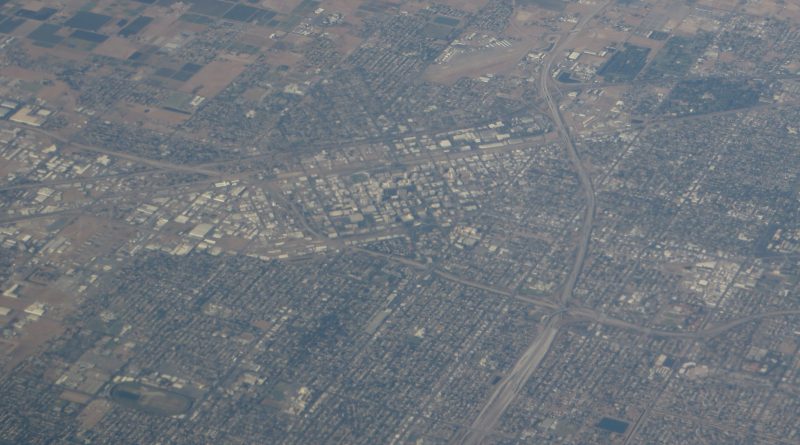
Downtown Fresno — Photo: Ken Lund from Reno, Nevada, USA — CC BY-SA 2.0, via Wikimedia Commons
Fresno Council to Vote on SEDA Ballot Measure That Critics Say Opens Taxpayer Subsidies
Fresno City Council will vote Thursday on whether to place a November ballot measure called the “No Debt on Development Act” before voters — a proposal Council President Nelson Esparza says would prevent taxpayer money from funding the controversial Southeast Development Area mega-project. Critics say the measure does the opposite, opening financial pipelines that could put ratepayers on the hook for hundreds of millions in infrastructure costs.
The measure targets SEDA, Mayor Jerry Dyer’s plan to annex 9,000 acres of mostly farmland on Fresno’s southeastern edge and build up to 45,000 new homes. A city-commissioned report last year showed the project’s first phase alone — South SEDA — faces a $440 million infrastructure funding gap even after developer fees.
Esparza introduced the proposal Friday, with resolution language appearing Monday morning nine minutes before the state’s 72-hour public-notice deadline. No staff report accompanied it.

The measure would prohibit the city from spending general fund tax revenues or incurring bond debt to pay for infrastructure in SEDA — except for South SEDA. That carve-out, opponents say, is the problem.
“He hasn’t put guardrails on it,” said District 6 Councilmember Nick Richardson. “This policy proposal removes guardrails.”
Under the proposal’s language, the city could issue bonds to build South SEDA’s infrastructure as long as the debt is “payable solely from legally restricted, non-General Fund revenues” — categories that include development impact fees, assessment district revenues, infrastructure financing district revenues, enterprise fund revenues (water and sewer systems funded by ratepayers), grants, and other sources that don’t directly obligate the general fund.
A May 2025 city report showed South SEDA’s infrastructure will cost $672 million, with existing developer fees covering only $233 million. The city’s plan assumes a hypothetical “SEDA Special Financing District” will generate the remaining $440 million, potentially including a $205 million bond — twice the size of Dyer’s marquee Pave More, Pay Later road-repair bond. The city has not disclosed where that $440 million will come from.
Patience Milrod, attorney for the Central Labor Council and nonprofit Regenerate California Innovation, sent a letter Tuesday to city officials detailing concerns. “It appears the measure does not live up to its hype: in particular, it allows Fresnans’ taxes and fees to flow into SEDA rather than funding only Fresno infrastructure and services,” Milrod wrote. She called the proposal “a contradictory and confusing mess.”
Milrod argues the measure restricts only the narrowest spending category while leaving expensive items untouched — for example, sewer and water trunk lines outside SEDA’s boundaries that must be expanded to serve it, costs she estimates in the hundreds of millions to billions. The measure also prohibits outright fee waivers but not deferrals, credits, reimbursement agreements, or setting fees below cost recovery — mechanisms she describes as financially identical to waivers.
Esparza defended the proposal. “This measure wasn’t intended to win over staunch opponents,” he said. “It was designed to protect the city’s long-term finances, and it accomplishes just that.” He said the measure prohibits the city from incurring debt for infrastructure and bans waiving development impact fees, “ensuring that developers are truly responsible for the cost of building out our city’s fringes.”
Richardson said the measure’s intent is unclear: “It’s confusing whether the intent of it is to kill SEDA based on limiting funding sources, or if it’s to expedite SEDA by allowing an expansion of funding sources available for South SEDA.”
Dyer said he would not oppose the measure despite its impact on his signature project. “The item addresses many of the concerns that have been raised by opponents of SEDA in terms of preventing leapfrog development,” he said. If approved, it would give the city time “to prove the financial viability of the development of South SEDA, and the fact that it will not hinder the development of within the core.”
The ballot measure is one of four proposed initiatives the council will vote on Thursday. Political science experts and democracy watchdogs say ballot measures should have been introduced months in advance for voters and council to review. Placing all four measures on the November ballot will cost $600,000, according to the Fresno County Clerk/Registrar of Voters.
The Breakdown
- The “No Debt on Development Act” would prohibit the city from using general fund tax revenues or bond debt to pay for infrastructure in SEDA — except for the first phase, South SEDA.
- For South SEDA, the measure allows bonds secured by non-general-fund revenues: development impact fees, assessment districts (special taxes on properties to pay for local improvements), infrastructure financing districts (zones where property tax increases fund development), enterprise funds (water/sewer ratepayer money), grants, and similar sources.
- South SEDA’s infrastructure is projected to cost $672 million. Existing developer fees cover $233 million. The city assumes a “SEDA Special Financing District” will generate the remaining $440 million, possibly through a $205 million bond, but has not disclosed the funding source.
- Critics say the measure restricts only direct general fund spending while leaving ratepayer subsidies, fee deferrals/credits, and off-site infrastructure costs (trunk lines outside SEDA that serve it) eligible for taxpayer funding.
- The City Council votes Thursday on whether to place the measure on the November 3 general election ballot.
What This Means for You
You’ll decide this November whether to approve a measure that could allow the city to bond against water, sewer, and other ratepayer-funded accounts to build SEDA’s first phase — a mechanism that keeps general fund spending off-limits while potentially putting your utility bills on the line for a project a city report showed can’t pay for itself with developer fees alone. The council president whose vote brings this to you says it protects taxpayers; the councilmember questioning it says it removes existing guardrails. Your November ballot vote will determine whether these non-general-fund revenue sources can be used to close South SEDA’s $440 million funding gap.
What You Can Do
The Fresno City Council meets Thursday to vote on placing this measure on the November ballot — that meeting is when the council decides whether you get a say at all. If the measure makes it to November, your vote will determine whether the city can use non-general-fund revenues (ratepayer money, financing districts, bonds) to subsidize South SEDA’s infrastructure gap.
What to Watch
The real question this measure surfaces but doesn’t answer: what is the actual source of that $440 million the city’s plan assumes will appear to close South SEDA’s funding gap?
The measure’s language allows bonds secured by assessment districts, infrastructure financing districts, and enterprise funds (water and sewer ratepayer accounts), but the city has not disclosed which of these it will use or how much each would contribute to the $440 million gap.
Councilmember Richardson is right to call this confusing — a measure titled “No Debt on Development” that explicitly allows debt for development, as long as it’s the right kind of debt. The South SEDA carve-out isn’t a minor exception; it’s the entire first phase of a project the mayor has staked his legacy on, and it happens to be the phase the city’s own report showed is $440 million short.
Here’s the concrete tension the materials raise: the measure prohibits outright fee waivers but leaves deferrals, credits, and reimbursement agreements untouched — mechanisms Milrod identifies as financially identical to waivers, just with different timing.
If the city uses bonds secured by ratepayer revenues (water, sewer) to cover infrastructure gaps while developers defer fee payments, ratepayers may front costs that developers pay back later or not at all, depending on the financing structure the city hasn’t yet disclosed.