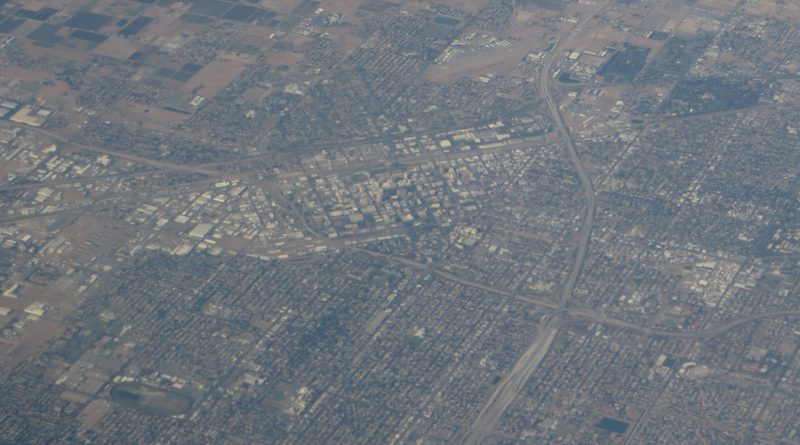
Downtown Fresno — Photo: Ken Lund from Reno, Nevada, USA — CC BY-SA 2.0, via Wikimedia Commons
Planning Commission Advances 9,000-Acre SEDA Development Plan Without Public Financial Analysis
The Fresno Planning Commission voted 6-1 Wednesday to recommend approval of the Southeast Development Area plan, a multi-phased project covering roughly 9,000 acres in southeast Fresno. The vote sends the proposal to City Council for final approval, despite the absence of a completed financial analysis that was ordered by the council itself.
The meeting drew enough attendees to fill council chambers and require opening the balcony. Commissioners reduced public comment time from three minutes to two minutes to accommodate the crowd. According to city staff, the plan aims to add housing, create jobs and improve environmental sustainability, with plans for up to 45,000 housing units and an estimated 30,000 to 37,000 jobs.
Commissioner Gurdeep Shergill cast the lone no vote. Two commissioners who had voted against the plan in November — DJ Criner and former chair Peter Vang — were replaced by Mayor Jerry Dyer with new appointees Joseph Giles and Jaime Holt prior to Wednesday’s vote. All planning commissioners serve at the mayor’s pleasure.

The council-ordered financial analysis for SEDA’s first phase has not been made public, with a public unveiling scheduled for September. Planning Director Jennifer Clark told commissioners that determining how the city pays for infrastructure “is the responsibility of the city council,” not the planning commission. When pressed on how SEDA would pay for itself, Clark listed mechanisms — impact fees, property tax, Mello-Roos assessments, a public-private partnership — but said picking one “would be premature.”
A financial report released in May stated Phase One would cost around $7.4 billion. The material does not state what portion of that figure represents public spending versus private financing or other funding sources.
By a show of hands, five people in attendance supported the plan. Speaker after speaker opposed it — farmers inside the plan boundary, residents from across the city, the superintendent of Central Unified, the president of Fresno Unified’s board, and Councilmember Miguel Arias.
Mark Marshall, superintendent of Central Unified, told commissioners his board passed a resolution opposing SEDA in April and asked the city to fund infrastructure west of Highway 99 first. Veva Islas, president of the Fresno Unified board, said: “We are currently already suffering from a decline in attendance and enrollment. SEDA would further our enrollment decline.” Both the Fresno Unified and Central Unified school boards passed resolutions opposing the project earlier this year.
Debbie Bigum, who lives inside the plan area, said SEDA would incur six-figure costs for existing residents who will be required to connect to city water and sewer. Last year, Mayor Dyer proposed a community benefit fund, but Bigum said the actual language in the new SEDA plan was “not legally binding.” “The cumulative cost could be more than the value of the home,” she said.
Rod Wade, a southwest Fresno resident, said life expectancy on his side of town runs 20 years shorter. “They want to build all the fancy stuff on the north side of town, but they want to put the trucks to bring the pollution to our side of town,” he said.
Supporters emphasized potential economic benefits. One supporter said the plan “puts jobs and tax revenue generation first and comes back to benefit all the residents in the city.” Bill Betts, president of the Betts Company, a local manufacturer, said Fresno was “driving growth to our neighbors in Visalia and Madera.” The Fresno Chamber of Commerce, Invest Fresno, and a business development specialist from the county’s economic development corporation spoke in favor.
Planning Commission Chair Kathy Bray said: “I see this as another good chance to get some decent jobs in Fresno.”
The project previously came before the City Council in December. Council voted not to approve it and directed staff to conduct further review and revisions. At Wednesday’s meeting, commissioners were shown three environmental impact reports before voting.
The commission is also recommending that the City Council strengthen requirements for SEDA funding of community provisions that would benefit existing SEDA residents.
The Breakdown
- The plan area: 9,000 acres in southeast Fresno, generally bounded by the Gould Canal on the north, McCall and Highland on the east, Jensen and North on the south, and Temperance and Minnewawa on the west.
- Phase 1 (South SEDA): Located east of Temperance Avenue and south of Jensen Avenue. Under full buildout, the development would eventually extend toward Clovis Unified School District’s Terry Bradley Education Center.
- Scale: Up to 45,000 housing units and an estimated 30,000 to 37,000 jobs at full buildout.
- The vote: 6-1 to recommend approval. The recommendation now goes to City Council for final approval.
- What’s missing: A financial analysis ordered by City Council in December has not been made public. A public unveiling is scheduled for September — after the planning commission vote but before the council’s final decision.
What This Means for You
The City Council will make the final decision on whether this project moves forward. That council is the body Fresno voters elect to weigh exactly this kind of question — whether to approve a development of this scale, how to pay for the infrastructure it requires, and whether the benefits claimed justify the costs imposed on existing neighborhoods. The planning commission’s role was limited to consistency findings under state law, but the material shows commissioners were told they could not weigh information learned outside the meeting itself and that the claim a plan pays for itself should be treated as evidence the plan pays for itself. The council is not bound by that same constraint — it controls the actual approval decision and the financing question the commission was told not to consider.
What You Can Do
The planning commission’s recommendation now goes to the Fresno City Council for a final vote. The material does not state when that vote is scheduled. Contact information for the City Council is available at fresno.gov.
What to Watch
The missing financial analysis is not a secondary detail — it is the question the City Council itself ordered in December when it voted not to approve the plan and directed staff to conduct further review. That analysis was scheduled for public release in September, after the planning commission vote but before the council’s final decision. A voter weighing this council’s judgment has a right to know whether the council will vote on the same terms the commission did — approving a plan whose financial viability rests on mechanisms listed but not chosen, with a cost figure stated but not broken down by public versus private funding — or whether the September analysis will actually answer the question the council claimed to be asking.
The composition of the planning commission itself is worth noting. Two commissioners who voted against the plan in November were replaced by Mayor Dyer before Wednesday’s vote. All planning commissioners serve at the mayor’s pleasure. A voter deciding whether to trust this process should know that the body recommending approval is not the same body that previously balked, and that the difference is the mayor’s direct appointment power, not a change in the plan’s substance.
The stated cost — $7.4 billion for Phase One — is a total project figure. The material does not break down what portion of that represents public spending, private financing, tax credits, or debt carried by developers. Do not assume the full $7.4 billion is public money or that any per-unit calculation based on that total reflects the actual public cost. If the September analysis does not clearly separate public contribution from total project cost, that is itself a red flag.
Finally, the stated job and housing numbers — 30,000 to 37,000 jobs, up to 45,000 housing units — rest on growth projections. One speaker, Alan Cederquist, told commissioners the plan assumes 117,000 new residents when the state Department of Finance projects Fresno’s population to decline. Whether the jobs materialize, and whether the housing built is housing Fresno actually needs at a price Fresno residents can afford, are questions a voter is entitled to ask before this council votes yes.