
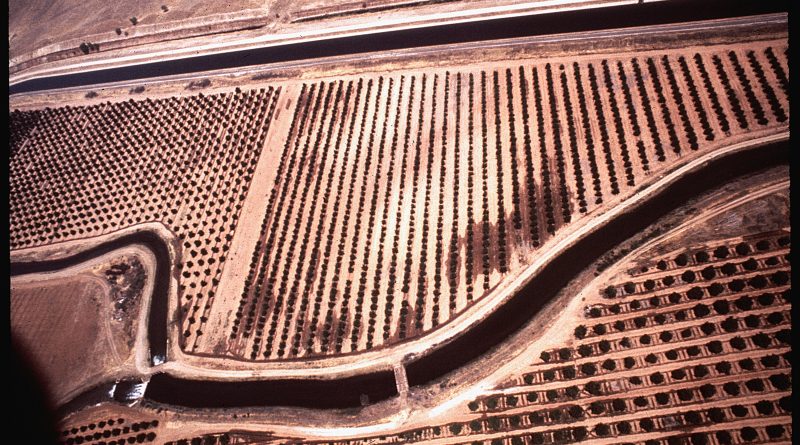
Fresno irrigation canal — Photo: Gene Daniels — Public domain, via Wikimedia Commons
Kings County Water District Backs Groundwater Fee Despite Not Pumping
Lakeside Irrigation Water District directors voted Sept. 2 to support a land assessment fee they acknowledged their own operations don’t necessitate. The district uses its 330 acres primarily for groundwater recharge, not extraction.
The fee — $26.84 per acre annually — is proposed by Mid-Kings Groundwater Sustainability Agency, whose boundaries include Lakeside’s land. Mid-Kings GSA expects to collect $2,467,400 in 2027 for operations and compliance with state groundwater regulations.
“To keep Mid-Kings out of probation, I’d say we need to help them out because if we don’t, it might transfer over to everything else,” board member Clinton Church said at the meeting.

The Tulare Lake subbasin, covering most of Kings County, entered state probation in 2024 for lacking an approved plan to address critical overdraft. Probation carries additional reporting requirements and state fees.
Lakeside’s general manager Shawn Corley noted landowners would effectively pay twice: once to the district for water service, once to the GSA for groundwater management. “My only deal with this is, not paying, but that the landowners in Lakeside get dinged twice,” Corley told the board.
Directors noted cemeteries, schools, and parks received exemptions from the Mid-Kings fee. Lakeside did not.
The district would owe $8,884 in land assessment fees for its 331 acres if landowners approve the measure. Kings County Water District, with 1,017 acres in Mid-Kings, also voted Sept. 3 to support the fee. That district would pay $27,296 for water year 2027.
Mid-Kings is separately proposing a $19.24-per-acre-foot pumping fee under Proposition 26. Lakeside Irrigation won’t be charged that fee because it doesn’t pump, though individual farmers within its boundaries may be.
Revenue from the pumping fee would fund Mid-Kings programs addressing water quality, land subsidence, and domestic well damage caused by excessive groundwater extraction.
Lakeside’s 32,000-acre footprint spans three GSAs across two subbasins. Roughly 20% of its land sits in Mid-Kings GSA, 1% in El Rico GSA (both in Tulare Lake subbasin), and 80% in Greater Kaweah GSA in the Kaweah subbasin, which has an approved groundwater plan.
The Breakdown
- Mid-Kings GSA proposes $26.84 per acre annual assessment, generating $2,467,400 in 2027 for groundwater management operations and state compliance.
- Lakeside Irrigation Water District board voted Sept. 2 to support the fee despite district land being used for recharge, not extraction.
- A separate $19.24-per-acre-foot pumping fee requires Proposition 26 approval; Lakeside won’t be charged because it doesn’t pump.
- Landowners must approve the land assessment via Proposition 218 ballot due Sept. 29 at 1 p.m.
What This Means for You
If you own land in Mid-Kings GSA’s boundaries, you received a ballot determining whether the state-mandated groundwater management you’ll fund will be paid for through local fees or through state enforcement penalties. The Tulare Lake subbasin’s probation status means the vote isn’t whether to pay for compliance, but who controls how that payment is structured. The board votes from Lakeside and Kings County water districts represent agencies accepting a cost for a problem their own operations didn’t create, in order to keep the larger regulatory structure from collapsing into more expensive state intervention.
What You Can Do
Ballots are due Sept. 29 at 1 p.m. Mail your ballot, drop it at the Kings County Elections Department box (1400 W. Lacey Blvd Building #7, marked “Ballot Drop Off”), or bring it to the final public hearing.
What to Watch
The fee structure embeds a real tension: landowners whose operations recharge groundwater pay the same per-acre rate as landowners whose operations deplete it. Lakeside directors noted this explicitly — their land provides a net benefit to the aquifer, yet the fee treats all acres identically.
The exemptions granted to cemeteries, schools, and parks raise the value-for-money question directly: if the fee is justified as payment for groundwater use, why do non-extractive uses pay while other non-extractive land doesn’t? The answer appears to be political viability, not technical consistency — exempting publicly sympathetic land types while charging districts that actively recharge groundwater suggests the fee’s design prioritized passage over precision.
The separate pumping fee under Proposition 26 is where actual extraction gets charged. That split — a flat land fee plus a pumping fee — means a recharge operation and a high-volume extraction operation on identical acreage pay the same base rate before pumping is factored in. Whether that structure actually moves the subbasin toward balance, or simply funds compliance paperwork while leaving incentives unchanged, is the practical test of whether $2.5 million annually bought management or documentation.