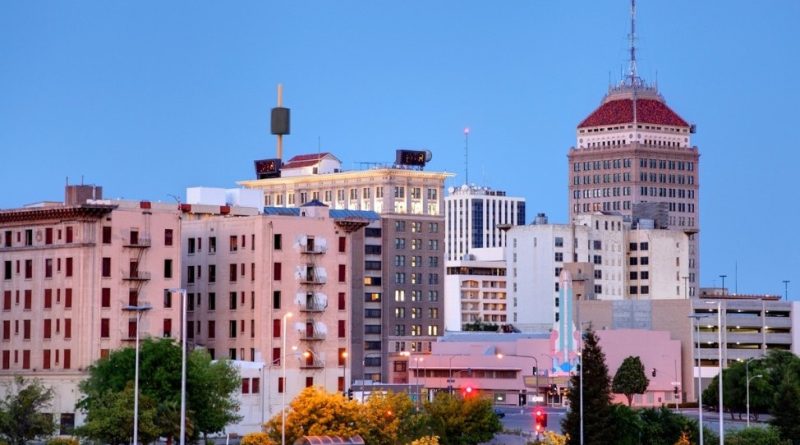
Fresno skyline — Photo: Etherealsmoke — CC BY-SA 4.0, via Wikimedia Commons
Fresno City Council to Vote on $65M Sales Tax Measure After Measure C Replacement Stalls
The Fresno City Council will vote July 30 on whether to place a half-cent sales tax measure on the November ballot, a move city leaders say is necessary after the Fresno County Board of Supervisors delayed a countywide Measure C replacement last week.
The proposed measure — the Fresno Public Safety, Infrastructure Restoration and Essential Services Act — would generate an estimated $65 million annually and maintain the city’s current 8.35% sales tax rate by replacing revenue from Measure C, which expires June 30, 2026.
“This measure does not increase sales tax at all in the City of Fresno. It keeps it exactly as it is,” said City Council President Nelson Esparza at a Thursday press conference. “Nobody in the city will pay two taxes for the same thing.”
The city faces a $54 million annual funding gap when Measure C expires, affecting 217 city positions across departments. According to Mayor Jerry Dyer, the breakdown includes $30 million and 85 employees in public works, $19 million and 93 employees in FAX transit, $1.1 million and 39 employees in capital projects, and $1.1 million at Fresno Yosemite International Airport.
Of the $54 million, $20.6 million is used annually as matching funds to leverage an additional $368 million in state and federal dollars, Dyer said.
The proposal comes days after the Fresno County Board of Supervisors voted July 14 to require additional review of the Better Roads, Safe Streets initiative, a citizen-led effort that had collected 22,000 signatures to qualify for the November ballot. That decision effectively delays any countywide measure until 2028.
“As a result of that, they have effectively killed any opportunity for this measure to be placed on the ballot in November of 2026. As a result of the study, we missed it by one day,” Dyer said.
Board Chairman Garry Bredefeld, District 2 Supervisor, raised concerns over the countywide measure’s language and allocation. “The measure is full of promises about street and road repair that will not happen. It’s really a public transportation tax disguised as a roads tax,” Bredefeld said.
The city’s proposed measure is structured as a general tax rather than a specific-purpose tax, requiring only 50% plus one vote to pass instead of the two-thirds threshold required for special taxes. Dyer pointed to recent voting patterns: Measure P drew 52% support, and a 2022 Measure C renewal requiring two-thirds approval received 58%.
The measure includes two sunset provisions: it expires after 10 years, or terminates immediately if a countywide transportation tax takes effect, whichever comes first. If county voters approve a Measure C replacement in 2028, the city measure would end automatically.
“We all went into sort of triage mode when we found out that the county transportation measure would be delayed,” Esparza said. “It’s really not a situation that the city created. We’re just responding and reacting the best we can.”
If voters approve the measure in November, the tax would take effect July 1, 2027. The measure would include annual independent audits and citizen oversight language, according to Dyer.
Measure C was first approved by voters in 1986 and extended in 2006. It has generated more than $2 billion locally and helped leverage roughly $8 billion in state and federal funding, Esparza said.
The Breakdown
- Vote Date: Fresno City Council votes July 30 on whether to place the measure on the November ballot
- Tax Rate: Half-cent sales tax maintaining current 8.35% rate (no increase)
- Revenue: $65 million annually
- Gap It Fills: $54 million annual shortfall from Measure C expiration
- Vote Threshold: Simple majority (50% plus one) as a general tax
- Sunset Provisions: Expires after 10 years OR immediately upon a countywide transportation tax taking effect, whichever comes first
- Effective Date: July 1, 2027 (if approved by voters in November)
- Jobs at Risk: 217 city positions across public works, FAX transit, capital projects, and the airport
What This Means for You
You’ll vote on this measure in November. If it passes, your sales tax rate stays exactly the same — but the city keeps $54 million a year in services rather than cutting 217 positions and reducing bus routes, street maintenance, and other infrastructure work. If it fails, you can expect some bus routes to be cut or reduced with wait times stretching from 30 minutes or less to 45 minutes to an hour, weekend and late-evening service could end as early as 8 p.m., and the city’s $1.2 billion in deferred street maintenance would continue growing. The measure is structured to end automatically if the county ever passes its own transportation tax, meaning it’s designed as a temporary bridge rather than a permanent addition.