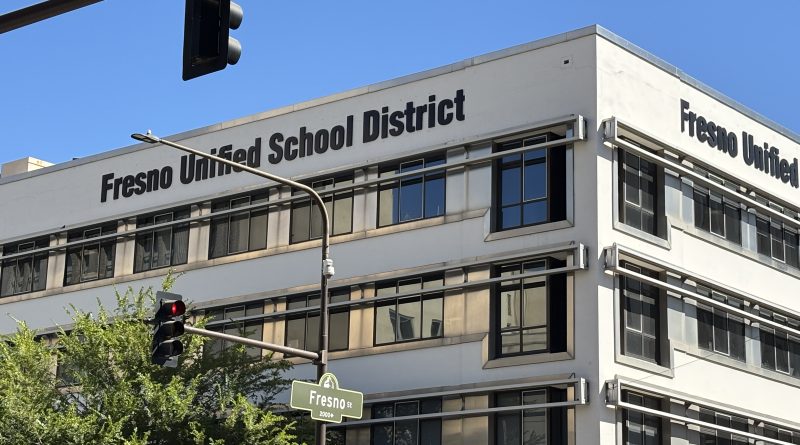
Fresno Unified School District — Photo: Jengod — CC0, via Wikimedia Commons
Fresno Unified’s New Bus Stops Leave Magnet Families Scrambling Days Before School Starts
Annie Masutsubo’s 11-year-old son Benji used to walk to his bus stop with his older sister. This year, under Fresno Unified’s new transportation system, he’ll walk half a mile alone and cross a busy street where cars travel 35 to 40 mph.
“His new route has him cross a busy street where the speed limit is between 35 and 40; that’s what I would call a major intersection that he, as an 11-year-old, needs to cross and won’t have his sister with him anymore,” Annie said.
With classes starting in a week, Fresno Unified has replaced neighborhood bus stops for magnet and choice school students with a “hub” model — stops now clustered at neighborhood schools instead of close to students’ homes. Some families say they learned of the change only last week, leaving them little time to prepare for routes that can now be a mile or more away.

The district says the old system created “long ride times, unreliable arrivals, and heavy traffic around elementary campuses at drop-off,” according to an Aug. 7 post on ParentSquare. The new contractor, Zūm (a Redwood City-based student transportation company), will serve all general education students starting this school year with technology that lets parents track buses and gives the district route-management tools.
But for families like the Masutsubos and the Lappes, the change arrived too late and with too little detail to adjust safely.
Christy Lappe said one of her students now has to walk a mile to a bus stop instead of riding with a sibling from nearby Roosevelt High School. School administrators mentioned changes were coming, she said, but details stayed vague until last week. When she called the district, she was told to fill out a form requesting her children ride together and was offered Fresno FAX city bus passes as an alternative.
“I think that, instead of being a benefit where they’re saving money from maybe not running as many busses, I definitely think that they’re going to see a decline or enrollment and or tardies because there’s gonna be kids that are having to like not fight to get to school,” Lappe said.
Lappe said she might be able to work around the change, but she worries about families without the same flexibility. “The communication factor, not having a choice, and then rolling this out within a short amount of time span just isn’t feasible,” she said.
Benji, the Baird Middle School student, said he doesn’t feel comfortable walking to his new stop without his sister. He worries about drivers running red lights and carrying his backpack further in the summer heat. “I kind of feel angry at FUSD for just doing this,” he said. “We had the same route last year, why can’t we do it now?”
When Annie Masutsubo called the district to ask for help, she said officials wouldn’t commit to changing the system for one student. “I was shocked because I, in the beginning, had a lot of faith in the district; I’m proud to be a Fresnan, I have sent all four of my children to Fresno schools because I’ve always loved them,” she said.
Fresno Unified was not immediately available for comment on parent concerns. Parents seeking information have been directed to register for the Zūm app, according to ParentSquare posts.
The Breakdown
- Fresno Unified replaced neighborhood bus stops for magnet and choice school students with a “hub” model — stops now at neighborhood schools instead of closer to students’ homes.
- The district contracted with Zūm, a Redwood City transportation company, to serve all general education students starting this school year.
- Parents say they learned of the change only about a week before school starts, leaving little time to adapt to stops that can now be half a mile to a mile or more away.
- The district says the old system created long ride times, unreliable arrivals, and heavy traffic; the new model uses technology to track buses and manage routes.
- Families with multiple students at different schools or students who previously rode together say the new system separates siblings and forces longer walks.
What This Means for You
Fresno Unified’s school board approved this transportation contract and oversees how district services operate. If you’re a parent of a magnet or choice school student, this change affects whether your child now walks alone on a busy street, or whether you’re juggling multiple drop-offs because siblings can no longer ride together.
This matters when you’re deciding whether to keep your child in a magnet program, whether to vote for school board members who prioritize efficient routing over family accessibility, and whether the district’s communication around major changes meets the standard you expect.
What You Can Do
Parents seeking information about new bus stops have been directed to register for the Zūm app. The district told at least one parent to fill out a form requesting siblings be allowed to ride together, and offered Fresno FAX city bus passes as an alternative for some students. Fresno Unified’s main contact information is available through the district’s website.
What to Watch
The district says this model will reduce ride times and traffic congestion. A system that clusters stops at neighborhood schools instead of closer to homes trades one set of logistical problems (long routes, traffic at campuses) for another (longer unsupervised walks, siblings separated, families without transportation options).
Two questions worth tracking: How many families pull their kids out of magnet programs because the commute became unworkable? When families are forced to commute, they may begin exploring other options outside the district, which results in less funding overall. Fresno Unified is already facing declining enrollment. When enrollment or attendance drops, will the board revisit this decision?