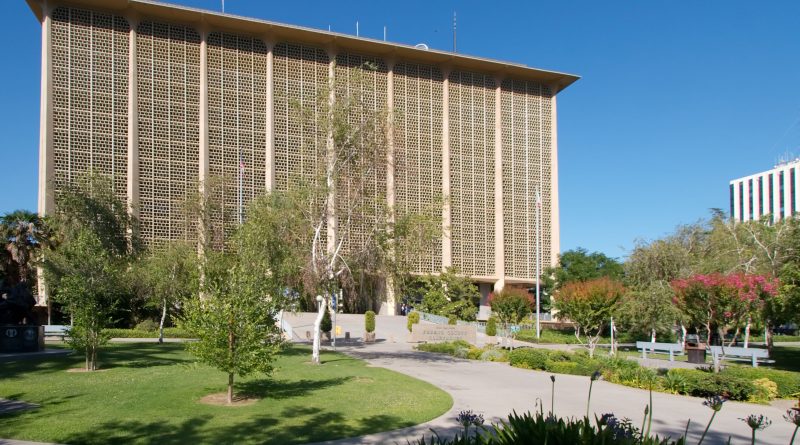
Fresno County Courthouse — Photo: Mfield, Matthew Field, http://www.photography.mattfield.com — CC BY-SA 3.0, via Wikimedia Commons
Fresno County Sues State Over Transportation Tax — AG Now Forces Judge Off Case
California Attorney General Rob Bonta just forced out the judge assigned to decide whether Fresno County’s Better Roads, Safe Streets transportation tax measure stays on the November ballot.
The county’s lawsuit against the state over that ballot measure now has a new judge.
That lawsuit stems from the county Board of Supervisors voting 3-2 last week to sue the state, the county’s own elections clerk, and two initiative supporters — Fresno Mayor Jerry Dyer and Clovis Councilmember Lynne Ashbeck.

The supervisors argue a new state law, AB 1923, unconstitutionally overrides their authority. That law requires the county to place Better Roads on the November 2026 ballot even though the board voted to delay it until March 2028.
Here’s how this fight started: Better Roads supporters submitted over 32,000 signatures in April — well above the roughly 22,000 needed to qualify. Instead of placing the qualified initiative on the ballot, Supervisors Garry Bredefeld, Buddy Mendes, and Nathan Magsig voted in July to order a $100,000, 500-page study of the measure.
That study took long enough that the measure missed the deadline to qualify for November. The board then voted to place it on the March 2028 ballot instead — after the current Measure C transportation tax expires in June 2027.
The state legislature stepped in. Assemblymember Esmeralda Soria and Senator Anna Caballero authored AB 1923, an urgency bill directing Fresno County to place any initiative that qualified as of July 8 on the November 2026 ballot. Governor Gavin Newsom signed it days before the supervisors’ lawsuit vote.
County Clerk James Kus told the board he’s following the state law and putting the measure on the November ballot, regardless of the board’s vote to delay it. That created the absurd situation the county is now suing over: a county government suing its own elections official for following state law.
The lawsuit names the state, Kus, Dyer, Ashbeck, and two other Better Roads proponents. Supervisors Luis Chavez and Brian Pacheco voted against pursuing it.
“We’re using taxpayer dollars to initiate these lawsuits,” Chavez said at the meeting. “I don’t think it’s a good use of our taxpayers to be suing the state of California or citizens or our own county clerk. I think we should let democracy be democracy and let people vote.”
Bredefeld defended the suit: “This board did nothing wrong. It followed state election laws.” He called AB 1923 a law that “targeted Fresno County to benefit the people that they have relationships with.”
Better Roads would replace Measure C, the half-cent sales tax approved in 1986 and renewed in 2006. The current version expires June 30, 2027. Better Roads would maintain the half-cent rate for 30 years and generate an estimated $7.4 billion, with a larger share going toward local roads, public transit, and pedestrian and bicycle infrastructure compared to the current Measure C spending formula.
The board’s own replacement effort failed in 2022 when it couldn’t reach the two-thirds approval threshold required for government-sponsored special taxes. Better Roads, as a citizen initiative, only needs a simple majority to pass.
County staff have projected roughly 90 potential county employee layoffs if Measure C expires without a replacement. Fresno officials separately warned the city could lose tens of millions annually and hundreds of jobs. Clovis and rural communities would also lose access to Measure C funding.
The lawsuit is now in court with a new judge, courtesy of Attorney General Bonta forcing the original judge off the case. Whether Fresno County voters actually get to vote on Better Roads in November — or whether the courts block that process — is the question that judge will now decide.
The Breakdown
- Better Roads, Safe Streets is a citizen-led initiative to replace Measure C, Fresno County’s expiring transportation sales tax — it qualified with over 32,000 signatures but the Board of Supervisors voted to delay it until March 2028 by ordering a $100,000 study that missed the deadline for the November 2026 ballot.
- The state legislature passed AB 1923, requiring the county to place the measure on the November ballot anyway — County Clerk James Kus says he’s following that law and putting it on the ballot, regardless of the board’s vote.
- Supervisors Bredefeld, Mendes, and Magsig voted to sue the state, Kus, Mayor Jerry Dyer, Councilmember Lynne Ashbeck, and two other initiative supporters, arguing the state law is unconstitutional — Supervisors Chavez and Pacheco voted against the lawsuit.
- California Attorney General Rob Bonta just forced out the judge assigned to decide the case.
What This Means for You
Whether you get to vote on Better Roads in November or wait until March 2028 — after Measure C expires and the county loses its transportation funding — depends on this lawsuit. Three supervisors are using your tax dollars to sue the state and the county’s own elections clerk to stop you from voting sooner rather than later. Two supervisors opposed that decision. The question in front of you as a voter is whether the people who delayed this measure and are now suing to keep it off the ballot longer are acting in your interest or their own.
What to Watch
Why did Attorney General Bonta force the original judge off this case? Forcing a judge out mid-case is not routine. Who benefits from a different judge hearing this?
And watch what the new judge actually decides: does the board’s authority to “review” an initiative really include the power to delay it past an election by ordering a study, or is that exactly the kind of voter-suppression tactic AB 1923 was written to stop? The board says it “followed state election laws” — but those laws give a board a ministerial role (checking signatures, setting a date), not discretion to delay a qualified initiative because they don’t like it.
The county spent $100,000 on a study written by the same people who wrote the board’s own failed replacement measure. That study argued Better Roads is too prescriptive and could expose the county to litigation. A reasonable question: was that study an honest risk assessment, or a stalling tactic designed to produce exactly the delay the board wanted?
Finally, watch whether the courts actually block this measure from the November ballot. If they do, Fresno County loses Measure C funding in June 2027 with no replacement in place — that means layoffs, service cuts, and a funding hole that won’t be filled until March 2028 at the earliest, assuming voters approve something then. Three supervisors are betting that delaying this vote is worth that risk. You get to decide in November whether they’re right — assuming the courts let you.