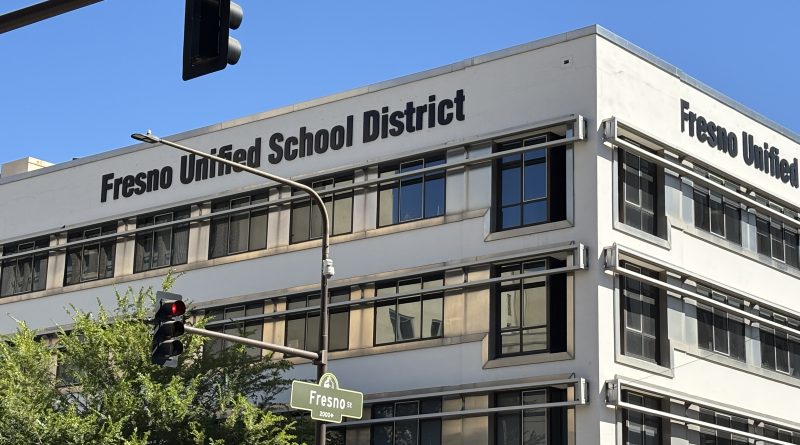
Fresno Unified — Photo: Jengod — CC0, via Wikimedia Commons
Two-Thirds of Fresno Unified Elementary Schools Miss District’s Early Literacy Goal
Your school board set a goal for how many first graders should be reading at grade level this year. Two-thirds of elementary schools didn’t hit it.
Fresno Unified Superintendent Misty Her told the school board Wednesday that 52% of sampled first-grade test scores met proficiency standards — falling 5.3 percentage points short of the district’s 58.7% target. Out of 66 elementary schools, 44 missed the mark.
The results come from iReady, a digital reading assessment the district uses to track progress toward its 2030 goal: 80% of first graders reading at grade level. The district is aiming for 64% proficiency by June 2027, 69% by 2028, and 74% by 2029.
Her pointed to bright spots. Last year, 70% of kindergartners met foundational reading skills targets — well above the 62.5% goal — and she said those students should lift first-grade scores when tested again this fall.
Calwa Elementary, a Spanish dual-language immersion school, jumped from 50% proficiency in 2024-25 to 64.5% last year. “Our teachers are the secret sauce,” said Principal Antonio Sanchez. “They believe that all kids can learn at high levels and they are committed to improving their practices.”
But the spread is wide. Muir Elementary reached 88.6% proficiency among its 44 tested first graders — the highest in the district. Columbia Elementary hit 25% among 72 students tested — the lowest.
The board meeting also covered the district’s arts-education spending under Proposition 28, a state funding stream voters approved. Fresno Unified has hired 57.3 full-time positions since 2023 using Prop. 28 funds and plans to hire up to 65. The district spent $8.8 million on arts staffing this school year and $10.4 million on materials. For 2026-27, the district expects $13.8 million in Prop. 28 funding, with $8.9 million going to staffing.
Parents also spoke up. Kristina Holmes-McIntyre, co-founder of the Fresno Community Parent Coalition, asked the board to ban around 50 pesticides and chemicals used on school grounds — 35 of which, she said, are banned in other countries. She thanked Her and Deputy Superintendent Ben Drati for being open to the group’s concerns, which include making pesticide notifications to parents more visible and digitizing the parent request form for pesticide application information.
Meg Wunder, a library tech at Rowell Elementary, asked the board to replace the library’s 55-year-old HVAC system. The building wasn’t included in early-2000s renovations funded by Measure K, a local school bond. The system is so old, Wunder said, that maintenance workers have to manufacture replacement parts themselves.
“I don’t care about the frizzy hair,” Wunder told the board. “I care about having to replace another copy of ‘Rikki-Tikki-Tavi’ because it’s growing mildew.”
The district received over $700 million in federal pandemic relief in 2021 and committed to installing HEPA air filters in every classroom. A year later, none had been installed, even during peak wildfire season.
The Breakdown
- Fresno Unified’s goal: 58.7% of first graders reading at grade level by spring 2026. Actual result: 52%.
- 44 out of 66 elementary schools fell short of the district target.
- The district’s long-term plan aims for 80% proficiency by summer 2030, with stepped targets each year in between.
- iReady is the digital assessment the district uses to measure early literacy; it has faced criticism over the years, though the material doesn’t specify the nature of those concerns.
- Proposition 28 is state arts-education funding approved by voters. Fresno Unified is using it to hire staff and buy materials; funds are available for three years after being awarded.
What This Means for You
Your school board set these literacy targets as part of a multi-year strategic plan. Right now, the district is off pace: if 52% proficiency this year was 5.3 points short of the target, the gap to 80% by 2030 is steeper than the annual increases built into the plan.
What You Can Do
Parents and staff spoke during Wednesday’s board meeting about concerns including pesticide use, air quality, and facilities.
What to Watch
The district is rolling forward $1.8 million from 2024-25 and $8.1 million from 2025-26 in Prop. 28 arts funding into next year’s budget, on top of the $13.8 million allocation expected for 2026-27. That’s nearly $24 million available for arts staffing and materials next year — but Prop. 28 funds are only available for three years after being awarded, meaning some of that money has a deadline attached.
On literacy, the Superintendent’s presentation emphasized that last year’s strong kindergarten scores should lift this fall’s first-grade results.