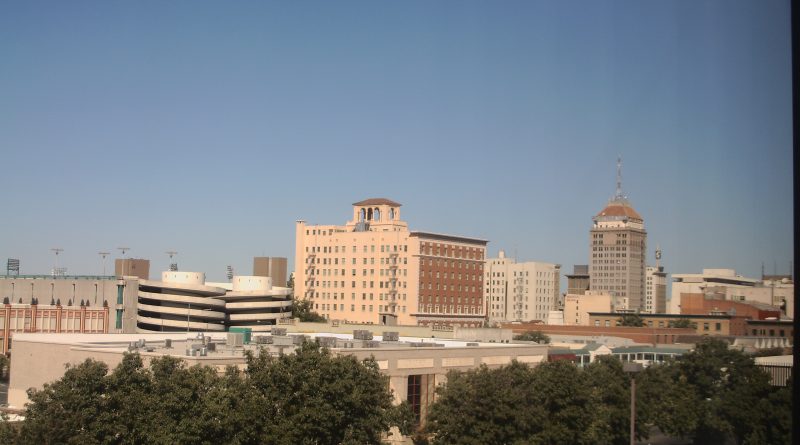
Fresno skyline — Photo: Qymekkam — CC BY-SA 3.0, via Wikimedia Commons
County Supervisors Block Countywide Transportation Tax, Pushing Fresno City to Go It Alone
Fresno County’s 40-year-old transportation sales tax, Measure C, expires next summer. Two weeks ago, the Board of Supervisors had a straightforward choice: place a citizen-led replacement measure on this November’s ballot, or order a study that would almost certainly push any vote to 2028—after the money runs out.
They chose the study. The 3-2 vote on July 14, with Board Chair Garry Bredefeld and Supervisors Buddy Mendes and Nathan Magsig in the majority, effectively killed the countywide “Better Roads, Safe Streets” initiative’s chances of reaching voters this year. Vice Chair Luis Chavez and Supervisor Brian Pacheco voted to let voters decide the measure themselves.
The citizen initiative, backed by a broad coalition organized as Moving Forward Together and former Mayor Ashley Swearengin, had already gathered enough signatures to qualify. Supervisor Magsig spent more than an hour questioning the measure’s drafters before concluding it was too “prescriptive” in how it dictated spending.

“I think this is voter suppression, quite frankly,” Fresno Mayor Jerry Dyer told reporters immediately after the meeting.
Now, with the county’s Aug. 7 ballot deadline looming, Fresno city leaders are scrambling to draft their own replacement tax—one that would help city residents but leave Clovis, Mendota, unincorporated areas, and rural transit systems with nothing.
Nine days after the supervisors’ vote, Mayor Dyer, City Council President Nelson Esparza, and Councilmember Mike Karbassi introduced the “Fresno Public Safety Infrastructure Restoration and Essential Services Act,” a half-cent sales tax that would apply only inside city limits.
“I would rather not be standing here,” Esparza said at the news conference, according to Fresnoland. “Measure C has served this county well over the decades, and I would rather have had a continuation of that, but that’s not where we find ourselves.”
The city’s proposal is a general tax, meaning city leaders have full discretion over how the money is spent. There’s no guarantee any of it goes to transit, bike lanes, or sidewalks—unlike the citizen-led countywide measure, which would have dedicated specific shares to those purposes. Esparza acknowledged the choice was driven by the calendar: “This general tax is really the only pathway we could see here in the short term,” he told KMPH.
The city measure would take effect July 1, 2027—the day after Measure C expires—and would sunset after 10 years or when a countywide transportation tax replaces it, whichever comes first. The Fresno City Council must vote to place it on the ballot at their last meeting before the filing deadline. Councilmember Nick Richardson told Fresnoland he’d heard nothing about the plan before the mayor’s announcement.
The practical effect of the supervisors’ delay is stark. County staff told the board the 30-day study they ordered would likely take the full allotted time, leaving no room to call the special meeting needed to place the Better Roads, Safe Streets measure on the ballot before the Aug. 7 cutoff. Board Chair Bredefeld controls the calendar for any such meeting, and with him among the study’s chief backers, advocates are ruling out that narrow path.
Without a countywide replacement, Clovis stands to lose an estimated $6.34 million a year, according to city spokesperson Taylor Danielson. The Fresno County Rural Transit Authority is projected to lose about $4 million annually, per general manager Janelle Del Campo. Neither has announced service or staffing cuts yet, but both say they’re studying the fallout.
On the county side, Public Works staff have projected roughly 90 layoffs among county road crews and engineers if Measure C expires without a replacement. Mayor Dyer has said the city stands to lose $54 million a year and as many as 217 jobs across public works, capital projects, transportation, and airport departments if the city’s own measure fails.
The Breakdown
- The county Board of Supervisors voted 3-2 on July 14 to order a 30-day study of the citizen-led “Better Roads, Safe Streets” measure instead of placing it directly on the November ballot. The study timeline makes it nearly impossible to meet the Aug. 7 ballot deadline, effectively pushing any countywide vote to 2028 at the earliest.
- The citizen measure would have applied a half-cent sales tax across all of Fresno County, with every dollar dedicated to transportation. Because it’s a citizen initiative, it needed only a simple majority to pass—unlike prior county-sponsored renewals that required a two-thirds vote and failed.
- In response, Fresno city leaders introduced their own half-cent sales tax, the “Fresno Public Safety Infrastructure Restoration and Essential Services Act,” which would apply only inside city limits. It’s structured as a general tax, giving the city full discretion over spending—no guaranteed share for transit, bike lanes, or sidewalks.
- The city measure must first be approved by the Fresno City Council to reach the ballot, with a vote expected at the council’s last meeting before the filing deadline. If placed on the ballot and approved by voters in November, it would take effect July 1, 2027, and sunset after 10 years or when a countywide tax replaces it.
- Without a countywide replacement, Clovis loses an estimated $6.34 million a year, the Fresno County Rural Transit Authority loses about $4 million annually, and roughly 90 county road crew and engineer positions are at risk. The city of Fresno stands to lose $54 million a year and as many as 217 jobs if its own measure fails.
What This Means for You
If you live inside Fresno city limits, you’ll vote in November on whether to keep paying the same sales tax rate you do now—except this time, the money stays with the city instead of being split countywide. The city’s measure gives future councils full control over the money, with no binding requirement that it goes to roads, transit, or any other specific purpose.
If you live in Clovis, Mendota, or an unincorporated area, the supervisors’ July 14 vote means you’re almost certainly not getting a say on a countywide replacement until 2028—after Measure C’s money runs out. That’s a direct consequence of how three supervisors (Bredefeld, Mendes, Magsig) voted versus two (Chavez, Pacheco).
What You Can Do
The Fresno City Council’s vote on whether to place the city’s measure on the ballot is expected at the council’s last meeting before the filing deadline for the November ballot. That meeting is scheduled for Thursday, July 30.
If the measure makes it onto the ballot, you’ll vote on it in November—and that vote determines whether the city has $54 million a year to work with, or whether it faces the 217 job cuts Mayor Dyer has warned about.
What to Watch
Start with the obvious: a “general tax” with “full discretion” means exactly that—the city can spend this money on anything it wants, and there’s no legal requirement that a single dollar goes to fixing a pothole, running a bus, or building a sidewalk. City leaders have floated the idea of an annual audit and a possible oversight committee, but those aren’t binding commitments written into the measure itself.
Here’s the sharper edge: the city is asking you to trust that future leaders will spend transportation money on transportation, but they’re not willing to write that promise into the measure the way the citizen-led countywide initiative did. Esparza says it’s because of the rushed timeline, but a rushed timeline is itself a consequence of the supervisors’ July 14 vote—a vote the city’s own mayor called “voter suppression.”
The material also raises a fairness question worth naming directly: Fresno city residents would keep paying the same tax rate they do now, but instead of sharing that revenue with Clovis, Mendota, rural transit, and county road crews, they’d keep it all. Clovis loses $6.34 million a year. Rural transit loses $4 million. Roughly 90 county road workers lose their jobs.
Finally, there’s the raw question of what just happened. A citizen-led measure gathered the signatures, met the legal standard, and was ready for the ballot. Three supervisors—Bredefeld, Mendes, Magsig—voted to order a study instead, knowing the timeline made it nearly impossible to place the measure on the ballot this year. Mayor Dyer, a Republican, called it voter suppression. Mendota’s mayor accused the board of stalling because “members really just don’t like us.”