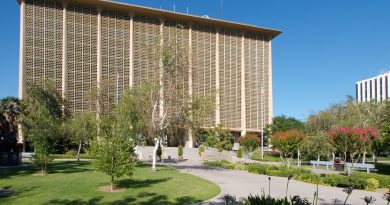

Fresno skyline — Photo: JMora24 — CC BY-SA 4.0, via Wikimedia Commons
State Overrides Fresno County Board, Forces Transportation Tax Onto November Ballot
Your family’s commute, the roads your kids’ school buses use, and whether Fresno County can keep fixing potholes next year all hinge on a ballot measure that wasn’t supposed to make it to you this November — until the state stepped in Thursday and forced it there anyway.
Governor Gavin Newsom signed Assembly Bill 1923 into law Thursday afternoon, placing the Fresno County Transportation Improvement Act on the November 3 ballot over the objections of a majority of county supervisors. The measure is a 30-year, half-cent sales tax meant to replace Measure C, the county’s longtime transportation funding source that expires in June 2027.
The state legislature passed AB1923 Thursday morning — 27-8 in the Senate, 54-16 in the Assembly — just three days after Assemblymember Esmeralda Soria and State Sen. Anna Caballero rewrote the bill from scratch. It had originally been a healthcare bill for financially distressed hospitals.

More than 30,000 Fresno County voters signed petitions to get the Better Roads initiative onto the ballot. But last month, the Fresno County Board of Supervisors voted 3-2 to order a 30-day study of the measure — a timeline that pushed past the August 7 deadline to place it on the November ballot, effectively delaying it until 2028.
That study is being conducted by VRPA Technologies Inc., a firm that also co-authored a rival transportation measure that never gathered signatures.
Without a Measure C replacement, the City of Fresno alone expects to lose at least $54 million annually. Local leaders have warned that could mean hundreds of job losses.
The City of Fresno had prepared a backup plan — a transportation tax of its own for the November ballot — but Mayor Jerry Dyer announced Thursday afternoon the city will no longer submit that measure, now that the countywide version is moving forward.
The Breakdown
- What the bill does: AB1923 overrides the county board’s authority and places the Fresno County Transportation Improvement Act on the November 3 ballot as an “emergency statute.” The measure would extend the half-cent transportation sales tax for 30 years to fund road repairs, transit, and other infrastructure.
- Why it happened: Soria and Caballero said they acted because the county board’s 3-2 vote to order a study effectively blocked voters from deciding on the measure in November — the last chance to renew Measure C before it expires in June 2027.
- Who supports it: More than 70 organizations and individuals registered support for AB1923, including 11 Fresno County mayors, the Central Labor Council, Amalgamated Transit Union Local 1027 (representing Fresno bus drivers), Fresno Unified School District, churches, and environmental groups. Fresno County Supervisor Luis Chavez also broke with his board colleagues to endorse it.
- Who opposes it: The Fresno County Board of Supervisors, the Fresno-Madera-Tulare-Kings Building and Construction Trades Council, the Fresno County Farm Bureau, the Howard Jarvis Taxpayers Association, and the Fresno Area Hispanic Foundation’s Board of Directors all registered opposition.
- What happens next: The measure will appear on the November ballot. But Fresno County Board of Supervisors Chair Garry Bredefeld has vowed to bring a motion to the board’s August 11 meeting to authorize a lawsuit against the state, arguing the bill is unconstitutional and violates state election law. The board needs only a simple majority (three votes) to approve litigation.
What This Means for You
You’ll vote on this measure in November — that’s now settled. But the fight over how it got there raises a real question about who gets the final say when your county’s elected board and the state legislature disagree.
Bredefeld and other supervisors argue the state just set a precedent that Sacramento can override your county’s decisions whenever it wants. Soria and Caballero argue the opposite: that 30,000 voters signed petitions to put this on the ballot, and the board’s procedural delay was blocking your right to decide.
Either way, your vote this November will settle what the board’s 3-2 vote tried to delay — and if the county does file a lawsuit, the legal fight could stretch past Election Day, potentially delaying the measure to 2028 anyway.
What You Can Do
The Fresno County Board of Supervisors meets Tuesday, August 11, and will discuss potential litigation in closed session. If you want to weigh in on whether the county should spend taxpayer money on a lawsuit, you can submit public comment through the county clerk or attend the meeting in person at the Fresno County Hall of Records.
The transportation measure itself will appear on your November 3 ballot — read the full text when it’s available from the county registrar, and decide for yourself whether a 30-year, half-cent sales tax is worth the roads, transit, and infrastructure it’s meant to fund.
What to Watch
Bredefeld has accused Newsom of signing the bill as a favor tied to the Central Valley Community Foundation, which financially backed the Better Roads signature drive and also serves as a fiscal sponsor for a nonprofit run by the governor’s wife, Jennifer Siebel Newsom. The foundation collected about $230,000 in behested payments at the governor’s direction this year from three donors: Omidyar Network Services LLC, the Lisa Stone Pritzker Family Fund, and Vanguard Charitable. Behested payments are legal in California and are used by both Democratic and Republican politicians, but political watchdogs have long criticized them as creating the appearance — or reality — of favors in exchange for donations.
Bredefeld and other opponents have also described the Better Roads coalition as “bending the knee” to Ashley Swearengin, the former Fresno mayor who now leads the Central Valley Community Foundation. The foundation responded that it has never donated to the California Partners Project (the Newsom-linked nonprofit) and that grants it received from the state were awarded through a competitive process, not as favors.
Whether or not Bredefeld’s allegations hold up, the question for you as a voter is simpler: what do you actually know about how this measure would be spent, and who benefits? A 30-year tax is a generation-long commitment. The measure is framed as funding roads and transit — services your family uses. But the real test of any tax measure like this is whether the spending is transparent, whether the promised repairs actually happen in your neighborhood, and whether the priorities reflect what families across the county actually need, not what’s easiest to fund or politically convenient to spotlight.
The other question worth asking: why did it take a state override to get this in front of you? If 30,000 voters signed petitions and the measure qualified, what was the board’s 3-2 vote to delay it actually protecting — your right to more information, or their preference that you not vote on it at all?