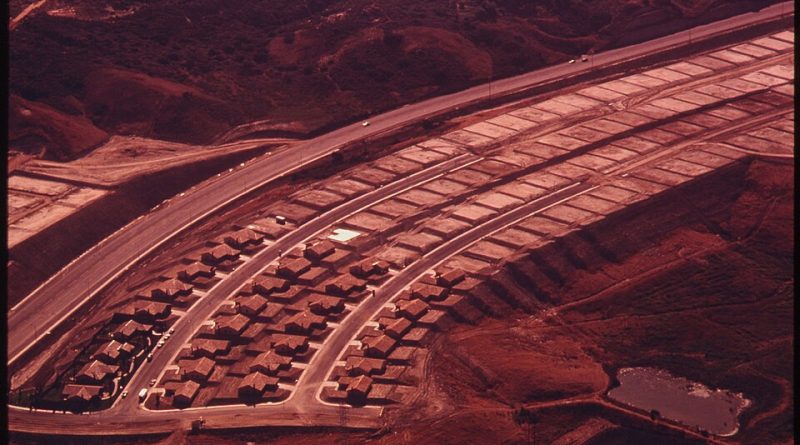
Planning Commission Approves 53-Home Development on East McKinley Despite Setback Waivers — Photo: Charles O'Rear — Public domain, via Wikimedia Commons
Planning Commission Approves 53-Home Development on East McKinley Despite Setback Waivers
Fresno’s Planning Commission approved a 53-lot housing subdivision on 5.42 acres along East McKinley Avenue on March 5, 2025. The project required the developer to ask for smaller rear-yard setbacks and smaller lot sizes than the zone normally allows.
Lennar Homes of California, LLC filed the application. Nathan Roberts of Yamabe & Horn Engineering represented the developer. The site sits on the north side of East McKinley between North Armstrong and North Laverne Avenues in Council District 7.
The commission granted both the subdivision map and a planned development permit. The permit explicitly modifies standard RS-5 zone requirements — meaning the lots will be smaller and the houses closer together than the baseline rule requires. The material does not state what the standard setback or lot-size requirement is, or how much smaller the approved lots will be.

The commission also adopted a Mitigated Negative Declaration under CEQA dated February 10, 2025. That document is supposed to assess environmental impacts and state what mitigation measures apply, but the material provided does not include the declaration itself or specify what impacts were identified or what the required mitigation is.
The Breakdown
- The project subdivides 5.42 acres into 53 single-family residential lots.
- The developer requested and received approval to reduce minimum rear-yard setbacks and reduce minimum lot size below what the RS-5 zone district normally requires.
- The material does not state the dollar amount of the project, how many of the 53 homes will be classified as affordable housing, or what price range the homes will sell at.
- Approval is subject to Conditions of Approval dated March 5, 2025, but the material does not include those conditions or state what requirements the developer must meet.
What This Means for You
This approval means 53 new homes will be built in this part of District 7, and those homes will be closer together and on smaller lots than the zone’s standard rules would permit. If you live in or near this area, that affects your neighborhood density and how tightly packed new construction will be. If you care about where new housing goes in Fresno and what development standards the city enforces or waives, this is a record of a decision that happened without a stated public-comment process in the material.
What to Watch
The material does not state how much taxpayer money, if any, the city is contributing to this project, or whether Lennar is building it entirely with private financing. If the city is subsidizing this development — through fee waivers, infrastructure work, or direct funding — that’s public money going to a private developer’s profit, and voters have a right to know the amount and the terms. Ask the Planning and Development Department for the staff report’s full text and the Conditions of Approval to see whether any city subsidy is buried in there.
The developer asked for lot sizes and setbacks smaller than the zone’s baseline standard, and the commission granted both requests. That means this project packs more homes into the same acreage than the rules would normally allow. The material does not explain why the variance was necessary, what the developer argued to justify it, or whether anyone raised concerns. Smaller lots and tighter spacing can mean less green space, more runoff, and more strain on shared infrastructure like streets and utilities. If the city routinely grants these waivers, the question is whether the underlying zoning standard means anything at all, or whether developers just ask for exceptions and get them. Look at how often the Planning Commission approves planned development permits that reduce lot sizes and setbacks — if it’s a pattern, the city is effectively allowing higher density than its own rules call for, without calling it that or planning for the consequences.
The Mitigated Negative Declaration is supposed to identify environmental impacts and state what the developer must do to reduce them. The material does not include the declaration or say what impacts were found or what mitigation measures apply. If “mitigated” just means the developer agreed to follow standard rules they’d follow anyway, that’s not mitigation, that’s checking a box. Get the full declaration and see whether it names real impacts — water use, traffic, drainage, air quality — and whether the mitigation is enforceable or just aspirational. If the city is approving 53 new homes without requiring the developer to account for the actual environmental cost, that cost doesn’t disappear, it just shifts to the public.