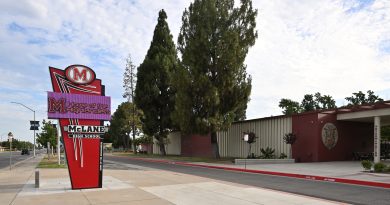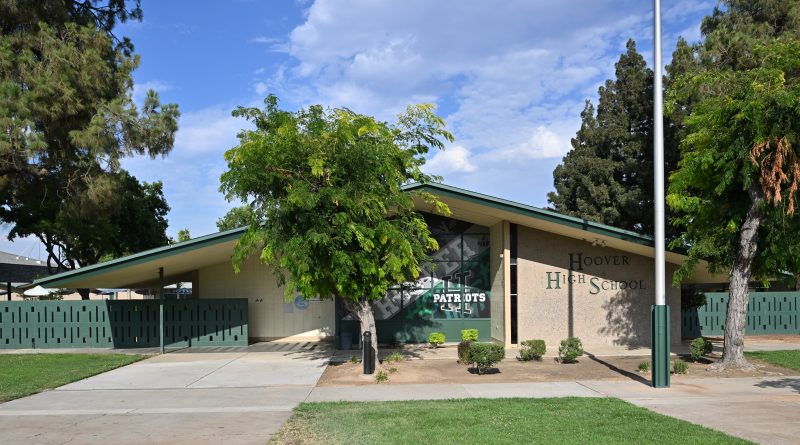
Fresno Unified School District — Photo: G. Edward Johnson — CC BY 4.0, via Wikimedia Commons
Fresno Unified’s Teacher Pathway Shows Promise — But Getting Students Through College Remains the Challenge
High school teacher academies can work — students who complete them are four times as likely to become teachers as their peers. But a new study finds the pipeline breaks for students of color long before they reach a classroom of their own, and it breaks at a stage Fresno Unified is actively trying to fix.
The study, released Monday as an Annenberg working paper, tracked more than 1.5 million Texas students across eight high school cohorts. Researchers found that while students of color enroll in high school education courses at higher rates than they enter the teaching profession overall, they don’t make it to teaching jobs at anywhere near the rate white students do — and the gap is driven almost entirely by who actually finishes college.
Among students who took high school education courses, white students were more than twice as likely to become teachers as Black or Hispanic students: 13.3% compared to 4.9% and 5.5%. Nearly 70% of Black and Hispanic students who took education classes never enrolled in a four-year public college. Only 1.5% of students who completed high school education courses earned a teaching credential without a four-year degree.
“It’s unsurprising to me, particularly for students of color, that the pipeline breaks,” said Heather Peske, executive director of the National Council on Teacher Quality. Students of color are more likely to be first-generation college students and carry heavier debt loads, she noted, so districts must lay out a clear path “rather than just assuming that it should be up to the high school students themselves to figure out that pathway.”
That’s exactly what Fresno Unified has been building. The 79,000-student district connects its high school teacher academies to more than a dozen programs designed to guide aspiring teachers all the way through — including part- and full-time jobs and paid fellowships.
Students who graduate from one of Fresno’s teaching academies can be hired as a paraprofessional with a stipend to attend a local university while they work. From there, they can move into Fresno’s residency program, which provides $45,000 to attend university full time in exchange for a commitment to teach in the district after earning a credential.
“We see greater success of continuation when there is a progression of programs that lead into teaching,” said Teresa Morales-Young, Fresno’s director of teacher development. “Our greatest challenge is that students may want to leave the area for college. That’s where we try to incentivize the experience to stay and invest.”
A separate decade-long evaluation of Maryland’s statewide teacher-academy program found similar patterns. Students who participated were 45% more likely to become teachers and earned 5% higher wages than those who hadn’t — but the program still showed a racial gap. Among academy participants, 5% of white girls and 1.6% of Black girls eventually became teachers. About half of Black women who did become teachers chose alternative certification rather than traditional university programs, and they tended to choose districts with higher starting salaries and more Black educators than their home districts — not necessarily the districts that trained them.
The Maryland study cost out the academies at about $32 per student per year — less expensive than many career pathways because they use classrooms and equipment schools already have. Teachers who came through the academies and did return to teach were just as effective as other novice teachers but stayed longer: fewer than one in five left within three years, compared to more than 30% of other teachers.
The Breakdown
- High school teacher academies significantly increase the likelihood a student will become a teacher — students who complete them are four times as likely to enter the profession.
- But the pipeline breaks at college: nearly 70% of Black and Hispanic students who take high school education courses never enroll in a four-year public college, and only 1.5% earn teaching credentials without a four-year degree.
- Fresno Unified has built a multi-stage pathway to address this: academy graduates can become paraprofessionals with stipends for college, then move into a residency program offering $45,000 for full-time university attendance in exchange for a teaching commitment.
- Teachers who come through these programs stay longer — fewer than one in five leave within three years, compared to more than 30% of other novice teachers.
What This Means for You
Fresno Unified’s school board has chosen to invest in a multi-year pipeline that costs real money — $45,000 per resident, plus stipends for paraprofessionals — because they’re betting it will produce teachers who actually stay. The research says that bet is sound: teachers who come through structured pathways like this leave at half the rate of other new teachers. But the question for voters watching the district’s budget is whether the board is funding enough spots in these programs to actually move the needle on teacher shortages, and whether the financial incentives are strong enough to compete with students leaving the area for college. The number of teachers Fresno produces through this system — and whether they reflect the students they’ll teach — depends on decisions the board makes every budget cycle about how much to spend keeping students here.
What to Watch
Fresno Unified is putting significant public money into keeping teacher candidates local rather than losing them to out-of-area colleges — $45,000 per resident is not a small commitment. The research makes clear that commitment works, but it also raises a harder question the material doesn’t answer: how many students are actually moving through Fresno’s pipeline right now, and is that number large enough to matter? A handful of residents getting $45,000 each is one thing; a program at the scale needed to address Fresno’s actual teacher shortage is another.
The Maryland study found that even well-designed academies show a persistent racial gap — white students convert to teaching jobs at more than twice the rate of Black or Hispanic students, driven almost entirely by who finishes college. Fresno’s stipend and residency programs are designed to address exactly that college-completion barrier, but the material doesn’t document whether they’re actually closing the gap here or just making the same pattern slightly less steep. If Fresno’s program is producing teachers who look like the students in the district’s classrooms, that’s worth knowing. If it isn’t, that’s worth knowing too.
The Maryland study also found that Black teachers who came through academies often didn’t return to their home districts — they chose districts with higher pay and more Black colleagues. Fresno’s residency program requires a teaching commitment in exchange for the $45,000, which addresses that directly. But does Fresno’s starting salary and the makeup of its teaching staff make that commitment feel like an opportunity or an obligation? The answer to that question determines whether this pipeline actually delivers on its purpose or just trains teachers for somewhere else.