
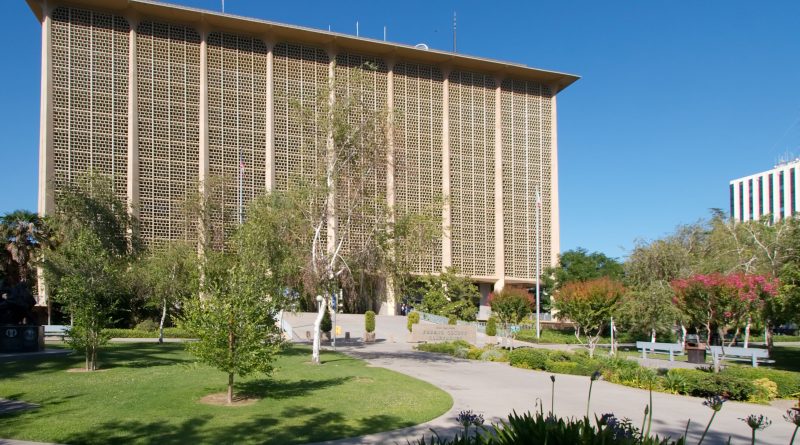
Fresno County Courthouse — Photo: Mfield, Matthew Field, http://www.photography.mattfield.com — CC BY-SA 3.0, via Wikimedia Commons
Fresno County Supervisors Advance Firearms Ordinance for Prosecutors After Courthouse Park Stabbing
The Fresno County Board of Supervisors passed the first of two votes Tuesday to allow district attorney prosecutors and investigators to carry firearms on county property — a direct response to last month’s stabbing of a senior deputy district attorney in Courthouse Park.
The ordinance, approved unanimously, would require prosecutors to hold a concealed-carry weapon (CCW) permit and receive written approval from District Attorney Lisa Smittcamp before carrying firearms in county buildings or parks. Prosecutors could also carry pepper spray and tasers.
The attack that triggered the vote occurred Aug. 20 when Dustin Crawford, 42, stabbed a prosecutor in Courthouse Park in what Smittcamp described as retaliation for a case the prosecutor had worked on. Crawford was arrested for attempted murder. The injured prosecutor has since returned to work.

Smittcamp used Tuesday’s hearing to frame the issue as broader than one incident. “The status of downtown makes workers, including myself, vulnerable to violent and the mentally ill people that we have roaming around in our communities,” she said. She disclosed facing threats against her life “on average two times a month” and shared stories ranging from a radio caller threatening to kill her years ago to a recent stalking incident.
Sheriff John Zanoni said Courthouse Park — once a place where county workers and residents would lounge on downtime — now requires a different approach. “We are going to be a good presence out there to ensure that people are there for the right reasons, and those that aren’t need to move on,” he said, adding he’ll direct staff to increase security in the area.
The ordinance expands an existing county policy that already allows board supervisors, their assistants, the county administrative officer, and county counsel to carry firearms on county property if they have CCW permits. There are roughly 15,000 active CCWs in the county, according to Zanoni, who called demand “extremely in demand” with interest increasing constantly.
One logistical hurdle remains: courthouse weapons rules are separate from county property rules. Zanoni acknowledged the sheriff’s office is working with court leaders on how prosecutors could safely store firearms before entering courtrooms. “I don’t know if we have enough lockers at this time,” he said. “So we’re looking at that.”
Both Smittcamp and Zanoni said they would be judicious in approving weapon-carrying despite permit holders’ legal right to do so. Starting next year, CCW permits will last three years instead of two, reducing how often residents must reapply and prove firearm proficiency. Zanoni said prosecutors who carry at county facilities will face higher training and proficiency standards than standard CCW holders.
Smittcamp and Zanoni used the hearing to criticize state criminal-justice policy, arguing lawmakers have been too soft on crime. Smittcamp cited Proposition 57 and AB 109 as failures, while both officials pointed to a recent Public Policy Institute of California report stating that Proposition 47 — a recently rolled-back measure that reduced certain offenses from felonies to misdemeanors — was at least partially responsible for increases in drug use and homelessness.
“I don’t care what junk science people have been listening to for the last 20 years,” Smittcamp said. “Police presence and law enforcement presence deters crime. Period. End of story.”
Board Chair Garry Bredefeld echoed the pro-CCW sentiment at the hearing’s close. “The fact is, police can’t be everywhere, unfortunately,” he said. “People have to protect themselves. I encourage, and have encouraged, citizens who are law-abiding citizens to get CCWs to protect themselves and protect their family.” He added: “I also believe that an armed society of law-abiding citizens is a safe society.”
Fresno Mayor Jerry Dyer endorsed the ordinance in a statement but did not directly respond to Smittcamp’s characterization of downtown as dangerous. “I fully support prosecutors having the ability to carry firearms in public spaces and within government facilities where allowed,” Dyer said, adding that “consistent and ongoing training” is imperative. He noted prosecutors “become vulnerable targets due to their profession” and may be especially vulnerable near Courthouse Park where they encounter defendants going to and from court.
Fresno Police Chief Mindy Casto declined to comment. The city’s own crime and homicide rates have been trending downward, according to citywide statistics from the Fresno Police Department.
Fresno City Attorney Andrew Janz held a news conference last month announcing he would authorize his department’s investigators and prosecutors to also carry weapons, citing a May incident in which a knife-wielding intruder rang his doorbell at 3:30 a.m., then hopped his backyard fence and banged on the back door before law enforcement arrived.
The county’s proposed budget, with hearings beginning Sept. 14, would keep DA employee counts flat for the third straight year while eliminating three grant-funded positions. It would add three positions to the Sheriff’s Office.
The Breakdown
- The ordinance passed its first of two required hearings Tuesday. A second hearing is scheduled for Sept. 22 at the Board of Supervisors chambers on the third floor of the county Hall of Records building.
- If approved at the second hearing, the ordinance takes effect 30 days later.
- Prosecutors and special investigators with CCW permits would be able to carry firearms on county property (buildings, parks, facilities) with written approval from DA Lisa Smittcamp.
- The ordinance does not automatically extend to courthouses, which operate under separate weapons rules. The sheriff’s office is working with court leadership on a storage solution for prosecutors before they enter courtrooms.
- Prosecutors could also carry pepper spray and tasers as alternative self-defense tools.
- The county already allows board supervisors, their assistants, the county administrative officer, and county counsel to carry firearms on county property if they hold CCW permits. This ordinance adds DA prosecutors and investigators to that list.
What This Means for You
This is a policy call made by the five elected members of the Fresno County Board of Supervisors — the body Fresno County voters elect to set county policy. The ordinance reflects their judgment that expanding who can carry firearms on county property is the right response to the Aug. 20 stabbing and broader security concerns raised by the DA and Sheriff. If you agree or disagree with that judgment — whether arming prosecutors is the right use of county resources and authority, or whether other security measures (more deputies, different courthouse protocols) would be a better allocation — that assessment factors into how you evaluate this board’s decision-making when you vote in county supervisor races. The second hearing on Sept. 22 is the last opportunity for public input before the ordinance takes effect.
What You Can Do
The second and final hearing on this ordinance is scheduled for Tuesday, Sept. 22, at the Board of Supervisors chambers on the third floor of the county Hall of Records building in downtown Fresno. That hearing is the board’s last opportunity to amend or reject the ordinance before it takes effect 30 days later, and it’s the public’s last chance to weigh in before the board takes its final vote.
What to Watch
Smittcamp said Tuesday she wants the board to “increase security in the courthouse” and fund additional sheriff’s deputies — not just for prosecutors, but for “many people working in and around Courthouse Park.” The county’s budget hearings begin Sept. 14, with the proposed budget adding three positions to the Sheriff’s Office while keeping DA staffing flat. The cost-benefit question is straightforward: is adding three sheriff positions and arming prosecutors the highest-return allocation for public safety dollars, or would a larger personnel increase, different deployment strategy, or investment in courthouse infrastructure (metal detectors, secure entries, the lockers Zanoni said may not exist in sufficient number) deliver better security per dollar spent? Smittcamp’s own framing — “we cannot rely on the criminal justice system that we are a part of to protect us” — raises the question of whether arming individual prosecutors is a substitute for system-level fixes the board hasn’t funded, rather than a complement to them. Watch whether the Sept. 14 budget hearings produce any additional security funding beyond the three sheriff positions already proposed, and whether the board directs staff to cost out alternatives (more deputies, courthouse upgrades, the locker infrastructure Zanoni acknowledged is incomplete) rather than treating this ordinance as the full solution.