
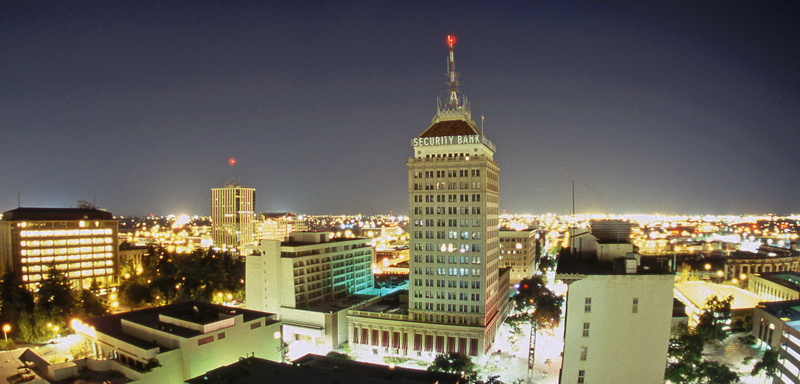
Fresno downtown skyline — Photo: JMora24 — CC BY-SA 4.0, via Wikimedia Commons
Fresno County Board Approves $426.5M Facilities Overhaul, Del Webb Tower Slated for Demolition
The Fresno County Board of Supervisors last Tuesday approved a 10-year facilities master plan carrying a $426.5 million price tag — a capital allocation decision that could reshape downtown Fresno’s skyline and relocate multiple county departments over the next decade.
The plan calls for eventually demolishing the 21-story County Plaza building, known locally as the Del Webb building, after relocating the departments currently occupying it. Completed in 1964 as a hotel and office complex, the tower was flagged by consulting firm Gensler as the county property with the highest deferred maintenance burden downtown and deemed too costly to renovate.
Supervisor Luis Chavez told KMPH the board’s decision followed a needs assessment showing “close to half a billion dollars” in maintenance costs for existing county buildings. The approved plan shifts that capital toward new construction and selective renovations rather than attempting to preserve all aging assets.

“We obviously got an eye-popping amount,” Chavez said. “It’s super expensive to renovate older buildings because they don’t have the codes. They don’t have ADA accessibility, and they don’t have the infrastructure.”
The $426.5 million breakdown: $221.7 million for new construction, $178.6 million for major renovations, $23.5 million for demolition, and $2.6 million for building acquisition. The Plaza, Hall of Records, and Crocker buildings together carry over $100 million in deferred maintenance, according to the Gensler presentation accepted by the board.
Several county departments — the County Administrative Officer’s office, the Board of Supervisors itself, county counsel, and the Sheriff’s Office — are slated to move into two buildings the county recently purchased at Ventura and O Street. The Hall of Records, Crocker Building, and the 650 O Street and 705 P Street properties would undergo renovations. New purpose-built facilities for the Sheriff’s Office and emergency dispatch would go up at the Juvenile Justice Center, with a new public works building planned for the Fresno Fairgrounds.
The Del Webb building wouldn’t come down immediately. The implementation schedule uses it as temporary “swing space” while the Hall of Records and Crocker Building are renovated — departments would move out in phases before demolition and property disposal.
Supervisors raised the possibility of selling the Del Webb building rather than demolishing it. Gensler representatives told the board a sale would likely require the county to address the building’s substantial deferred maintenance first — a cost that would fall to the county regardless. Chavez acknowledged community interest in preserving the structure for housing or office space, contingent on finding “the right buyer or investor who could take on the project.”
Chavez emphasized no final decision has been made. “We just got kind of a summary of all the properties, parcels, land, and we’ll be making a decision down the road,” he said. He anticipates decisions during the county’s 2027-2028 budget cycle.
Financing remains unresolved. Chavez said the county could put money up front or issue bonds, with borrowing costs factored into the decision. Supervisor Nathan Magsig noted the investment “can’t be done overnight.” Ed Hill, the county’s chief operating officer, described the plan as a “living document” subject to change with economic conditions and funding opportunities.
The overall build-out is expected to take 10 to 15 years. Gensler representatives said the county doesn’t need more space — it needs to use existing space more effectively. The implementation plan anticipates four to five years of active construction and renovation.
The Breakdown
- The Board of Supervisors approved a $426.5 million facilities master plan last Tuesday, targeting years of deferred maintenance across downtown county properties.
- The plan calls for demolishing the 21-story Del Webb building after relocating departments and using it as temporary space during other renovations.
- County departments including the Board of Supervisors, CAO, county counsel, and Sheriff’s Office would move to recently acquired buildings at Ventura and O Street.
- The Hall of Records, Crocker Building, and two other downtown properties would be renovated; new facilities for the Sheriff and public works would be built at the Juvenile Justice Center and Fresno Fairgrounds.
- Financing method (upfront capital vs. bonds) remains undecided; final property-specific decisions are expected during the 2027-2028 budget cycle.
- The build-out is projected to take 10 to 15 years, with four to five years of active construction.
What This Means for You
This vote sets the fiscal and operational trajectory for the county government Fresno voters elect to oversee. The Board of Supervisors — whose members you vote for — just committed the county to a decade-long, near-half-billion-dollar capital program that will determine where and how county services are delivered, which downtown properties survive, and how much debt or upfront cost the county carries. The 2027-2028 budget cycle, when financing and property-specific decisions are made, will be the point where this plan either locks in or shifts — your supervisors’ votes then will either authorize the borrowing and spending or pull back. If you’re weighing how your elected supervisors manage long-term capital risk and prioritize infrastructure over other budget demands, this is the decision that stakes out their position.
What You Can Do
The Board of Supervisors meets regularly at the Hall of Records. Public comment periods are available at each meeting. The county’s 2027-2028 budget cycle, when financing and property decisions are expected, will include public hearings — those dates have not yet been set.
What to Watch
The $426.5 million figure is a consultant’s estimate for a 10- to 15-year buildout — not a locked appropriation and not a completed procurement process. The county hasn’t stated how much of this will be financed through bonds versus cash, and borrowing costs are acknowledged as a variable. That means the actual fiscal impact depends entirely on decisions the board hasn’t made yet, in budget cycles where voter attention will be elsewhere.
Here’s the ROI question this plan doesn’t answer: if the county is spending $426.5 million to “use existing space more effectively” rather than acquire more space, what measurable service improvement or cost avoidance does that generate? The stated driver is deferred maintenance — but deferred maintenance is what happens when an asset isn’t generating enough value to justify the upkeep. Demolishing the Del Webb building rather than selling it as-is concedes the county can’t offload the liability at current condition, which raises the question of whether other aging assets in this plan are being renovated because they’re genuinely strategic or because the county hasn’t found a buyer willing to take them either.
The plan also front-loads construction for departments that directly serve the board (the CAO, county counsel, the board’s own chambers) while using the Del Webb building — the one with the most deferred maintenance — as “swing space” for an extended period before demolition. That’s operationally practical, but it means the county continues carrying the highest-maintenance asset on the books while building new space for administrative functions first. The Board of Supervisors’ own offices being prioritized in the construction sequence is a decision voters should notice.
Finally: a 10- to 15-year capital program with no locked financing method and decision points pushed to future budget cycles is effectively a statement of intent, not a committed investment. Economic conditions, real estate market shifts, and future board compositions will all have the opportunity to rewrite this. The plan is a “living document,” per the county’s own COO — which is another way of saying it’s not binding. Whether this plan survives contact with the 2027-2028 budget cycle, or gets scaled back when the borrowing costs become real, is the actual thing to watch.