
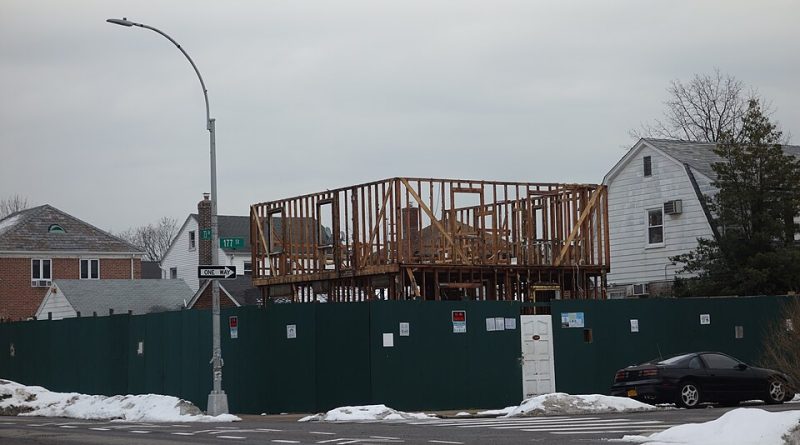
Fresno City Council's Building Fast-Track Fuels Housing Boom — But Who's Actually Winning? — Photo: Tdorante10 — CC BY-SA 4.0, via Wikimedia Commons
Fresno City Council’s Building Fast-Track Fuels Housing Boom — But Who’s Actually Winning?
Fresno City Council voted 4-3 last year to let developers build homes in office districts and near bus stops without needing council approval or public hearings — a move backed by the Chamber of Commerce and a coalition of developers and business leaders. The city has also waived $9.9 million in developer fees over the past decade.
The policy changes are part of a broader shift that has made Fresno the best place in California to start a business, according to a new study, with cheap land and fast-tracked building rules drawing companies and families fleeing coastal cities.
Fresno added more than 2,000 new homes last year, a 1.1% jump in its housing stock and the seventh-most of any city in California — outpacing even San Francisco, which added about 1,500, according to state figures.

The median listing price in the Fresno metro area hit $469,500 in September, up 42.8% from $328,800 in September 2019, according to Realtor.com. That’s almost double the statewide rate of growth over the same period, with California’s median listing price climbing 24% from $584,700 to $725,000.
Yet Fresno homes remain 35.2% cheaper than the state average, making the city an increasingly attractive escape route for younger Californians desperate to get on the housing ladder. Rents in Los Angeles are roughly 65% higher than in Fresno, according to Realtor.com.
“Business owners see Fresno as the future of California due to its centralized location, affordability, and growing population,” Mayor Jerry Dyer said. “Fresno is also considered an attractive location due to having an available workforce, affordable housing for their employees, and great technical training schools.”
Republican state Assemblymember David Tangipa, who represents the city, credited the city’s business incentives and available land. “We don’t have as heavy of a crazy environmental arm, we have room to grow,” he said. “There’s a lot of land that actually people can grow.”
Developer Scannell Properties broke ground last year on a $100 million industrial park in southwest Fresno that is expected to create up to 1,000 jobs. The city is already home to distribution hubs for Amazon and Ulta Beauty, and Gap moved its e-commerce fulfillment operation there.
Justin Derby, 45, a construction executive, recently moved his wife and two kids, ages 9 and 12, from pricey Marin County after landing a job in Fresno. “The homes that I am looking at, which are in fantastic school districts, would be three to four times more expensive in the North Bay,” he said.
While Los Angeles lost some 33,000 residents last year, Fresno held steady at nearly 561,000, according to state Department of Finance figures. Over the longer haul, Fresno County has added roughly 22,500 people since 2021 and now tops 1 million residents, Census estimates show.
But there are signs the boom is coming under pressure, with home sales recently easing as higher mortgage rates squeeze buyers’ budgets. The slowdown reflects a broader divide in the housing market, with wealthier buyers better equipped to absorb higher borrowing costs while those shopping at the lower end are increasingly forced to pull back.
The Breakdown
- The Fresno City Council voted 4-3 last year to allow developers to build homes in office districts and near bus stops without needing council approval or public hearings.
- The city has waived $9.9 million in developer fees over the past decade.
- The policy changes were backed by the local Chamber of Commerce and a coalition of developers and business leaders.
- Fresno’s median home price has risen 42.8% since 2019, nearly double the statewide rate of 24%, even as the city markets itself as an affordable alternative to coastal California.
What This Means for You
The City Council’s 4-3 vote last year eliminated the requirement for council approval and public hearings before developers can build homes in office districts and near bus stops. The council made this decision, and future councils elected by voters could reverse or modify it when those seats are up for election.
The city has waived $9.9 million in developer fees over the past decade. The sources do not specify what these fees would have funded.
What to Watch
The material does not state how much of the $100 million Scannell Properties industrial park is private financing versus public subsidy — the full $100 million is described only as the project total.
If the city contributed land, tax breaks, or direct funds, that’s taxpayer money benefiting a private developer, and voters deserve to know the figure. The staff report, the development agreement, or the city budget line would show it.
The $9.9 million in waived developer fees over the past decade is public money the city chose not to collect.
The material does not identify which developers received those waivers, how much each received, or whether any have ties to the Chamber of Commerce or the coalition that backed the council’s 4-3 vote. Campaign finance filings and city records of fee waivers would show whether developers who benefited from the policy also funded council members’ campaigns.
Fresno’s home prices have risen 42.8% since 2019, while the state average rose 24% over the same period.
The material does not explain why prices in Fresno are climbing nearly twice as fast as the state average even as the city markets itself as affordable.