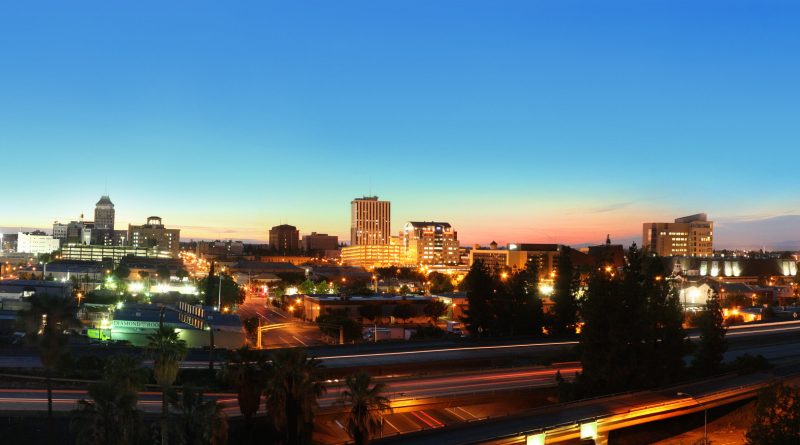
Fresno skyline — Photo: JMora24 — CC BY-SA 4.0, via Wikimedia Commons
After a Decade of Delays, Downtown Housing Project Secures City Funding Approval
The Fresno City Council approved up to $11 million in public funding in late February for an eight-story, 174-unit apartment building near Chuckchansi Park — a decision that moves forward a downtown housing project that has been stalled for over ten years.
The Park at South Stadium Apartments, at Fulton and Inyo Streets, is expected to begin construction this August and open in summer 2028. The vote marked the latest step in a project that dates back to 2015, when city leaders first sought proposals for development around the ballpark.
“The Park at South Stadium Apartments represents everything we have been working toward — quality infill housing, affordability, and a vibrant urban core,” Mayor Jerry Dyer said in a news release after the vote.
The total project cost is approximately $80 million. The city’s contribution — $8 million from a revolving loan fund and $3 million from other sources — covers a portion of that, with the rest coming from bond-market financing secured by the developers.
The project will include 70 income-restricted units set aside for very low- and low-income households for at least 55 years. The apartments are intended primarily for students attending higher education institutions in the Fresno region, with a mix of studios, two-bedroom, and three-bedroom units.
Developers Jeff Isenstadt and Mehmet Noyan, co-managers of The Park Partners LLC, called the announcement “monumental” and said the support from city leaders was “unprecedented.”
The City Council had previously approved land-sale agreements for the project in November 2025, declaring the city-owned parcels as exempt surplus land under state law to allow the affordable-housing development to proceed.
The Breakdown
- On February 26, 2026, the Fresno City Council approved two resolutions committing up to $11 million in city funds to the Park at South Stadium project — $8 million as a variable-rate loan from the city’s Revolving Loan Fund (money set aside for development projects, to be repaid with interest), and $3 million from other city funding sources.
- The project is an eight-story building with 174 apartments (studios, two-bedrooms, and three-bedrooms), designed primarily for students. Seventy of the units are restricted to low- and very low-income households for at least 55 years.
- The total project cost is approximately $80 million. The city’s share covers eligible construction costs; the rest comes from private bond financing secured by the developers.
- Construction is expected to begin in August 2026, with the building opening in summer 2028.
- The project has been in development since 2015, when city leaders first sought proposals for housing around Chuckchansi Park. It has gone through multiple changes and financing setbacks over the past decade.
What This Means for You
This vote represents an $11 million commitment of public resources — an $8 million loan that the city expects to be repaid with interest over a 60-month term, and $3 million in direct funding from state and federal sources — toward a privately-developed housing project. The decision reflects the council’s stated goal of bringing 10,000 homes to downtown Fresno, an area where the city has struggled for years to attract private developers despite streamlined permitting processes and more relaxed zoning.
The project’s 70 income-restricted units represent 40 percent of the total — a requirement tied to the sale of city-owned land under state law.
What You Can Do
The City Council is expected to vote on the project at their June 18, 2026 meeting.
What to Watch
The project’s $80 million total cost is not the same as the public investment — the city is contributing up to $11 million, with the rest coming from private bond financing and developer funds. That’s a per-unit public cost of roughly $63,000 across all 174 apartments, or $157,000 per income-restricted unit if you count only the 70 affordable ones.
The city has spent nearly $300 million in state funding this decade to upgrade downtown and Chinatown infrastructure — investments meant to “catalyze housing,” in the mayor’s words. If this is the first major project that funding has catalyzed in over a decade, what does that say about the strategy’s actual return?
Why is public money going toward subsidizing new construction rather than toward lowering the cost of existing housing that Fresno already has in large supply? That’s a real policy question, not a rhetorical one — the city could be using these dollars to buy down rents, acquire existing buildings for public or nonprofit ownership, or invest in infrastructure that makes all housing more livable.
Who actually benefits from a project like this? The 70 households who will get income-restricted units, yes. But also the developer who builds it, the bondholders who finance it, and the employers and institutions whose low wages or high tuition make “affordable student housing” necessary in the first place.