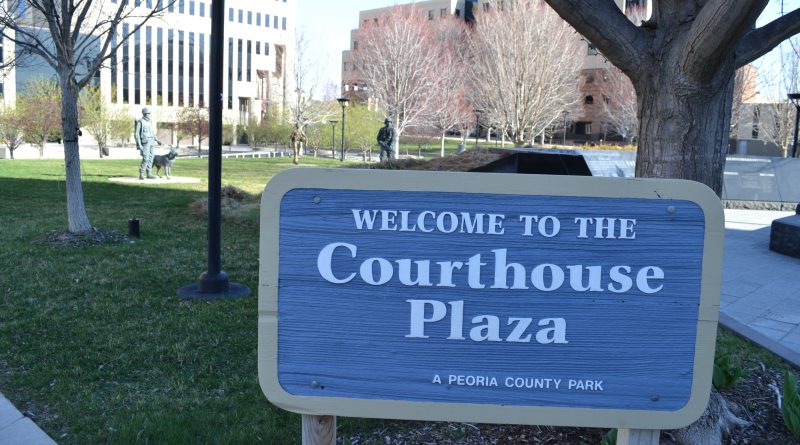
Courthouse Park — Photo: NatFee — CC BY-SA 4.0, via Wikimedia Commons
Fresno County Supervisors Approve Guns for Prosecutors, Consider Library Privatization
At its September 8 meeting, the Fresno County Board of Supervisors unanimously approved the first reading of an ordinance letting District Attorney Lisa Smittcamp authorize prosecutors and special investigators in her office to carry concealed guns on county property. The ordinance was brought forward by Board Chair Garry Bredefeld (District 2), Sheriff John Zanoni, Smittcamp, and Supervisor Nathan Magsig (District 5).
The decision came after an August 20 incident in which a prosecutor was stabbed in Courthouse Park by a former defendant. Smittcamp told the board the injured prosecutor had recovered and returned to work.
This is the third expansion of who can carry guns on the job in less than two years. In November 2020, the board allowed sitting supervisors and their staff to carry concealed weapons. In June 2026, that permission was extended to the county administrative officer, county counsel, and — with the CAO’s approval — any other county employee.
During the meeting, Smittcamp admitted her office was “still developing a policy” for workplace safety and gun training. Sheriff Zanoni said the demand for concealed-carry permits “keeps growing,” describing monthly “mass trainings” of 200 people at the sheriff’s range. He repeated that more guns “will deter incidents,” but also raised concerns about the county’s potential liability in case of “accidents” — without offering details.
Supervisor Luis Chavez (District 3) asked Smittcamp if there was “anything else we can do to make sure our folks are safe.” She replied that arming staff was “just one step,” mentioning the need to “increase security staff” in the courthouse, which would require more funding.
Bredefeld said “police can’t be everywhere” and that “an armed society is a ‘polite’ society.” Magsig added that “we will not tolerate crime” and expressed support for those “exercising their Second Amendment rights.”
The same day, four library employees in “Keep Libraries Public” T-shirts spoke against the threat of privatization of the county library. Bredefeld had recently requested that County Administrative Officer Paul Nerland prepare a report on the feasibility of privatizing the library system. Nerland has not said when that report would be available.
Critics say Bredefeld pushed for privatization after objecting to gay-themed young-adult books in the library’s collection, and that he sees privatization as a way to remove such books after other attempts at banning them were unsuccessful.
The Breakdown
- The September 8 ordinance requires a second reading before final approval.
- If adopted, prosecutors and special investigators in the DA’s office would join supervisors, their staff, the county administrative officer, county counsel, and any other employee the CAO approves in being allowed to carry concealed guns on county property.
- Both Smittcamp and Zanoni said training and safety policies were still being developed — after the board had already voted to expand who can carry weapons.
- The library privatization study was requested by Bredefeld; no timeline has been given for when it will be completed or what it will recommend.
What This Means for You
These are decisions by officials you elected — the Board of Supervisors — about who carries guns in county buildings you visit and whether the public library system stays public. The gun ordinance was approved unanimously with no dissenting vote, meaning every supervisor on the board supported it. The library privatization study is still underway, but the fact that it was requested at all tells you something about the priorities of at least one supervisor and whether the board as a whole will resist or support such a move when the report comes back.
When you vote for county supervisor, you’re voting for who makes these calls — on public safety policy, on what gets funded, on whether institutions like the library remain under public control. If you care about either of these issues, you now know where your current board stands.
What You Can Do
The ordinance requires a second reading before final approval. If the library privatization report is released, it will likely come before the board for discussion.
What to Watch
The board approved expanding who can carry guns before the DA’s office or the sheriff had finished writing the training and safety policies those employees would follow. Sheriff Zanoni himself raised the county’s potential liability for “accidents” but offered no details — meaning the county may be taking on legal risk it hasn’t fully calculated. Ask yourself: is that responsible stewardship of public resources, or is it a decision driven more by ideology than by a careful accounting of cost and consequence?
On the library: privatization of public services is often sold as a cost-saving measure, but the record is mixed at best. Private contractors are accountable to shareholders or owners, not voters — you lose the ability to vote out the people making decisions about your library. And privatization doesn’t always save money; it can shift costs in ways that are harder to track. If Bredefeld’s stated reason for this push is objecting to certain books in the collection, ask yourself whether handing control to a private company is really about fiscal responsibility, or whether it’s about bypassing the public process that currently governs what a public library offers. When that report comes back, look at the numbers carefully — and at who actually benefits if the library is no longer yours to shape.