
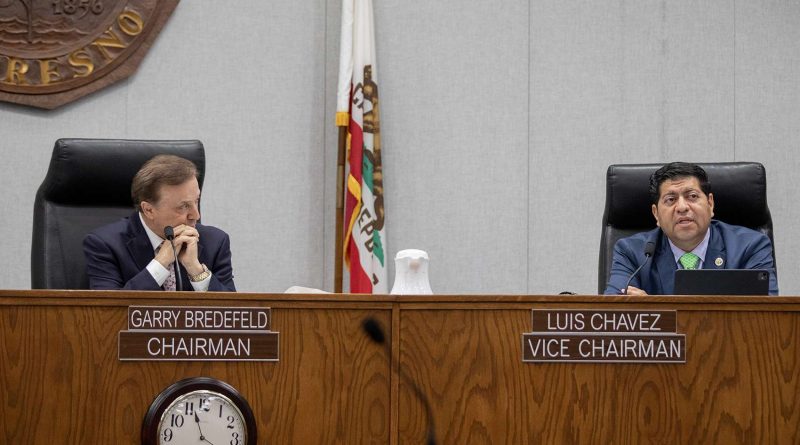
Fresno County Board of Supervisors Chairman Garry Bredefeld and Vice Chairman Luis Chavez at a board meeting — Photo: Mid Valley Times
Fresno County Supervisors Kill Home Kitchen Program After Reversal Vote
A food entrepreneur who hoped to expand his small barbecue business is now considering shutting down entirely. A nonprofit director says the county just rejected a chance to regulate something already happening in neighborhoods anyway. And three supervisors who voted yes two weeks ago changed their minds and voted no.
The Fresno County Board of Supervisors rejected a two-year pilot program Tuesday that would have allowed up to 66 home-based food businesses countywide — what state law calls Microenterprise Home Kitchen Operations, or MEHKOs. The 3-2 vote killed an ordinance the same five supervisors had unanimously approved at their first hearing on June 30.
Board Chair Garry Bredefeld and Supervisors Buddy Mendes and Nathan Magsig cast the three no votes. Supervisors Luis Chavez and Brian Pacheco voted yes both times.

The supervisors who switched cited concerns about health inspections, traffic, and neighborhood impacts. State law allows only one planned annual inspection of MEHKOs unless a complaint is filed. Bredefeld said he wanted at least two inspections per year, including one unannounced visit, but county counsel confirmed that isn’t legally allowed under state law.
“You have one inspection here with no other inspection at all, unless there’s a complaint,” Bredefeld said at Tuesday’s meeting. “To me, that poses a great risk to the public. I don’t think there are enough guardrails in place for this.”
Mendes said he was “already getting tired of hearing this” before the board moved to a vote.
The program would have allowed permit holders to serve up to 30 meals per day and 90 per week, with a cap of roughly $100,000 in annual revenue. Operators would have needed food-handling certifications, a health permit, and to meet specific standards for their homes. Health inspections would occur when they first applied and then annually, plus in response to complaints or suspected foodborne illness.
Veva Islas, executive director of Cultiva La Salud — a nonprofit that pushed for the program — called the reversal a matter of integrity. “There is a lot to say about a board that unanimously approves something in its first reading and then dramatically shifts,” she said. “I don’t think that this is a board that’s reasonable that we could go back to and try to make any type of gain in terms of any logical arguments.”
Paul Samarin, a veteran with PTSD who runs a small Texas-style barbecue business called House of Paul, said he left Tuesday’s meeting “heartbroken.” He had been counting on MEHKO as a way to expand beyond the limited “cottage food” permits that restrict what he can sell from home. His pastrami takes 30 days to make, and he’s struggled to find enough shelf space or afford a brick-and-mortar lease.
“That’s been a hard decision: to try to discern when the time is when you realize the door is closing, and you’ve just got to walk away from it,” Samarin said Thursday, “or when it’s time to persevere and stay with it.”
Opponents included the California Restaurant Association, which submitted letters arguing the county should support brick-and-mortar restaurants rather than “create an avenue for restaurant-like operations, but without all the responsibilities, costs, and restrictions.” Members of the Sunnyside Property Owners Association raised concerns about traffic, parking, noise, and compatibility with residential neighborhoods.
“You want 30 more cars to come?” asked Heidi Nakayama, a representative of the association. “Who’s making sure there’s not 50?”
Samarin said he understands some of those concerns but pointed out the program was meant to be a test. “You can always go back on it,” he said. “It’s not like this set-in-stone thing.”
Islas said county residents are already selling meals from their homes. “There’s no quality control. MEHKO was the quality control,” she said. “I drive up and down the streets going to Fresno, Kerman, westside, wherever, and you see these random tents popped up on the side of the road. They got the meat out, flies everywhere — where’s the regulation on that?”
The county had received just under $155,000 in state grant money in 2024 to explore a local MEHKO program. Between $20,000 and $30,000 remain to be spent by the end of the contract term in August, according to Public Health Director Joe Prado, who said the county does not plan to send any funding back to the state.
Islas said her organization may try again with a different board composition. At least two new supervisors will take office in 2027: former Sheriff Margaret Mims won the District 4 seat in June’s primary and will replace the retiring Mendes, and either Fresno City Councilmember Mike Karbassi or Kerman Mayor Maria Pacheco will take the District 1 seat in November as Brian Pacheco runs for the State Assembly. If Magsig wins his State Senate runoff this fall, a special election would fill his District 5 seat as well.
The Breakdown
- The Board of Supervisors voted 3-2 on July 14 to reject a pilot program for Microenterprise Home Kitchen Operations (MEHKOs) — home-based food businesses that can serve up to 30 meals a day — a reversal from their unanimous approval of the same ordinance on June 30.
- The program would have allowed 66 permits countywide for home-based food businesses, capped at 30 meals per day, 90 per week, and roughly $100,000 in annual revenue.
- Permit holders would have needed food-handling certifications, a health permit, and home inspections upon application and then annually (plus in response to complaints).
- Supervisors who switched their votes cited concerns about limited inspections (state law allows only one planned annual visit unless there’s a complaint), traffic, and neighborhood impacts.
- The county received just under $155,000 in state grant money in 2024 to explore the program; between $20,000 and $30,000 remain to be spent by August.
What This Means for You
The three supervisors who reversed their votes — Garry Bredefeld, Buddy Mendes, and Nathan Magsig — voted to kill the program. Mendes won’t be on the board next year (he’s retiring). If Magsig wins his State Senate race this fall, a special election will fill his District 5 seat. The November general election will decide who takes the District 1 seat (either Mike Karbassi or Maria Pacheco). Margaret Mims has already won the District 4 seat and will take office in 2027, replacing Mendes.
What to Watch
Islas said county residents are already selling meals from their homes. The program would have created inspections, certifications, meal limits, and a complaint process — and the board walked away from it.
That means the activity Islas described continues without those requirements. Is that actually safer for residents than a pilot program with annual inspections and enforceable caps? Or did the board just decide that keeping something invisible is easier than managing it?
The California Restaurant Association opposed MEHKO, arguing it would create competition for brick-and-mortar restaurants without the same costs and regulations. Home-based food entrepreneurs argued MEHKO was a stepping stone, not a replacement, for traditional restaurants — a way to test a concept before committing to a lease.
The board heard both sides and chose the established industry over the aspiring one. That’s a policy choice, and it’s worth asking: does this board exist to protect the businesses that already have a seat at the table, or to create pathways for the neighbors who don’t yet?