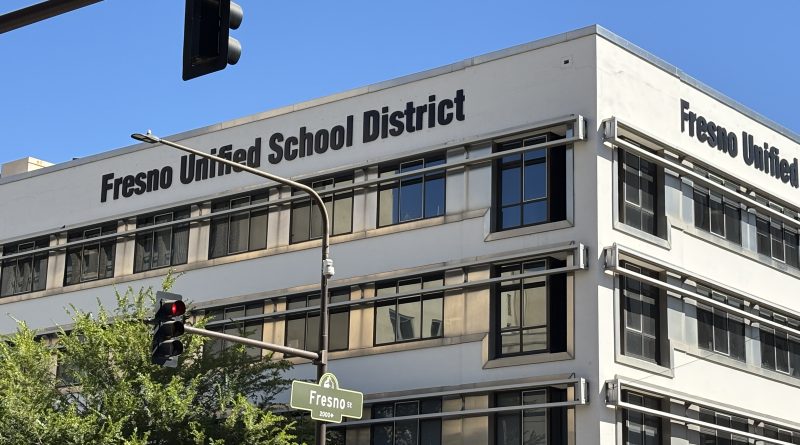
Fresno Unified School District — Photo: Jengod — CC0, via Wikimedia Commons
Fresno Unified Reports Test-Score Gains, Approves $1.8 Million Contract as Special-Education Gaps Widen
Fresno Unified’s board opened the 2026-27 school year Wednesday with preliminary data showing two years of steady state-test gains district-wide — and a sharp drop in scores among students with disabilities that one trustee called evidence the district isn’t doing enough differently.
Superintendent Misty Her presented data showing overall SBAC proficiency at 40% in English Language Arts and 29% in math, both up since the board adopted its five-year improvement plan in 2022. The Bullard region led both categories; the Edison region followed.
For students with disabilities, the pattern reversed. ELA proficiency fell 5.5 percentage points to 10.5% between 2025 and 2026. Math proficiency dropped 4.9 points to 9.1%.

Trustee Susan Wittrup, who worked 37 years in the district’s special-education system, flagged the gap directly: “Our kids are starting school on Monday at Starr Elementary with two classes that don’t have teachers, again. I love the strategic plan, but something has to be done differently, and I’m not hearing that.”
The board approved a five-year strategy tied to the 2022 goals-and-guardrails framework, including weekly data-review meetings between departments and supervisors and quarterly sessions where school-site leaders share progress and practices. Her said an annual report will follow at the end of this school year.
The board also approved — without discussion — a contract with Otus, an education-technology company, to host student digital portfolios under the district’s “Portrait of a Learner” initiative. The first year costs $152,000 through June 30, 2027. The total estimated cost over five years, with renewal options for four additional one-year periods, is $1,790,250.
The Breakdown
- Overall SBAC proficiency: 40% ELA, 29% math (both up since 2022).
- Students with disabilities: ELA proficiency dropped to 10.5% (down 5.5 points), math to 9.1% (down 4.9 points) between 2025 and 2026.
- Five-year contract with Otus for digital student portfolios: $152,000 first year, $1,790,250 total estimated cost through 2031.
- New implementation this year: weekly departmental data meetings, quarterly school-site leader sessions.
What This Means for You
The board is now two years into a strategy meant to run through 2030. The data they presented Wednesday shows the overall plan producing small gains — and a widening gap for one of the district’s most vulnerable student groups. The five-year contract they approved without discussion commits the district to spending nearly $1.8 million on a platform whose connection to measurable outcomes wasn’t part of the public record at this meeting.
What to Watch
The district’s own data shows special-education proficiency moving the wrong direction while overall scores inch up. One trustee with decades in the system stated plainly that the current approach isn’t different enough to fix it. Whether the administration changes course — or whether the board pushes harder — will matter more than the five-year timeline on paper.
The Otus contract raises the value-for-money question directly: $1,790,250 over five years buys a platform to host student work tied to “district values.” What measurable student outcome — test scores, graduation rates, college enrollment — does that $1.8 million improve, and by how much? The material presented to the board didn’t state one. A district spending that much on a tool should be able to name what the tool is supposed to move.