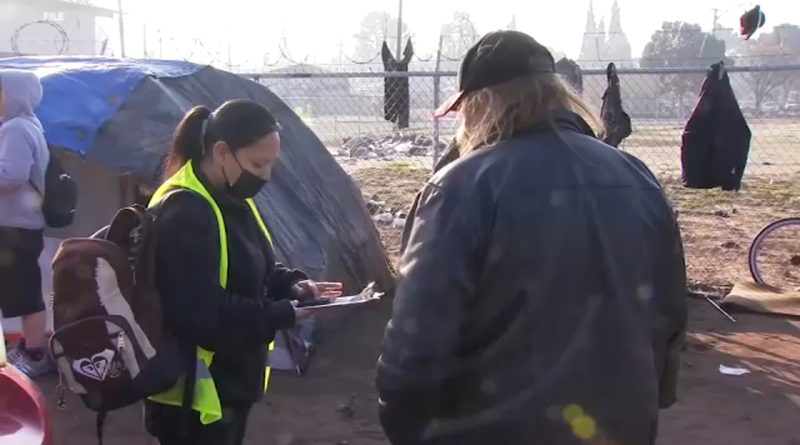
A volunteer conducts a Point-in-Time homeless count survey at a Fresno encampment — Photo: ABC30/KFSN
Fresno-Madera homelessness count shows 9.2% increase in 2025, new survey method debuts in 2026
The Fresno-Madera Continuum of Care reported that homelessness in Fresno and Madera counties increased 9.2% between 2023 and 2025, even as California and the nation saw overall declines. The 2025 Point-in-Time count showed 4,905 people experiencing homelessness across the two counties, compared to 4,493 in 2023.
Officials released the validated 2025 data alongside preliminary, unvalidated results from the 2026 count, which used a new survey-based methodology. The 2026 preliminary count showed 3,254 people experiencing homelessness — 1,619 unsheltered and 1,635 sheltered — but officials cautioned against comparing the figures to previous years because of the methodology change.
Under the new approach, trained volunteers conducted surveys with people experiencing homelessness, gathering information about barriers that led to their situation, including substance use, mental health challenges, and previous housing. The method replaced the former visual count approach, which relied on volunteers conducting drive-by observations.

“Unfortunately, historically, the point in time count has not lent itself to either one of those, accuracy or timeliness,” Fresno Mayor Jerry Dyer said. “Folks would drive by and try to do their very best, but see someone on the corner, not knowing if they’re really homeless or not.”
Officials noted that unsheltered individuals who declined to complete the survey were not included in the 2026 count. Laura Moreno, chair of the Fresno-Madera Continuum of Care, said organizers plan to refine the survey process for the 2027 count and develop better ways to account for individuals who decline to participate.
The 2025 data showed that among those counted, 29% cited a substance use disorder and 31% reported a serious mental illness. Five percent were younger than 18. Officials reported more than 4,000 beds available year-round for people experiencing homelessness across the two counties, with 84% occupied on the night of the count.
According to the U.S. Department of Housing and Urban Development’s 2025 Annual Homelessness Assessment Report, California was among five states to report a decrease in homelessness, with a 2.8% drop — the state’s first decline since 2016. Nationwide, homelessness fell 3.3%.
Dyer said that Fresno has effectively eliminated encampments using a definition of 10 or more people in one location for 10 or more days, though he acknowledged the city has not eliminated homelessness. “Have we eliminated the homeless problem in Fresno? No, you can look around and you can see we still have people experiencing homelessness,” Dyer said.
Fresno County Supervisor Luis Chavez described the value of the new survey methodology in understanding individual circumstances, such as an older man who became homeless after facing medical costs and a divorce, and a couple who had enough income for rent but lacked money for a security deposit and first month’s rent.
The 2026 data must still be certified by HUD before becoming official. The new counting method establishes the 2026 data as the new baseline for homelessness record keeping across the region.
Fresno has closed two housing shelters at the end of 2025 due to declining funds and is converting others to permanent supportive housing at the requirement of California officials. Dyer pointed to uncertainty around future Homeless Housing, Assistance and Prevention funds, emphasizing the importance of local partnerships as funding potentially dwindles.
The Breakdown
- The 2025 Point-in-Time count, validated by HUD, showed 4,905 people experiencing homelessness in Fresno and Madera counties — a 9.2% increase from 4,493 in 2023
- The 2026 preliminary count used a new survey-based method where volunteers interviewed people experiencing homelessness rather than conducting visual drive-by counts
- The 2026 preliminary results showed 3,254 people experiencing homelessness (1,619 unsheltered, 1,635 sheltered), but cannot be compared to previous years due to the methodology change
- People who declined to participate in the survey were not counted in the 2026 numbers
- The 2026 count will serve as a new baseline once certified by HUD
- Officials cited more than 4,000 shelter beds available across both counties, with 84% occupancy on the night of the 2025 count
What This Means for You
The new survey method aims to provide more detailed information about why people become homeless locally, which officials say will help them identify emerging trends and direct resources where they are most needed — though the change in counting methods means it will take additional years to establish whether homelessness is actually increasing or decreasing in the region.