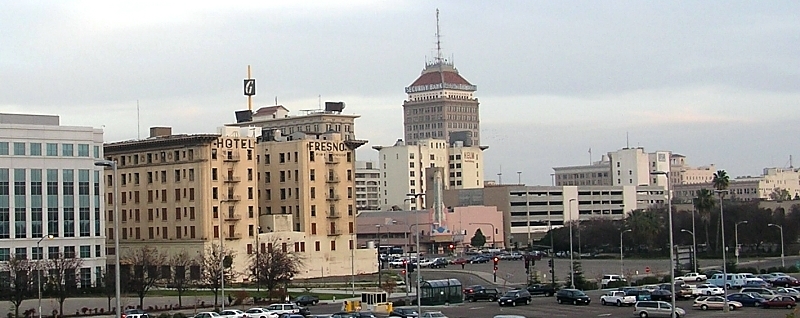
Fresno skyline — Photo: No machine-readable author provided. Mortadelo2005 assumed (based on copyright claims). — CC BY-SA 3.0, via Wikimedia Commons
Dyer Files City Tax Measure as Backup After County Stalls on Transportation Ballot Initiative
Mayor Jerry Dyer filed a city-only transportation sales tax measure for the November ballot on Aug. 7 — the final day allowed — after learning the countywide “Better Roads, Safe Streets” measure still requires action by the Fresno County Board of Supervisors next week, a procedural step that falls after the city’s own filing deadline.
The city framed the decision as a $65 million hedge against the risk that county supervisors might not move the countywide measure forward at all, despite Gov. Gavin Newsom signing legislation Thursday meant to place it before voters. County Counsel has publicly stated his opinion that the state’s action was not lawful, and the city said there is “no indication” the board will support the measure when it meets — possibly Tuesday.
Dyer had said Thursday the city would not file its own measure, according to the statement. That position reversed within 24 hours after the city received updated information and legal guidance showing the countywide measure had not yet qualified as of the city’s deadline.
The city’s measure includes language that automatically nullifies itself if the “Better Roads, Safe Streets” measure is approved by voters. If both appear on the ballot and both pass, the city-only version becomes void.
“This has truly been one of the most difficult decisions I’ve faced as Mayor,” Dyer said. “I know that submitting the City’s measure today may disappoint my fellow mayors throughout the county, and that weighs heavily on me. But I want to reassure them — and all of our partners — that this choice in no way diminishes my support for the Better Roads, Safe Streets measure.”
A spokesperson for Assemblywoman Esmeralda Soria, who authored AB 1923, pushed back on the idea that the countywide measure could still be blocked. “Let me be clear: the Fresno County Transportation Act is now LAW,” spokesperson Brody Fernandez said. “Authored by Assemblywoman Soria, passed by both houses of the Legislature, and signed by Governor Newsom, AB 1923 is the law of the land.”
The city’s measure is a general tax expected to generate $65 million annually — enough to cover a projected $54 million revenue shortfall and preserve 217 jobs, according to the city. As a general tax, none of the revenue can be earmarked for a specific purpose, a feature critics have described as giving voters a “blank check” with no guaranteed use.
According to city officials, the move toward a general fund rather than earmarked expenditures is strategic. A tax for the general fund only requires an approval from 50% plus one voter. Meanwhile, s specific tax like the “Better Roads, Safer Streets” requires 2/3 voter approval, which is rarely approved.
The Breakdown
- Dyer filed the city’s measure in the final hours before the Aug. 7 deadline, after the County Clerk confirmed the countywide measure cannot be placed on the ballot until the Board of Supervisors takes formal action.
- The Board of Supervisors is expected to meet Tuesday — after the city’s deadline had already passed.
- The city’s measure automatically becomes void if the countywide “Better Roads, Safe Streets” measure passes — meaning if both are on the ballot and both win, only the countywide version takes effect.
- County Counsel has stated publicly that AB 1923, the state bill Newsom signed to allow the countywide measure on the ballot, is not lawful in his professional opinion. The county has pledged to fight AB 1923 in court.
What This Means for You
If you’re a Fresno city voter, you may now see two competing transportation tax measures on your November ballot — or just one, depending on whether the Board of Supervisors acts next week to place the countywide version alongside it. The city-only measure is structured as a general tax with no restrictions on how the revenue is spent, meaning the $65 million expected annual revenue is yours to approve or reject without a predetermined spending plan attached.
A county-wide measure would provide funding to Fresno and the 38 unincorporated areas in the county, like Sanger, Selma, Shaver Lake and more. The funds are designated for specific transportation related measures. While the measure has seen a lot of support, Fresno County Supervvisor Gary Bredefeld has gone on the record to state that the Better Road, Safe Streets measure “is a 30 year tax scheme designed to get people out of cars and onto public transportation.” It requires 2/3 voter approval to pass.
The City of Fresno measure would only apply to and serve the City of Fresno, not any of the rest of the County. It would generate more $11 million more in revenue for the City of Fresno than the deficit expected from “Better Roads, Safe Streets,”, with no designation for how the funds are spent. The term is for 10 years and would be nullified if a county Lee initiative passes. It requires only a 50% voter approval to pass.
What You Can Do
The Fresno County Board of Supervisors is expected to meet Tuesday to decide whether to place the “Better Roads, Safe Streets” measure on the ballot. If you want to weigh in on that decision, contact the Board of Supervisors before the meeting or attend in person.
What to Watch
The city’s $65 million annual revenue estimate is exactly that — an estimate. As a general tax, the money flows into the city’s general fund with no legal obligation to spend it on transportation, roads, or anything else the measure might imply.
The stated $54 million shortfall and 217 jobs at risk make the case for revenue. If both measures appear and both pass, the countywide version wins and the city measure disappears.
Also worth watching: whether the Board of Supervisors actually places the countywide measure on the ballot Tuesday, and whether the county follows through on its pledge to fight AB 1923 in court.
while some may be considering which measure is better than the other, another question to ask is what might the consequences be if neither passes? And what led to this “crisis?”