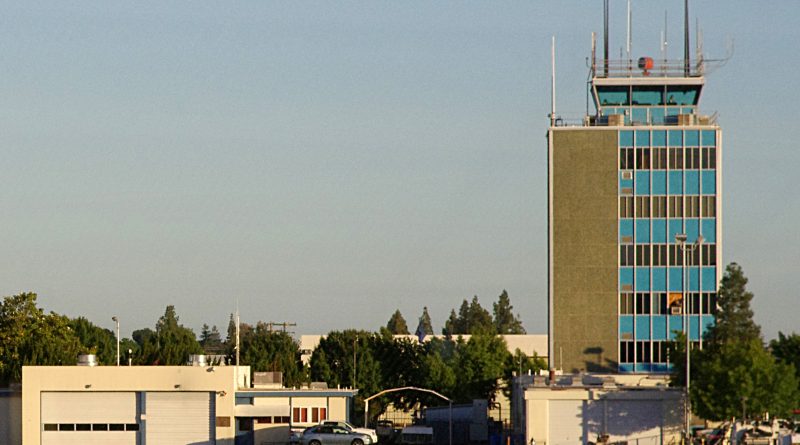
Fresno Yosemite International Airport — Photo: David Prasad — CC BY-SA 2.0, via Wikimedia Commons
Fresno City Council Tables $98.9 Million Airport Runway Contract Decision
The Fresno City Council tabled a decision on February 26, 2026, to award a $98,888,888 construction contract for reconstructing Runway 11L-29R at Fresno Yosemite International Airport. The contract would go to DeSilva Gates Construction-Vanguard, a joint venture based in Dublin, California.
The proposed contract is part of a project carrying additional costs: a $1,164,070 agreement with Krazan of Fresno for geotechnical testing and inspection, and a $4,391,389 agreement with Kimley Horn for construction management. The City Council agenda also included appropriating $7.5 million in city funds for fiscal year 2025-2026.
All contract work would proceed year-by-year, contingent on Federal Aviation Administration funding. The FAA previously announced a $14 million grant to reconstruct more than 9,500 feet of the existing runway, part of a $107 million package for 16 California airports announced by U.S. Senators Alex Padilla and Adam Schiff.

Five bids were received when the project went out for competitive bidding on September 3, 2025. The lowest bid came in approximately 32% below the engineer’s estimate of $130,674,836.25. The highest bid was $120,511,817.
According to the staff report, the project will replace asphalt surfaces with Portland Cement Concrete across the primary runway’s entire length. The work includes utility relocations, upgraded airfield lighting, revised pavement markings, and reconfigured taxiways.
The Breakdown
- The City Council tabled the contract award on February 26, 2026 — no vote was taken, no reason for the delay appears in the provided material.
- The construction contract total is $98,888,888, with consultant agreements adding $5,555,459 ($1,164,070 for testing, $4,391,389 for construction management).
- The City Council agenda item also included appropriating $7.5 million in city funds for fiscal year 2025-2026, requiring five affirmative votes and subject to mayoral veto.
- The FAA Airport Improvement Program is the primary funding source — each year’s work authorization depends on FAA funding being confirmed.
- The staff report states the project will enhance aircraft circulation as new international and domestic gates come online and references operational capacity for larger weighted aircraft.
What This Means for You
This project is funded primarily by federal grants, but the City Council controls whether and when to proceed with the contract award and the $7.5 million appropriation. The decision was tabled without stated reason, meaning the contract — and the runway work it funds — remains in limbo until the Council returns to the item.
The staff report describes the runway reconstruction as “critical” and “a key enabling component” of the airport’s terminal expansion. The Council’s decision to delay rather than vote — and the reason for that delay — is information the provided material does not supply.
What to Watch
The winning bid is 32% below the engineer’s estimate, a spread that can signal either an efficient bidder or corners the city will discover later. The provided material does not explain how the $130 million estimate was reached or why all five bids came in below it.
The $7.5 million city appropriation is a small fraction of the stated federal grant ($14 million), but the staff report notes the Airports Department’s FY26 budget already carried $79,678,572 in appropriation authority for this project. The relationship between that existing appropriation, the new $7.5 million, and the $14 million federal grant is not explained in the material — a voter reviewing this action does not know from the provided documents what the city’s total financial commitment is, or how much of the $98.9 million contract the city itself is on the hook for versus federal dollars.
The material states the project is needed to support “larger weighted aircraft” and new gates, but does not state which airlines, routes, or specific operational changes drove that need. A reconstruction project of this scale — the primary runway, more than 9,500 feet of pavement — has a purpose beyond routine maintenance. The question is whether that purpose is demand the airport has already secured or capacity the city is building in anticipation.