
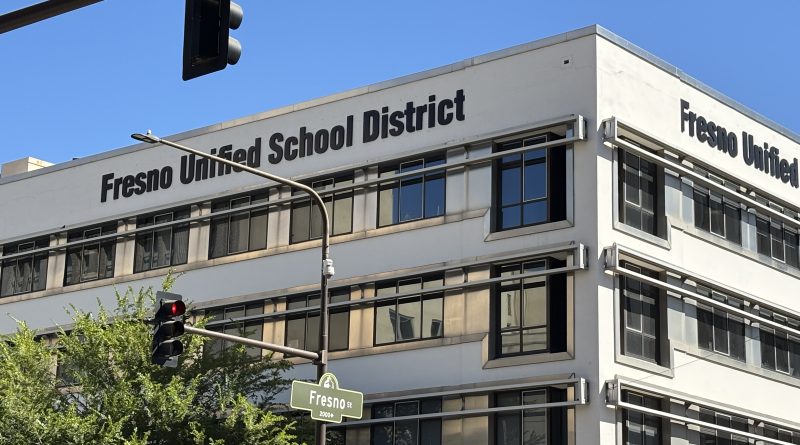
Fresno Unified — Photo: Jengod — CC0, via Wikimedia Commons
Fresno Unified Projects Accelerating Student Losses — 1,200 Gone Next Year, High Schools Hit Hardest
Fresno Unified expects to lose 1,199 students net in the 2026-27 school year — up from 1,044 lost this past year — with high schools carrying most of the attrition and elementary schools posting the only gains, according to November 2025 enrollment projections reviewed by Fresnoland.
The district is California’s third-largest by enrollment. Over the last decade it lost roughly 4,000 students total. The new projections show it losing that same number again in just the next two years, with freshman and senior classes alone shedding around 600 seats.
Roosevelt High School leads the downturn at a projected 132-student loss for the coming year. McLane High follows at 90, Fresno High at 67. On the upside, all five schools expected to add the most students are elementary campuses — Figarden Elementary up 32, Wawona K-8 up 30, Del Mar/Roeding/Vinland Elementary each up 17.

Across all grades, FUSD anticipates adding only 370 new students while losing 1,569 — a net drain that keeps accelerating. Paul Idsvoog, the district’s chief of operations, confirmed the projections were compiled by consultant group SchoolWorks and noted that final enrollment will firm up as registration continues into the school year.
The district has already addressed a $23 million budget deficit by cutting hundreds of jobs. Officials have outlined program consolidations and possible school closures as options if the trend continues, driven by what experts cite as declining birth rates, migration out of California, and rising housing costs.
Meanwhile, neighboring Clovis Unified to the east posted record enrollment of 43,254 students in 2025-26 — steady growth over the same decade Fresno Unified contracted.
The Breakdown
- Fresno Unified projects a net loss of 1,199 students for 2026-27, up from 1,044 lost in the prior year.
- High schools bear the brunt: Roosevelt (-132), McLane (-90), Fresno High (-67) lead the losses.
- Elementary schools show the only growth: Figarden (+32), Wawona K-8 (+30), Del Mar/Roeding/Vinland (+17 each).
- The district expects to add 370 students districtwide but lose 1,569 — a widening gap.
- Over the last decade FUSD lost ~4,000 students; projections show another ~4,000 gone by 2028-29.
- Budget impact: FUSD has already cut hundreds of jobs to close a $23 million deficit; further consolidations and closures are under consideration.
- Clovis Unified, by contrast, hit record enrollment of 43,254 in 2025-26.
What This Means for You
A district bleeding students this fast faces pressure to consolidate schools and cut programs — decisions that will reshape which neighborhoods have a nearby school and what services remain available. The candidates’ plans for managing enrollment decline and budget shortfalls are now the central operational question facing the district, not a secondary issue.
What to Watch
The district has named consolidations and closures as options on the table. That means schools could be shuttered or merged — decisions likely affecting families in the neighborhoods hit hardest by enrollment loss (Roosevelt, McLane, Fresno High areas in particular). The cost side is already visible: hundreds of jobs cut to close a $23 million gap. The question is whether those cuts hit classroom services or administrative overhead, and whether resources shift toward the elementary campuses still adding students.
The contrast with Clovis Unified’s growth raises a blunt market-dynamics question: families are voting with their feet, and housing costs appear to be a factor. Are Fresno Unified’s enrollment losses driven by factors the district can control — school quality, program offerings, facility conditions — or are they locked in by housing patterns and economic forces? If it’s the latter, aggressive consolidation may be the only financially sustainable path, regardless of the impact on individual neighborhoods. If it’s the former, strategic choices around curriculum, safety, and campus investment become the variable that could slow or reverse the trend. The material doesn’t settle which it is — but the velocity of the decline suggests the window to test the latter hypothesis is closing fast.