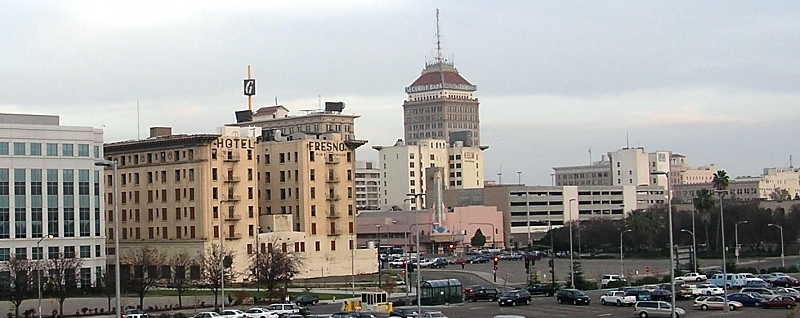
Fresno skyline — Photo: No machine-readable author provided. Mortadelo2005 assumed (based on copyright claims). — CC BY-SA 3.0, via Wikimedia Commons
Fresno County Puts Hotel Tax on November Ballot, Advances Home Kitchen Program
Fresno County supervisors voted unanimously Tuesday to place a hotel tax on this November’s ballot and approved the first reading of an ordinance allowing residents to run food businesses from their homes.
The hotel tax, called Measure A, would bring in about $4.5 million a year. It needs a simple majority to pass. The money goes into the county’s general fund — supervisors decide how to spend it.
The tax only applies to hotels and short-term rentals in unincorporated areas. Tourists and out-of-town visitors pay it, not residents. Fresno is one of three California counties without this tax. The other two don’t have the visitor traffic to make it worth collecting.

“This is rectifying something that should have been addressed a long time ago,” said Board Chair Garry Bredefeld.
Board Vice Chair Luis Chavez framed it as fairness. “Folks are coming in here using our infrastructure, our roads, our emergency (services), utilities, and all things of that sort,” he said. “I think it’s fair to ask folks that come into our community to pay for that.”
The same meeting advanced a two-year pilot program for Microenterprise Home Kitchen Operations — MEHKOs. These let residents store, prepare, and serve food from their homes starting in 2027. State law caps sales at 90 meals per week and roughly $100,000 annually, adjusted for inflation.
Chavez called it “an entrepreneur pipeline” — a cheap first step for people who might later run a food truck or brick-and-mortar restaurant. The county got $155,000 in state grants in 2024 to study whether the program would work here. Dozens of supporters in green shirts packed the board chambers Tuesday, some left waiting outside when the room hit capacity.
Veva Islas, a Fresno Unified trustee and nonprofit director, said home cooks are already selling food under the table. “This is not about creating a new industry,” she said. “Home cooks are already serving customers throughout Fresno County. The difference is that many are doing so without a realistic pathway to operate as legitimate businesses.”
Not everyone’s sold. Lorraine Salazar, a restaurant owner and California Restaurant Association member, raised concerns about enforcement. Restaurants face up to four health inspections a year. State law requires MEHKOs to get one. Fresno County staff said they’ll require at least one inspection every 12 months, plus monthly business reports from home kitchens.
Supervisors directed staff to look at adding an unannounced inspection, requiring MEHKO operators to get a state tax permit, file annual returns, and creating a way for the county to collect sales taxes on home-kitchen transactions. “That would make me feel more comfortable in terms of protecting the public as we see how this all works,” Bredefeld said.
The board still needs to vote on a second reading of the MEHKO ordinance July 14 before it becomes official.
The Breakdown
- Measure A is a general hotel tax on the November ballot. Simple majority passes it. Only applies to unincorporated areas. Expected to bring in $4.5 million annually, paid mostly by tourists. Supervisors control how it’s spent.
- The MEHKO ordinance creates a two-year pilot letting residents run food businesses from their homes starting 2027. State law caps it at 90 meals per week, roughly $100,000 annual revenue. Fresno County requires at least one inspection per year and monthly reporting. Supervisors want staff to study adding an unannounced inspection and stronger tax-collection requirements.
- Second vote on the MEHKO ordinance is July 14. If it passes, the program launches in 2027.
What This Means for You
You’re voting on Measure A in November. It’s a general tax — the board decides where the money goes, not you.
The MEHKO program doesn’t directly affect your vote unless you’re planning to run a home kitchen. But the enforcement gap Salazar named is real: your neighborhood restaurant gets inspected up to four times a year, a home kitchen once. Supervisors are trying to tighten that. Whether they actually do is worth watching — the final rules aren’t set yet.
What You Can Do
The second MEHKO hearing is July 14. That’s when the ordinance becomes official or gets changed. Public comment is open.
Measure A is on your November ballot. No hearing to attend — just vote.
What to Watch
Measure A is a general tax. That $4.5 million goes wherever the board votes to put it. Supervisors sold this as tourist money paying for roads and emergency services those tourists use. Whether that’s actually where the money goes is entirely up to future board votes.
On MEHKOs: the board directed staff to study stronger tax and inspection requirements. Whether those actually get written into the ordinance July 14 tells you how serious they are about the enforcement concerns Salazar raised. A one-inspection-per-year program with monthly self-reporting puts a lot of faith in voluntary compliance from people who, as Islas noted, are currently operating under the table. That’s not an accusation — it’s the pitch for the program. The question is whether formalizing that operation actually makes it safer or just makes it legal.