
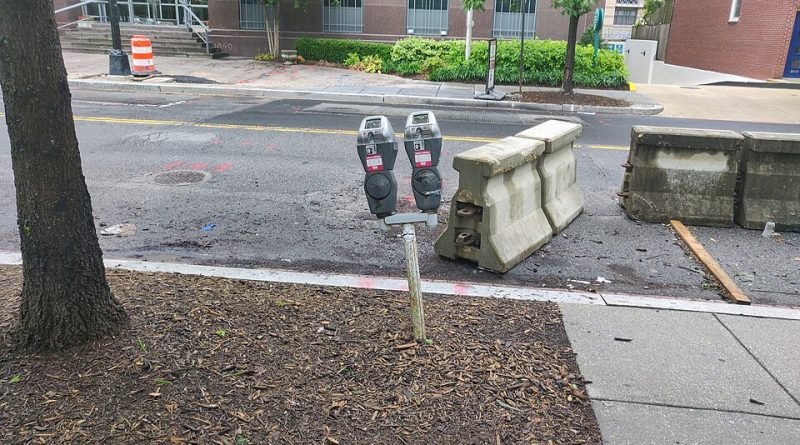
Fresno Council Approved $2 Million for Credit Card Parking Meters — Here's the ROI Question — Photo: Kurt Kaiser — CC0, via Wikimedia Commons
Fresno Council Approved $2 Million for Credit Card Parking Meters — Here’s the ROI Question
The Fresno City Council awarded a $2,005,710 contract to IPS Group Inc. on November 5, 2020, for 2,000 credit card-enabled parking meters to replace coin-only meters. The contract covers equipment, installation, annual support, data connectivity, and hosted web-based data management software, with the city financing the upfront cost through a five-year lease agreement beginning in fiscal year 2021.
The contract includes $222,000 annually for support and data connectivity, funded by “current and anticipated increase parking meter revenue” according to the staff report. The material does not state what revenue increase the city projects, what the current revenue baseline is, or what happens if collections fall short of the $222,000 annual cost.
IPS Group Inc. was selected as “the most responsive bidder” after a pilot demonstration of 60 single-space meters. The material does not identify how many bidders competed, what the competing bids offered, or what criteria made IPS Group the winner beyond being “most responsive.”
The Breakdown
- Contract value: $2,005,710 of taxpayer money to IPS Group Inc., covering 2,000 credit card parking meters, vehicle occupancy sensors, training, and five years of software/support.
- Payment structure: Financed through a five-year lease starting FY2021, with $222,000 annual support costs.
- Revenue assumption: Annual support costs funded by parking meter revenue increases the material does not quantify.
- Competitive context: The material identifies IPS Group as “most responsive bidder” but does not state how many competitors bid or what the competing proposals cost.
What This Means for You
As a Fresno voter, you’re backing a $2 million parking infrastructure bet with your tax dollars — and the city’s own financing plan assumes those meters will generate enough new revenue to cover a $222,000 annual bill. The material gives you no revenue projection, no breakeven timeline, and no contingency if collections underperform. That’s the core risk you’re carrying: a contract structured as if future revenue is guaranteed, with no documented plan for what happens when it isn’t.
This was a City Council decision in 2020, meaning the officials who approved it are accountable for whether the ROI pencils out. When you evaluate their record — or their challengers’ criticism of spending decisions — this contract is exactly the kind of commitment where the assumptions behind the numbers matter as much as the vote itself.
What to Watch
The material does not state what revenue increase the city projected to justify the $222,000 annual cost, what the pre-upgrade revenue baseline was, or how long the payback period runs. A responsible business case for a $2 million capital spend includes those figures — their absence here raises the question of whether the council approved this contract with a complete financial picture or based on aspirational assumptions. The city’s budget documents, parking division revenue reports, and any post-installation performance reviews would show whether the revenue increase materialized and whether taxpayers are subsidizing the annual cost or breaking even.
IPS Group Inc. collects $2,005,710 upfront plus $222,000 annually — a recurring revenue stream with no performance clause the material identifies. The city, and by extension Fresno taxpayers, bear the risk: the $222,000 annual bill is a fixed cost with no contingency clause in the material. The material gives no indication the contract ties IPS Group’s compensation to actual revenue performance or includes a clawback if the meters underperform.
The competitive question: if IPS Group was the “most responsive bidder,” what did the other bids propose, and what did Fresno leave on the table? The material doesn’t say how many competitors bid, what their pricing was, or whether “most responsive” means lowest cost, best features, or simply best at meeting the RFP’s spec. Bid records and the evaluation scoring sheet would show whether this was a genuine competitive process or a single-vendor outcome dressed up as one.