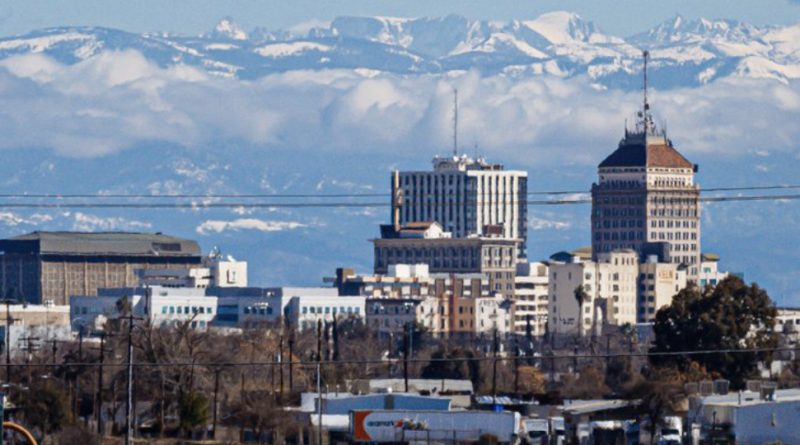
Downtown Fresno — Photo: Chewbacca2101 — CC BY-SA 4.0, via Wikimedia Commons
Two Longtime Elected Officials Face Off for Fresno City Council District 3
State Assemblymember Joaquin Arambula and Fresno Unified Trustee Keshia Thomas are headed to a November rematch for Fresno City Council District 3, which includes southwest Fresno, downtown, Chinatown, and parts of the Tower District.
Arambula finished first in June’s primary with 2,117 votes (about 30%), while Thomas trailed by fewer than 200 votes with 1,948 (roughly 27.6%). One will replace termed-out Councilmember Miguel Arias.
The race comes as both candidates bring different perspectives on what the district needs — and as both carry questions voters must weigh about their records and judgment.
Where They Stand
On Homelessness: Arambula said the city’s HART team needs improvement and pointed to his past work in emergency rooms seeing patients who were homeless. “Oftentimes it was people who were struggling because it was cold outside, or they were hungry,” he said, adding that addressing the “real underlying need” requires county help through programs like CARE Courts.
Thomas didn’t grade the HART team but emphasized tailoring help to individual needs. “Each unhoused or homeless person needs something different,” she said, adding she wants more social-services representatives — not police officers — talking with unhoused people. “Everything is kind of pushed to District 3,” she said of the homeless population in her area.
On SEDA: Arambula opposes the current proposal, especially now that southeast councilmember Brandon Vang has announced his opposition to the project in his own district. “I question why we in other parts of the city think we know better than Brandon Vang does,” Arambula said. He also questions why the city is discussing a broader environmental review that includes all forms of SEDA “under this idea that we’re really only discussing South SEDA.”
Thomas said she can’t support SEDA when existing neighborhoods lack basic services. “There’s no bank where I live. Grocery stores — there’s only one, and … I’m gonna say what it is: It’s awful,” she said. She voted in May as part of a slim Fresno Unified majority to formally oppose SEDA, after the district projected the buildout could shutter as many as 11 schools and drain $200 million a year in funding.
On Data Centers: Neither candidate committed to supporting a ban. Arambula said he has concerns about energy use and PG&E bills but wants to see new state reporting requirements on water and energy usage before deciding. “I’m wanting to make sure we ask the tough questions without having to completely rule out the idea that we should be creating jobs in our great city,” he said.
Thomas said her concern is whether companies follow through on promises to hire local residents. “My problem with a lot of these people moving in and opening huge companies here in Fresno is if they promise us one thing and we get another,” she said.
On Childcare: Arambula said he’d be hesitant about using Measure P dollars for childcare — “I thought Measure P was fairly prescriptive about how those dollars should be spent” — and wants to pursue creative funding like Stanislaus County’s approach supporting in-home and on-site childcare.
Thomas said she wants to find ways to help families just above the poverty threshold afford childcare. “If I’m making baseline, on the verge of poverty, should I really be charged for childcare?” she said, drawing on her own experience as a single mother. She isn’t yet sure where the money should come from but said “it needs to be done.”
On Downtown Revitalization: Arambula believes the planned high-speed rail station will push vacant-property owners to redevelop. “People will be climbing over each other to figure out how they can build,” he said, while adding he’s “just as concerned about gentrification.” He pointed to $250 million in state funding he helped secure for downtown infrastructure as something that could incentivize development.
Thomas wants city efforts to bring vacant buildings back to life extended to her district in downtown Fresno, with an emphasis on helping alleviate the high cost of revamping old buildings. She’d also like to explore converting some vacant properties into temporary homes for the unhoused.
On Transportation: Both support Measure S, the proposed replacement for Measure C. Arambula voted for AB 1923, which guaranteed Measure S a spot on the November ballot after the county supervisors voted to delay it. Thomas said Measure S is especially important given incomplete sidewalks and bumpy roads in her district.
Arambula hasn’t decided on Measure D, saying he has concerns whether the money would go toward its stated purpose or “become a slush fund for projects that the mayor or the city council may have.” Thomas also hasn’t made up her mind on Measure D.
On Ethics and Accountability: Arambula didn’t commit to supporting an ethics commission but criticized recent council scandals, specifically “public spending of tax dollars that seems to benefit a political candidate.” He referenced former Councilmember Luis Chavez paying more than $30,000 to a political consultant’s company for Facebook ads, then inking another contract with the same company for $99,999.99 just 11 days after the council raised the threshold for public-vote contracts to $100,000.
Thomas said she’s open to an ethics commission. “How can we mitigate some of that? Holding people accountable,” she said, “and if that means we need a commission that watches how monies are brought in, then so be it.” She vowed not to accept dark money or behave unethically in office.
On Redistricting: Arambula supports an independent redistricting commission with final say over new council districts — “something much different” than the failed advisory-only proposal councilmembers floated in July. He authored AB 2030, which empowered an independent commission to redraw county supervisor districts in 2030 and stripped that power from the elected supervisors themselves.
Thomas said she wants both residents and councilmembers to have a say in redistricting but stopped short of committing to an independent commission. “It should be a fair process,” she said, “because sometimes people pick individuals that may not make a fair decision on behalf of the entire city.”
What Voters Are Weighing
Arambula has raised almost double what Thomas has — more than $177,000 compared to her just over $91,000. His top donors include labor PACs, healthcare professionals and groups, and his father, former state Assemblymember Juan Arambula. Thomas has received large donations from labor PACs and groups supporting women and women of color running for office.
In early 2026, coverage of Arambula’s divorce included allegations from his ex-wife that she drove him to work because of “sobriety issues.” When asked whether that meant he was under the influence on the job, Arambula said things can get “messy” during a divorce and that he doesn’t put “too much into any of the hearsay that was reported at the start of the year.” He said he’s “been enjoying recovery” and trusts voters “can make up their own minds about who I am and how I’ve been.”
In August, the Fresno Bee reported that Thomas’ son said he was not called a racial slur by former Fresno Unified football coach Don Arax — contradicting Thomas’ earlier public accusation against Arax on a podcast. The Fresno Teachers Association called for Thomas to resign as trustee. Thomas issued a public apology to Arax, saying “I believed the information I had at the time, but I have since learned that the information I relied upon was not accurate.” She did not respond to the demand that she step down. Thomas declined to comment on the lawsuit Arax brought against her.
The Breakdown
- Arambula has served in the state Assembly since 2016, representing Fresno and surrounding communities. Thomas has served on the Fresno Unified school board since 2018, representing the Edison High area.
- The winner will replace Miguel Arias, who is termed out and looking to trade places with Thomas on the school board.
- Arambula and Thomas finished within fewer than 200 votes of each other in the June primary.
- Key differences include Arambula’s emphasis on state-level expertise and funding partnerships versus Thomas’ emphasis on investing in existing neighborhoods before expanding into new areas like SEDA.
What This Means for You
Your vote in this race will decide who represents the urban core — southwest Fresno, downtown, Chinatown, and parts of the Tower District — on the city council for the next four years. The choice is between a state legislator who brings experience securing state funding and a school-board trustee who says the district has lacked adequate representation. Both carry questions about judgment and accountability that voters will need to weigh alongside their stated positions on homelessness, development, and spending priorities.
What You Can Do
The general election is Tuesday, November 5, 2026. You can read more about where the candidates stand on issues at fresnoland.org’s candidate guide.
What to Watch
The biggest difference between these two candidates isn’t where they stand on specific issues — they’re close on Measure S, both oppose the current SEDA proposal, both want more accountability at City Hall — it’s whose judgment voters trust after what each has done with power.
Arambula’s ex-wife alleged he had “sobriety issues” that required her to drive him to work. He called it “hearsay” and said he’s “enjoying recovery,” but didn’t directly answer whether he was under the influence on the job. Thomas publicly accused a former coach of using a racial slur against her son, then apologized after her own son contradicted her, saying “the information I relied upon was not accurate.” She refused to resign when the teachers union demanded it.
Both stories raise the same question: when someone in office makes a serious mistake — whether in their personal conduct or in what they publicly claim — how do they handle it, and is that enough? Arambula says voters can “make up their own minds” about him. Thomas says she “can acknowledge what I know today, take responsibility for the words I spoke and offer you the apology you deserve.” You’ll need to decide whether either answer is sufficient for the office they’re asking you to give them.
Beyond that, the real tension in this race is whether the district needs someone who can pull state money and play the regional-partnership game — Arambula’s pitch — or someone who says the district has been ignored and needs a representative who will fight for it first — Thomas’ pitch. Arambula points to the $250 million he secured for downtown infrastructure; Thomas points to southwest Fresno still lacking a decent grocery store or a bank. Who’s right depends on what you think the core problem is: insufficient state funding and coordination, or insufficient attention to what the district already has.