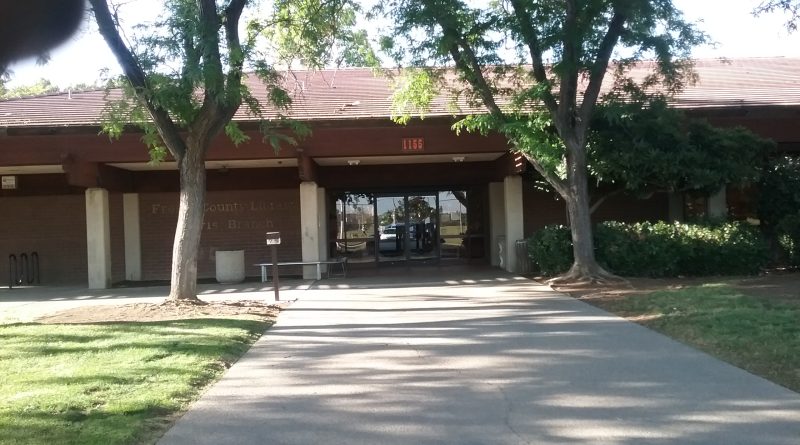
Fresno County Public Library — Photo: NeoBatfreak — CC BY-SA 4.0, via Wikimedia Commons
County Board Punts Library Privatization Talk to 2027, Sends Report Online Instead
The Fresno County Board of Supervisors pulled a planned discussion on privatizing the county library system from their October agenda. The board directed County Administrative Officer Paul Nerland at their September 22 meeting not to present the item at any 2026 board meeting.
The information will instead be released as a written Board Briefing Report, expected by early November. The public can access it on the same county webpage where other updates are posted.
The shift came after Supervisor Buddy Mendes, who retires at year’s end, said the board should reconsider how they receive the information since “I don’t know if there’s consensus on this board to push this forward.” Mendes added, “That’s something, I think, for a new board to look at, not this board.”

Supervisor Luis Chavez agreed: “We don’t necessarily want to have to discuss anything that doesn’t have support.”
The county commissioned a study examining the potential costs, savings, and operational impacts of privatizing management of the Fresno County Public Library system. County officials emphasized the study itself is not a proposal and does not represent board approval to privatize.
Because the board has taken no action on privatization, the library system remains open, operational hours have not been reduced, and employees have not been laid off.
The privatization effort would need at least four affirmative votes from the five-member board to move forward — a supermajority it currently lacks. With three supervisor seats up for election in November, the new board composition will determine whether privatization remains viable.
City and labor leaders mounted a preemptive campaign against the proposal. Fresno City Councilmember Mike Karbassi, who is running for a Board of Supervisors seat, held a news conference Monday outside the Sunnyside Regional Library alongside Chavez and union members to announce his intent to introduce a citywide resolution opposing privatization.
“We should never put profits ahead of the welfare of our children,” Karbassi said. “That is exactly what privatization will do. It is a stupid idea. And ‘stupid’ is an appropriate word. I read about it in the library.”
Chavez said preliminary data from the county shows the privatization study projects about $8 million in annual savings. He raised concerns about how those savings would be achieved, citing reductions in staff, services, and library closures seen in other jurisdictions that privatized their systems.
“Oftentimes these private corporations have one accountability system, one major motivation to do this,” Chavez said, “and that’s profits.”
The county explored privatization with Library Systems & Services in 2023. That proposal concluded the county would save around $8 million annually, offering a 10-year contract with about $85 million in total savings. The proposal said existing county library staff would transition to work with the company. Those talks fizzled out anyway.
Chavez said the county is looking to partner with the same company for this round of talks.
SEIU Local 521, which represents many of the county’s library workers, has been building opposition to privatization, citing workers’ concerns about potential layoffs and reduced hours.
Riley Talford, president of the Fresno-based SEIU Local 521 chapter, said at Monday’s news conference that privatization could lead to layoffs and a loss of resources to the communities libraries serve. “The Fresno County Library belongs to all of us,” Talford said. “It is not liberal or conservative, progressive or radical. It is a cornerstone of democracy.”
Fresno houses 11 of the county’s 34 libraries — the city with the highest concentration in the county. Most of the library system’s budget is funded through Measure B, a countywide sales tax first approved by voters in 1998 and renewed three times since, most recently in 2012. Measure B is up for renewal in 2028. It’s not clear how privatization would affect that renewal effort.
Joel Perez, a librarian at the Sunnyside Regional Library and SEIU member, said privatization could force the county to bow out of the San Joaquin Valley Library System, a network of county library systems that partner to get residents books. He cited Measure B’s consistent approval record as a reason to oppose privatization.
“Any one of the supervisors willing to consider privatization is actively toying with subverting the will of the people of Fresno County,” Perez said, “who have voted overwhelmingly time and again over decades to endow our community with libraries.”
Fresno County first discussed privatization following a split 3-2 vote earlier this year to prevent the library system from participating in Pride Month celebrations. Critics said the supervisors were attacking LGBTQ+ Fresnans rather than engaging in responsible governance. Many of those same criticisms have been used to describe the privatization talks.
Karbassi’s opponent in the Board of Supervisors race, Kerman Mayor Maria Pacheco, said she was also a “hard no” on the privatization effort. With Chavez already in opposition and a supermajority necessary, whoever wins that seat would potentially be a deciding vote.
Margaret Mims, who will replace Mendes next year after winning her election outright in June, did not immediately respond to a request for comment. Clovis Mayor Pro Tem Diane Pearce, who has announced her intention to run for Supervisor Nathan Magsig’s seat should he win a spot in the state legislature in November, said she has not yet made up her mind and will wait to see what the published county report says before deciding.
The Breakdown
- The Board of Supervisors directed staff at their September 22 meeting not to present a library privatization discussion at any 2026 board meeting.
- A written Board Briefing Report will be sent to supervisors by early November and posted publicly online.
- The county commissioned a study examining costs, savings, and operational impacts of privatizing library management — the study itself is not a proposal and does not represent board approval.
- Privatization would require at least four affirmative votes from the five-member board — a supermajority it currently lacks.
- Three supervisor seats are up for election in November, meaning the new board composition will determine whether privatization remains viable in 2027.
- A 2023 privatization proposal from Library Systems & Services projected $8 million in annual savings and $85 million over a 10-year contract. Those talks fizzled out.
What This Means for You
Your vote in November determines whether the new Board of Supervisors has the votes to privatize the county library system in 2027. With at least one current supervisor (Chavez) opposing privatization and at least one candidate (Pacheco) also a “hard no,” the outcome depends on which candidates you elect to the three open seats. If you use the county library system, pay attention to where each candidate stands on this — it’s not a hypothetical, the county already commissioned the study and already explored it once in 2023. A new board willing to pursue it could have the supermajority the current board lacks.
What You Can Do
The Fresno City Council is expected to vote on a resolution formally opposing library privatization at their next meeting on Thursday, October 8. Residents can attend that meeting or contact their councilmember before the vote. The county’s Board Briefing Report is expected to be posted publicly by early November on the county’s library update page. In November, your vote for Board of Supervisors will determine whether a new board has the votes to move privatization forward in 2027.
What to Watch
The $8 million in projected annual savings sounds good on paper. Here’s the question the material raises but doesn’t settle: where does that money come from? Chavez says he’s seen staff reductions, service cuts, and library closures in other jurisdictions that privatized. The 2023 proposal said existing staff would “transition” to work with the company — what does that mean in practice, and at what pay?
The county’s library system is funded primarily by Measure B, a sales tax voters have approved four times since 1998, most recently in 2012. It’s up for renewal in 2028. If voters keep approving that tax specifically to fund public libraries, and the board turns around and privatizes the system anyway, what happens to that dedicated revenue stream? Does it still go to libraries, or does it become a subsidy to a private contractor? And if the contractor doesn’t perform, what happens to Measure B renewal in 2028?
The county explored this exact move in 2023 with the same company. Those talks fizzled out. The board just pulled the October discussion because it lacks the votes to move forward this year. If privatization keeps getting shelved because it can’t clear the board, why does the county keep commissioning studies on it? Who benefits from keeping this in play as a threat, even when it doesn’t have the votes?