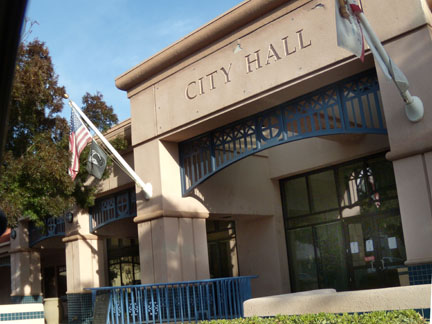
Fresno City Hall — Photo: GeorgeLouis at English Wikipedia — CC BY-SA 3.0, via Wikimedia Commons
Ethics complaint accuses Fresno council candidate of pay-to-play violation over donor’s lawsuit
A Fresno City Council candidate is defending himself against a state ethics complaint that says he broke California’s pay-to-play law by participating in closed-door discussions about a lawsuit involving one of his biggest campaign donors.
Rob Fuentes, who’s also a State Center Community College District trustee, received $16,800 from Richard Spencer of Harris Construction and Spencer’s wife Karen between March and August 2025. Then he sat in on a July 7 closed session about a lawsuit naming Harris Construction, according to the complaint filed with the California Fair Political Practices Commission.
The Levine Act bars public officials from voting on or influencing decisions involving anyone who gave them more than $500 in the past year. The question here is whether Fuentes should have disclosed the donations and stayed out of the room.
Fuentes says the complaint is “patently meritless and politically motivated.” He told Fresnoland that no settlement was discussed in that closed session and that neither he nor the board has talked about settling the case at all.
State Center’s lawyer is arguing the pay-to-play law doesn’t even apply here because a court decides the lawsuit’s outcome, not the district. The district also says the board took no action on July 7, so there was nothing for Fuentes to be disqualified from.
But FPPC guidance says a settlement agreement counts as a contract, and the law does cover contracts. Whether a settlement was considered matters.
The lawsuit itself is a mess over union labor and unpaid wages at State Center’s West Fresno campus. A subcontractor, JT2 Integrated Resources, is suing both the district and Harris Construction, claiming it didn’t know it had to use union plumbers and got stuck with a $1.63 million arbitration bill as a result. JT2 also says Harris owes it $3.6 million for extra work and delays.
Fuentes got his first donation from Richard Spencer on May 28, 2025 — a few weeks after the State Center board discussed this same lawsuit in closed session on May 6. He got $5,000 from Karen Spencer in March and another $5,900 from her in August, according to campaign filings.
The July 7 meeting came right after a one-hour ethics training on the Levine Act and the Political Reform Act — the laws designed to prevent exactly this kind of appearance.
One State Center trustee, Nasreen Johnson, said she’d be concerned if any trustee took large contributions while making decisions involving the donor. She added that trustees should recuse themselves not just when a conflict exists, but when it looks like one might.
Thomas Holyoke, a Fresno State political science professor, said Fuentes “probably should have recused himself,” especially if settlement talks were happening. Even if the law’s technical requirements are unclear, he said, the safe move is always to step aside.
“Laws like this are not only to prevent actual corruption, but they’re also to give the public a sense that their elected public officials are acting in the public interest,” Holyoke said.
The FPPC confirmed it sent a letter on July 10 asking Fuentes and the Spencers to respond within 14 days, but wouldn’t say whether they did or whether an investigation is underway. If the case results in a fine, penalties can run up to $5,000 per violation.
The lawsuit between JT2, State Center, and Harris Construction goes back to court Oct. 26 for a settlement conference, with a jury trial tentatively scheduled for mid-November.
The Breakdown
- The Levine Act prohibits public officials from participating in or influencing decisions involving anyone who gave them more than $500 in the past year.
- Rob Fuentes, running for Fresno City Council, received $16,800 total from Richard and Karen Spencer between March and August 2025.
- Richard Spencer owns Harris Construction, which is a defendant in a lawsuit the State Center board discussed in closed session on July 7.
- An anonymous complaint filed with the FPPC in July alleges Fuentes should have disclosed the donations and recused himself from that discussion.
- State Center’s lawyer argues the pay-to-play law doesn’t apply because a court, not the district, decides the lawsuit — but FPPC guidance says settlement agreements are contracts, which the law does cover.
- Fuentes says no settlement was discussed and calls the complaint politically motivated.
What This Means for You
You’re being asked to vote for Rob Fuentes for Fresno City Council. Whether he followed the law designed to keep donor money from influencing official decisions is a direct test of his judgment and ethics — the kind of thing you’re supposed to know before you mark that ballot.
The FPPC’s finding, when it comes, will tell you whether he actually broke the rules. But the underlying question — whether he should have stayed out of a discussion involving a donor who gave him nearly $17,000 — is one you can weigh yourself. That judgment call, and how he explains it, is part of what you’re voting on.
What You Can Do
The FPPC doesn’t share investigation details until findings are made, so there’s no public process to weigh in on right now. But this is a candidate for Fresno City Council — you can ask him directly how he squared participating in that closed session with the donations from the Spencers, and whether he thinks the appearance of a conflict matters even if the technical legal question is unclear.
What to Watch
State Center’s defense hinges on the argument that because a court decides the lawsuit, not the district, the pay-to-play law doesn’t apply. That’s a narrow read of a law designed to prevent the appearance of corruption, not just the fact of it.
Even if that argument holds legally, the optics are bad: Fuentes took $16,800 from a donor, then sat in on a closed-door discussion about that donor’s lawsuit with the district, right after an ethics training covering exactly this scenario. Trustee Nasreen Johnson said it herself — trustees should recuse when circumstances could create the appearance of a conflict, not just when a conflict is proven.
The question worth asking is whether Fuentes sees any problem with the appearance at all, or whether he thinks the technical legal argument is enough. That tells you something about how he’ll handle conflicts when he’s on the city council and the donor involved wants something from the city, not just a lawsuit settled.