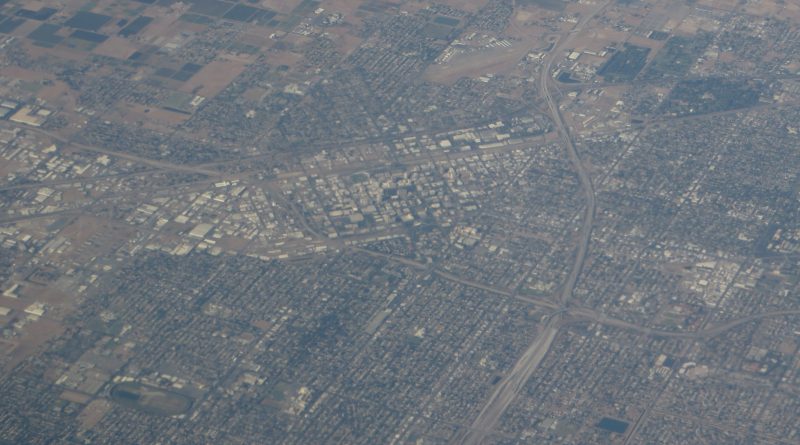
Downtown Fresno — Photo: Ken Lund from Reno, Nevada, USA — CC BY-SA 2.0, via Wikimedia Commons
Fresno Planning Commission Advances SEDA Development Plan 6-1 Without Financial Analysis
The Fresno Planning Commission voted 6-1 Wednesday night to recommend approval of the Southeast Development Area (SEDA) plan and forward it to the Fresno City Council. The vote came despite the absence of a publicly released financial analysis — a council-ordered study scheduled for unveiling in September — and opposition from school boards, neighborhood residents, and a sitting city councilmember.
Commissioner Gurdeep Shergill cast the lone dissenting vote.
SEDA is a multi-phased development covering approximately 9,000 acres in southeast Fresno. According to city planning staff, the plan proposes up to 45,000 housing units and an estimated 30,000 to 37,000 jobs. The full plan area is bounded by the Gould Canal on the north, McCall and Highland on the east, Jensen and North on the south, and Temperance and Minnewawa on the west. Phase 1, known as South SEDA, is located east of Temperance Avenue and south of Jensen Avenue.

The meeting drew enough attendees to fill the council chambers and balcony. Public comment time was reduced from three minutes to two minutes per speaker. By a show of hands, five people in the room supported the plan.
The Fresno City Council previously voted not to approve SEDA in December and directed staff to conduct further review and revisions. A financial report released in May 2025 stated Phase One would cost approximately $7.4 billion. The council-ordered financial analysis for Phase 1 has not been made public, with a public unveiling scheduled for September.
Planning Director Jennifer Clark told commissioners the city’s financial plan was not within the commission’s purview. “How the city pays for infrastructure, pays for funds — that is the responsibility of the city council,” Clark said. “As it relates to the responsibility of this body, you have the responsibility to determine whether or not this plan, as a plan, is consistent with the general plan.”
When pressed on how SEDA would pay for itself, Clark listed mechanisms — impact fees, property tax, Mello-Roos assessments, a public-private partnership — but said picking one “would be premature.”
Commissioner Lyday asked whether the commission could wait for the financial analysis. “Am I correct in thinking that we don’t actually have a financial analysis right now?” Planning Director Clark confirmed the analysis would go to the council, “hopefully Sept. 3.”
Commissioner Calandra, a former city councilmember, pressed on a community benefit fund Mayor Jerry Dyer promised last year to cover infrastructure connection costs for existing residents. “Without knowing that that actually has funding, how can we recommend this to the council?” she asked.
Two commissioners who voted against SEDA at a November planning commission meeting — DJ Criner and former chair Peter Vang — have since been replaced by Mayor Dyer. The new commissioners are Joseph Giles, a business representative for the Operating Engineers’ Union, and Jaime Holt, communications director for the San Joaquin Valley Air Pollution Control District. In November, SEDA survived 4-3. Wednesday’s vote was 6-1.
Commissioner Holt told the room that commissioners had been instructed by city planning staff that their votes could not weigh anything they learned outside the planning commission meeting itself. Only the staff presentation and testimony entered into the public record could count, she said. Holt disclosed that she had met Monday with two non-planning staff about SEDA and assured Planning Director Clark these individuals “gave me no new information.”
Veva Islas, president of the Fresno Unified School District board, told commissioners, “You will hurt families.” Both Fresno Unified and Central Unified school boards passed resolutions earlier this year opposing SEDA. Central Unified Superintendent Mark Marshall asked the city to fund infrastructure west of Highway 99 first.
Debbie Bigum, a resident inside the plan area, said SEDA would incur six-figure costs for existing residents required to connect to city water and sewer. “The cumulative cost could be more than the value of the home,” she said. Bigum said the actual language in the SEDA plan regarding the community benefit fund was vague enough to be meaningless. “It is not legally binding,” she said. “In other words, it is just rhetoric.”
Alan Cederquist, another SEDA resident, cited three concerns: a $3 billion shortfall not covered by developer fees; growth projections assuming 117,000 new residents when the state Department of Finance projects Fresno’s population to decline; and the impact to enrollment at Fresno Unified schools.
Rod Wade, a southwest Fresno resident, said life expectancy on his side of town runs 20 years shorter. “They want to build all the fancy stuff on the north side of town, but they want to put the trucks to bring the pollution to our side of town,” he said.
Councilmember Miguel Arias told commissioners, “You’re on this dais because one person selected you,” referencing Mayor Dyer.
Five speakers supported the plan. Bill Betts, president of the Betts Company, a local manufacturer, said Fresno was “driving growth to our neighbors in Visalia and Madera.” The Fresno Chamber of Commerce, Invest Fresno, and a business development specialist from the county’s economic development corporation spoke in favor.
Planning Commission Chair Kathy Bray said, “I see this as another good chance to get some decent jobs in Fresno.”
The commission also recommended that the Fresno City Council strengthen requirements for SEDA funding of community provisions that would benefit existing SEDA residents.
SEDA now moves to the Fresno City Council for a final approval vote.
The Breakdown
- The Fresno Planning Commission voted 6-1 to recommend approval of the Southeast Development Area (SEDA) plan and forward it to the Fresno City Council.
- SEDA covers approximately 9,000 acres in southeast Fresno and proposes up to 45,000 housing units and 30,000 to 37,000 jobs.
- A council-ordered financial analysis for Phase 1 has not been publicly released; a public unveiling is scheduled for September.
- A May 2025 city report stated Phase One would cost approximately $7.4 billion total.
- The Fresno City Council previously voted not to approve SEDA in December and directed staff to conduct further review.
- Both Fresno Unified and Central Unified school boards passed resolutions this year opposing the project.
- Two commissioners who voted against SEDA in November have been replaced by Mayor Dyer appointees since that vote.
What This Means for You
The Fresno City Council — the body you elect — will make the final decision on whether SEDA moves forward, likely as soon as September. That vote will determine whether the city commits to a development whose full financial plan has not been made public, despite a council directive to produce one. The planning commission’s role was to assess consistency with the general plan; the council’s role is to decide whether to approve the project itself. If you have concerns about SEDA’s cost, its impact on existing neighborhoods, or whether growth should be prioritized over investment in current infrastructure, the council vote is the decision point that matters. The commission vote Wednesday does not approve SEDA — it tees it up for the body whose members you can vote for or against.
What You Can Do
The Fresno City Council is scheduled to consider SEDA, with the financial analysis expected to be presented September 3. City Council meetings are held at Fresno City Hall, 2600 Fresno Street. Public comment periods are typically available; check the city’s meeting agendas at fresno.gov for confirmed dates and times.
What to Watch
The May 2025 report states Phase One would cost approximately $7.4 billion. The material does not break down how much of that total is public contribution versus private financing, developer equity, or other funding. The council-ordered financial analysis — not yet public — is what will clarify that split. Until that analysis is released, it is not possible to state what the actual public cost is, or whether the $7.4 billion figure represents taxpayer exposure or the full project capitalization including private sources.
The commission was told SEDA would “pay for itself” through mechanisms including impact fees, property tax, Mello-Roos assessments, and public-private partnerships, but planning staff declined to specify which mechanism or combination would be used, calling that choice “premature.” The question is whether the September analysis will actually answer that, or whether the council will be asked to approve the plan on the same terms the commission did — a promise that it will work out, with the details to come later.
A second tension: the promised community benefit fund. Mayor Dyer pledged it last year to cover infrastructure connection costs for existing residents, which one resident testified could exceed the value of her home. But residents say the fund language in the SEDA plan itself is not legally binding. The practical question is whether residents inside the plan area will actually be protected from six-figure costs, or whether the “benefit” exists only as long as it’s politically convenient.
A third: Commissioner Shergill asked directly why west Fresno neighborhoods are still waiting for basic infrastructure while the city advances a 9,000-acre expansion. That is the opportunity-cost question in its plainest form — not whether SEDA is a good project on its own terms, but whether public resources are being steered toward new construction when existing neighborhoods lack sidewalks, water, and sewer. The vote Wednesday suggests the commission was not empowered to weigh that trade-off, even when a commissioner raised it. The council vote will show whether that question gets an answer, or gets sidestepped again.