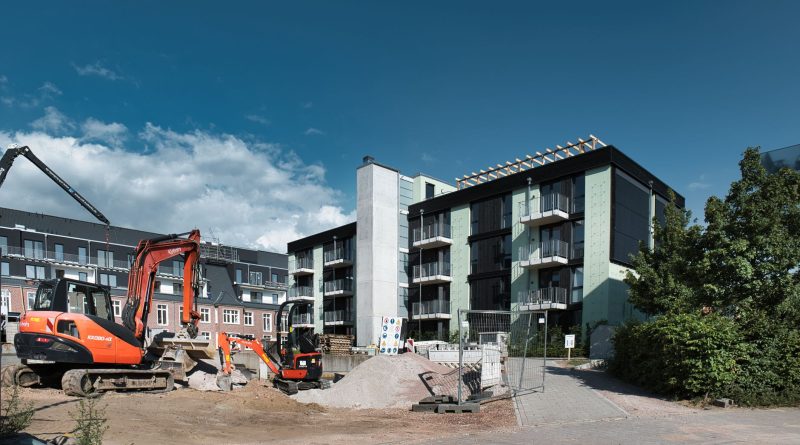
apartment construction housing development — Photo by Paparazzi Ratzfatzzi via Pexels
Tower District Bookstore Tenant Follows $2.7M Voter-Funded Park Into Community Land Trust Property
South Tower Community Land Trust completed its first commercial acquisition in December 2025 — a $295,000 purchase of 617-619 North Fulton Street in Fresno’s Tower District, financed through $350,000 in debt plus $127,000 from foundation grants, bank contributions, and individual donations starting at $5. The indie bookstore Judging By The Cover moved in as the building’s first tenant.
The land trust’s trajectory began in 2017, when the city planned to rezone a decommissioned police-substation lot at Broadway and Elizabeth for market-rate apartments. Resident organizing produced a two-block canvass whose results — nearly universal support for a park — collided with a shortage: the Tower District held 0.36 acres of park space per 1,000 residents against the city’s three-acre goal.
California’s 2019 Surplus Land Act reform required cities to prioritize affordable housing, parks, or schools when disposing of unused public land. That cleared the path. Fresno voters had passed Measure P in 2018 — a three-eighth-cent sales tax projected to generate $60 million annually for parks, recreation, and arts — though a lawsuit delayed collection until 2021. The resulting $2.7 million in Measure P funding broke ground on Broadway Parque in September 2024; the park opened July 2025.
South Tower Community Land Trust formed in 2022 to extend that organizing model beyond the park. The nonprofit sold its first permanently-affordable home in November 2025 and has up to seven tiny homes planned for a half-acre lot shared with an urban farm. Last fall, Fresno City Council approved a Tower District plan incorporating green space, fresh-food access, and protections against food-processing-facility expansion — changes the land trust had advocated through three years of listening sessions, hearings, and written comment.
The commercial acquisition closed one month past its original deadline. Executive director Kiel Lopez-Schmidt noted that the Tower District’s weak commercial market — two city pilot programs aimed at storefront vacancies yielded little movement — allowed the trust time to navigate a three-month CDFI underwriting process. The trust paid below the listing price; no competing offers materialized.
Bookstore owner Ashley Mireles-Guerrero joined the land trust board in January. She and her husband Carlos opened Judging By The Cover in Fresno’s Chinatown in 2024 after running pop-up sales starting in 2023, targeting authors underrepresented in mainstream bookstores — people of color, queer writers, self-published, indie-press. Tower District rents had been prohibitive. The new 2,300-square-foot space carries the same sales-floor area and rent cost as the Chinatown location but adds front and back patios for author events and workshops.
The Breakdown
- Broadway Parque: $2.7 million from Measure P (voter-approved three-eighth-cent sales tax, 2018), construction September 2024–July 2025.
- Commercial acquisition: $477,000 total cost ($295,000 purchase, remainder for remodeling). Financing: $350,000 loan from Community Vision CDFI, $127,000 from foundation grants, bank contributions (Community Reinvestment Act compliance), individual donations.
- Tower District plan approval: Fresno City Council, fall 2025, following three years of community input the land trust organized.
- Community land trust model: nonprofit holds land title permanently, sells structures through renewable ground leases (typically 99 years) with resale-price restrictions to preserve affordability.
- CDFI: Community Development Financial Institution — a lender certified to serve low-income communities, often providing capital for projects traditional banks won’t finance.
What This Means for You
Measure P — the parks sales tax Fresno voters approved in 2018 — funded the Broadway Parque project that anchored the land trust’s organizing base, which then expanded into affordable housing and commercial space. The $2.7 million Broadway Parque allocation represents one use of Measure P’s projected $60 million annual revenue.
The Fresno City Council’s approval of the Tower District plan last fall incorporated changes the land trust pushed for over three years of public process. Both are outcomes shaped by votes: the electorate’s approval of Measure P and the council’s decision on the district plan.
A voter weighing council members’ responsiveness to neighborhood organizing or evaluating whether Measure P spending aligns with stated goals has a concrete case to reference.
What to Watch
The material does not state the city’s cumulative Measure P spending to date, how many similar park projects that revenue has funded across Fresno, or what proportion of the $60 million annual target the tax actually generates. A voter approved this tax in 2018 on the promise of neighborhood park access; whether the Tower District’s 0.36-acres-per-1,000-residents figure has changed citywide, or whether other underserved neighborhoods have seen comparable investment, is a measure of whether the tax delivers as sold.
The land trust’s residential model — selling structures while retaining land title — lowers upfront purchase costs but restricts resale profits to preserve affordability for subsequent buyers. The material does not state the specific resale-price formula the trust applies, how much equity a homeowner can actually build, or whether the model proves financially sustainable for families over decades. That restricted-equity trade-off is the core mechanism; a reader evaluating whether permanently-affordable housing is worth the wealth-building limit a homeowner accepts needs to know the actual numbers, not the theory.
Fresno ran two pilot programs last year to address Tower District storefront vacancies, both described as ineffective — owners “content to sit on vacant spaces even with a threat of fines,” per Lopez-Schmidt. The material does not name the programs, state the fine structure, or explain why enforcement failed. A neighborhood whose commercial corridors stay empty despite city intervention is a policy failure with a direct cost to residents; whether the city council plans stronger measures or considers the pilots sufficient is a question the material leaves open.