
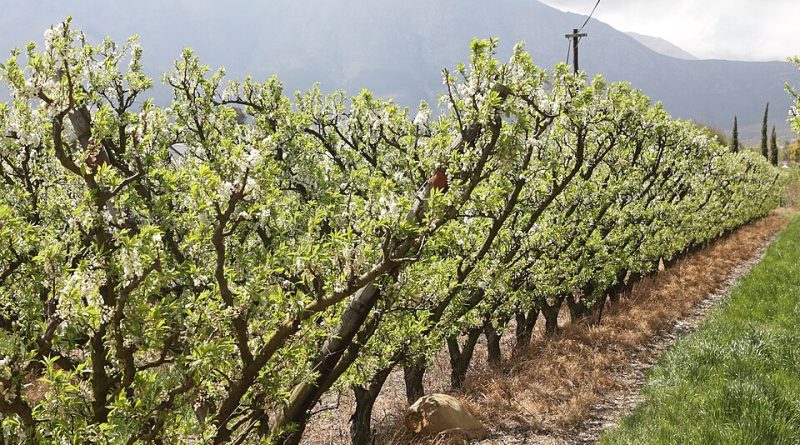
Fresno County Ag Hits Record $9.64B — But Who Actually Profits From This Growth? — Photo: Thomas Bjørkan — CC BY-SA 3.0, via Wikimedia Commons
Fresno County Ag Hits Record $9.64B — But Who Actually Profits From This Growth?
Fresno County’s Board of Supervisors received the 2025 Annual Crop and Livestock Report on Tuesday, showing agricultural commodities reached a record-breaking $9,642,283,000 in gross value — a 6.8% increase over 2024. The county retained its position as the top agricultural producer in California and the nation.
Almonds drove the record, posting $1.75 billion in gross value and representing 18.16% of total crop value. Pistachios moved into the number two spot at $1.22 billion, while grapes dropped to third at $1.03 billion. The county shipped agricultural products to 86 countries in 2025.
The report documented more than 300 different commodities produced in the county, with 75 commodities posting gross values exceeding $1 million. The top ten crops by value were: almonds, pistachios, grapes, cattle and calves, milk, poultry, tomatoes, peaches, oranges, and garlic.
The Breakdown
- Total gross agricultural commodities value: $9.64 billion, the highest in county history and a 6.8% increase from 2024’s production value
- Almonds: $1.75 billion gross value, the leading crop for the second consecutive year, representing 18.16% of total value
- Pistachios: $1.22 billion, moved from third to second place
- Grapes: $1.03 billion, dropped from second to third place
- More than 300 commodities produced, with 75 exceeding $1 million in gross value
- County products shipped to 86 countries
What This Means for You
A $9.64 billion agricultural economy is the economic base elected supervisors manage. The question isn’t just whether the number went up — it’s whether the growth is sustainable, who’s capturing the value, and whether the county’s dependence on a narrow set of high-value crops (almonds and pistachios alone account for nearly $3 billion) creates risk if market conditions shift.
What to Watch
The report documents gross value — the total revenue before accounting for production costs, water expenses, labor, debt service, or profit margins. It doesn’t break out who actually captures that value: large corporate growers, family operations, contract farmers, or out-of-state investors. Is the $9.64 billion circulating in the local economy, or flowing to absentee owners and off-balance-sheet subsidiaries?
A $3 billion concentration in two crops creates structural questions about risk if market conditions or resource availability shift. The material doesn’t state how much water this production consumed, who holds the water rights, or what the county’s long-term groundwater trajectory looks like.
Fresno County ships to 86 countries — a market footprint that exposes local growers to tariffs, trade disputes, and shifts in foreign demand, none of which the county controls. The material doesn’t identify which export markets matter most or what happens to production value if access to any of them closes.
More than 300 commodities sounds like diversification, but 75 commodities exceeding $1 million means the bulk of the value is concentrated. What’s the gross value share of the top 10 crops versus the remaining 290-plus? If a handful of high-value crops account for most of the $9.64 billion, “diversity” is a talking point, not a hedge.
The material doesn’t state how much of that $9.64 billion translates into county tax receipts, or whether the revenue growth is keeping pace with the public costs of supporting this industry — road maintenance, groundwater monitoring, emergency services for a dispersed rural population. Are supervisors showing you the cost-benefit breakdown, or just the top-line figure?