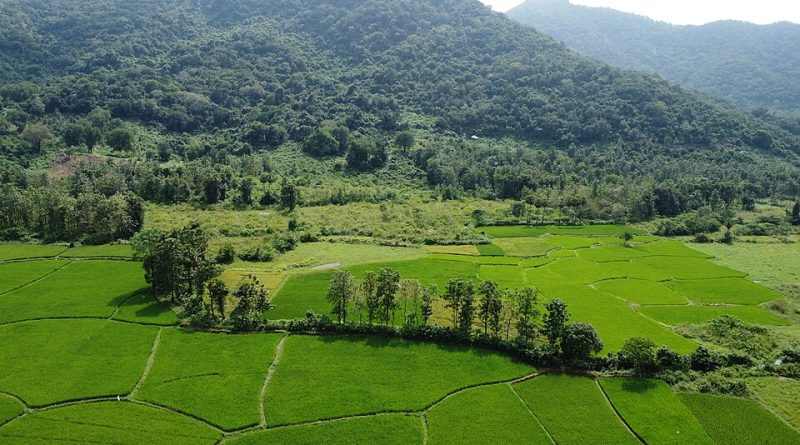
Fresno City Council Tables $4 Billion SEDA Development Plan Indefinitely — Election Results Triggered the Retreat — Photo: Saiphani02 — CC BY-SA 4.0, via Wikimedia Commons
Fresno City Council Tables $4 Billion SEDA Development Plan Indefinitely — Election Results Triggered the Retreat
The Fresno City Council voted 6-1 Thursday to indefinitely table the Southeast Development Area plan — a $4 billion, 9,000-acre proposal Mayor Jerry Dyer pitched as the city’s next growth engine, but which opponents warned risked 11 school closures, hundreds of millions in taxpayer infrastructure costs, and a repeat of the white-flight era that hollowed out Fresno Unified in the 1980s.
Councilmember Mike Karbassi made the motion. “I think we have beat this dead horse long enough,” Karbassi said, “and it’s clear there is no political will or ability to actually sustain [it] within the city of Fresno.” Northeast Fresno Councilmember Nick Richardson cast the lone dissenting vote.
The vote came hours after updated election results showed anti-SEDA candidates Naindeep Singh, Ariana Martinez-Lott, and Joaquin Arambula holding leads in three council races — a direct threat to any SEDA approval the outgoing council might have pushed through in its lame-duck session. Councilmember Miguel Arias said approving SEDA now would have been pointless: “We would have been caught up in litigation only to undo this action in January. Elections have consequences.”

Mayor Dyer acknowledged the outcome was “not unexpected” and said he plans to meet with opponents to discuss an alternative. He did not specify what that alternative would entail.
The Breakdown
- The project: SEDA would have covered 9,000 acres in southeast Fresno, accommodating up to 45,000 homes over time. The first phase, South SEDA, would have focused on the area east of Temperance Avenue and south of Jensen Avenue.
- The funding gap: The $4 billion total project carried a $3 billion funding shortfall. The first phase alone had a $440 million shortfall Dyer’s administration never resolved, despite three years of planning.
- City revenue claim vs. hidden costs: A city-commissioned report projected South SEDA could add $12 million annually to Fresno’s $535 million General Fund — a 2.2% increase. But existing residents in the SEDA area would be required to replace septic tanks with city sewer hookups at over $100,000 per house, according to Dyer officials at planning meetings. With thousands of existing homes in the area, that cost alone runs into hundreds of millions of taxpayer dollars — a figure Dyer never tallied publicly.
- Developer-backed revenue projection: The Building Industry Association of Fresno and Madera Counties released a study projecting $2.5 billion in net local government revenue over 15 years, assuming 1,500 homes built annually. That study did not account for the impact on existing neighborhoods or school districts.
- School district opposition: Fresno Unified estimated SEDA could shut down 11 schools — two middle schools and a high school — costing the district $200 million annually, or $3 billion over the same 15-year period the BIA analyzed. Central Unified and Sanger Unified also formally opposed the plan. The superintendent of Sanger Unified, where South SEDA homes would have been placed, publicly opposed the project.
- Campaign finance and timing: Councilmember Nick Richardson, a key swing vote, received a $500 donation — the maximum allowed under state pay-to-play laws — from a shell company owned by Ed Kashian, a SEDA backer whose Fancher Creek regional mall depended on SEDA’s new housing. Dyer scheduled the vote for after the election, when opposition would be “burnt out from election mobilizations or simply spending time with loved ones during the holidays,” per one analysis.
- Flawed financial assumptions: Attorney Patience Milrod filed a 40-page letter arguing the city’s financial analysis assumed a housing density illegal under SEDA’s own specific plan, used only a best-case sales scenario with no stress-test for slower sales or lower prices, and left the council with no understanding of “the magnitude of the risk that subsidies will extend and that reimbursement will not materialize.”
What This Means for You
Thursday’s vote means SEDA won’t move forward — for now. But “indefinitely tabled” is not the same as “rejected.” The vote leaves the door open for Dyer to bring back a revised version, and the specific vulnerabilities Milrod named — the subsidy risk, the school closures, the sewer-hookup cost Dyer never totaled — remain unquantified and unresolved.
The timing here matters: Dyer told developers in May he wouldn’t bring SEDA to a vote until he “knew he had the votes,” and he scheduled Thursday’s hearing for after the election. That’s what he said on the record.
What You Can Do
The new council members — Singh, Martinez-Lott, and Arambula — are expected to be sworn in in January. City council meetings are open to the public and include public-comment periods.
What to Watch
Start with the simplest question: why doesn’t the city’s own math add up? The financial analysis assumed a housing density SEDA’s specific plan doesn’t allow. It projected revenue using a best-case sales scenario and no worst-case. It claimed $12 million in annual General Fund revenue but never tallied the hundreds of millions in sewer-hookup costs Dyer promised to cover. If Dyer brings back an “alternative,” ask whether it fixes those problems or just repackages them.
Now ask who was actually going to profit. SEDA’s supporters were developers with land in the project area and businesses — like Ed Kashian’s Fancher Creek mall — that needed the new housing to succeed. Kashian’s $500 donation to swing-vote Richardson, the legal maximum under pay-to-play laws, is exactly the kind of below-the-radar influence a project like this attracts. The BIA study projecting $2.5 billion in revenue was commissioned by the industry that builds the homes, not by an independent party. When the people who profit from a project are also the ones funding the analysis that justifies it, you’re entitled to skepticism.
On the other side of the ledger: who was going to pay? Fresno Unified, which estimated $200 million in annual losses and 11 school closures. Homeowners in Fresno Unified’s boundaries, whose property values stagnated for 20 years the last time the city approved a project that siphoned enrollment to Clovis Unified. Existing Fresno residents, who’d subsidize the infrastructure gap if sales came in slower or lower than projected — a risk the city never modeled.
And southeast Fresno’s existing rural residents, who’d be required to pay over $100,000 each to hook up to city sewer, a cost Dyer said the city would cover but never budgeted for. That’s taxpayer money, not developer money, and the bill could run into the hundreds of millions.
SEDA’s first phase was billed as affordable housing, but the city’s own enrollment-loss projections suggest it would pull students — and their parents’ property-tax base — out of existing Fresno Unified schools and into the new development, leaving the district worse off.
Finally, there’s the timing. Dyer told developers in May he wouldn’t bring SEDA to a vote until he “knew he had the votes,” and he scheduled Thursday’s hearing for after the election, when opposition would be weakest. That’s not a conspiracy theory — it’s what he said on the record. When an official picks the moment that minimizes public accountability, assume there’s a reason.