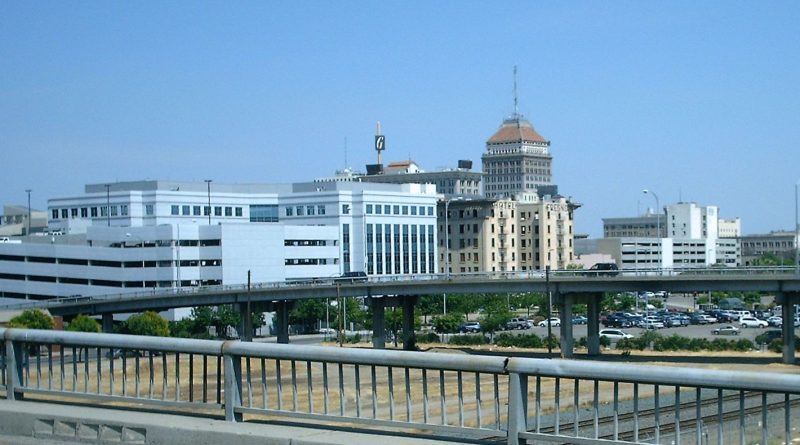
Fresno skyline — Photo: Strangevisitor from Fresno, USA — CC BY 2.0, via Wikimedia Commons
Fresno County Voters Face Two Transportation Tax Measures in November — Here’s What Each Would Do
Fresno County voters will decide November 3 whether to replace the county’s longstanding transportation tax with a new 30-year measure — and city of Fresno voters will also weigh a second, separate sales tax proposed by Mayor Jerry Dyer.
Measure S, the countywide measure also called “Better Roads, Safe Streets,” would replace the existing half-cent sales tax known as Measure C when it expires in 2027. The measure projects generating over $5.5 billion over 30 years, with around 65% — almost $5 billion — earmarked for maintaining, repairing, and improving local streets and roads.
The remaining funds would split between public transit (25%), regional connectivity (5%, with 1% of those funds going to the Fresno Yosemite International Airport), free bus fares for seniors, military members, veterans, people with disabilities, and students (4%), and administration and oversight (1%).
The measure also requires at least 120 miles of new bike and walking trails by 2057. No more than 5% of funds can go toward expansion projects until roads meet a Pavement Condition Index score of 70 or higher — a quality measure where 100 is perfect condition and zero is severely damaged.
City of Fresno voters will also decide Measure D, a separate half-cent general sales tax proposed by Dyer in late July. That tax would generate an estimated $65 million annually and flow into the city’s general fund, where the city would decide how to allocate it. Measure D would only take effect if it passes and Measure S does not.
Dyer proposed the tax to protect Fresno from losing $54 million in revenue and 217 jobs if there was no replacement for Measure C, according to the mayor.
Opposition to Measure S has focused on claims the measure dedicates too much to public transit and bike infrastructure instead of road repair. “Instead of making road repair and maintenance the clear priority, Measure S directs hundreds of millions of dollars toward public transportation and 120 miles of bike lanes while our streets and rural roads continue to deteriorate,” said Garry Bredefeld, Fresno County Board of Supervisors chairman.
Bredefeld also called the 30-year timeline excessive: “We don’t know what’s going to happen in terms of transportation needs five years, 10 years, let alone 30 years. So people need to understand this is a scam. Measure S is a scam.”
Critics have also raised concerns about funding for smaller cities. Areas like Mendota have an average pavement condition index of 36.
The measure’s path to the ballot itself became contentious. In July, the Board of Supervisors ordered a 30-day study to evaluate the initiative, pushing the process beyond the deadline to qualify for November and delaying the measure until March 2028. Assemblymember Esmeralda Soria and State Sen. Anna Caballero responded by amending Assembly Bill 1923 to require Measure S to appear on the November ballot. Gov. Gavin Newsom signed the bill August 6.
The Board of Supervisors sued the state, Dyer, and others in a 3-2 vote. Judge Jonathan Skiles ruled August 31 that AB 1923 is valid and enforceable, denying the board’s request to block the measure from the ballot. The board has not appealed.
Supporters of the state’s intervention framed it as upholding democracy. “This has always been pretty simple for me: let the people of Fresno County decide. Nearly 32,000 residents signed their names to put this measure before voters,” said Luis Chavez, District 3 supervisor.
Andy Levine, campaign manager for Yes on Measure S, warned failure would be “pretty catastrophic for our county. We would see a pretty rapid deterioration of roads, a completely reduced public transit infrastructure.”
Opponents countered there’s time for a better plan. “The reality is that Measure C money doesn’t run out until 2029,” said Brooke Ashjian, former Fresno Unified board member. The No on Measure S campaign has raised around $200,000. Yes on S received a $250,000 donation September 17, among others.
Measure C, first approved in 1986 and renewed in 2006, has provided transportation funding for over 40 years. Critics point to Fresno County’s potholes as proof it’s been ineffective. Supporters say Measure C focused on building highways, while Measure S prioritizes maintaining local streets.
“It prohibits adding lanes for cars. You can only add lanes for bikes or buses. The only way Measure S reduces traffic and congestion is if we get out of our cars and start taking bikes or buses around,” said Diane Pearce, Clovis Mayor Pro Tem and current candidate for the Fresno County Board of Supervisors.
Mail-in ballots have already been sent out. Voters will receive two ballot cards due to the large number of measures on the November ballot.
The Breakdown
- Measure S (countywide): 30-year half-cent sales tax replacing Measure C when it expires in 2027. Projected to generate over $5.5 billion. Around 65% goes to local road repair and maintenance, 25% to public transit, 5% to regional connectivity (with 1% of those funds to the airport), 4% to free fares for seniors/military/veterans/disabled/students, 1% to administration. Requires at least 120 miles of new bike/walking trails by 2057. Caps expansion projects at 5% of funds until roads reach a quality score of 70 or higher. Each city and the county gets a $400,000 annual base; remaining funds distributed 80% by population, 20% by roadway miles.
- Measure D (city of Fresno only): Half-cent general sales tax generating an estimated $65 million/year for the city’s general fund. Only takes effect if Measure D passes AND Measure S does not. Proposed by Mayor Dyer to protect the city from losing $54 million in revenue and 217 jobs if Measure C expires without a replacement.
- The lawsuit: The Board of Supervisors ordered a study in July that would have delayed Measure S until 2028. State legislators amended AB 1923 to force it onto the November ballot; Gov. Newsom signed it. The board sued; Judge Skiles ruled the state bill valid. The board is not appealing.
- Opposition claims: Too much funding for transit and bike lanes instead of roads. 30-year timeline is too long. Questions about funding for smaller cities. Measure would remove car lanes and increase traffic.
- Supporter claims: Measure C focused on highways; Measure S prioritizes local street repair. Failure would cause rapid road deterioration and gutted transit. Nearly 32,000 residents signed to put it on the ballot.
What This Means for You
Your vote on Measure S determines whether Fresno County continues a half-cent sales tax you’ve been paying since 1986 — and if so, where that money goes for the next 30 years. If you live in the city of Fresno, your vote on Measure D is a backup: it only matters if Measure S fails, in which case you’re deciding whether the city raises its own tax to replace the lost county funding. Either way, you’re deciding whether your sales-tax dollars fund road repair, public transit, bike lanes, or none of the above — and whether the county gets that revenue at all or lets the current tax expire in 2027 with no replacement.
What You Can Do
Mail-in ballots have already been sent out. Vote by November 3. If you want to contact elected officials involved in the debate, the Fresno County Board of Supervisors can be reached through the county’s website, and Mayor Jerry Dyer’s office can be contacted through the city of Fresno’s site.
What to Watch
The Yes on S campaign received a $250,000 donation on September 17 — who’s funding a half-billion-dollar-per-decade tax measure matters, because it tells you whose priorities the measure actually serves. The No campaign has raised around $200,000. Ask who benefits most from each side winning, and whether the answer is “the residents this is framed around” or someone else.
Measure S’s allocation to local roads sounds like the priority, but the fine print matters: no more than 5% can go to expansion until roads hit a quality score of 70. Mendota’s average is 36. How long does that cap last in practice, and does the formula (80% by population, 20% by road miles, plus a $400,000 base per city) actually get smaller cities the funding they need for major work, or does it keep them treading water? The material doesn’t answer that — it’s worth watching whether the promises hold once the money starts flowing.
The opposition’s claim that the measure “prohibits adding lanes for cars” and only allows bike or bus lanes is a real trade-off to consider if you’re a driver: is the county choosing a future where you’re nudged out of your car whether you like it or not, or is it finally catching up to cities that already learned car-only infrastructure doesn’t move people efficiently? That’s a values question, not just a technical one, and it’s yours to decide — but you should know that’s the choice you’re actually making.
If Measure S fails and the current tax expires in 2027, the county loses the revenue entirely unless a new measure passes later. Opponents say there’s time to craft a better plan by 2029 when Measure C funds run out. Supporters say roads will deteriorate rapidly without continuous funding. The real question: is “we can do better” a plan, or a delay tactic? You won’t know until you see whether the opposition actually produces that better plan, or whether rejecting this measure just means the county goes without.