California High-Speed Rail Authority — Photo: Unknown authorUnknown author — Public domain, via Wikimedia Commons
California Missed Its Own Train Deadline — Then Quietly Dropped Its Lawsuit
California promised to buy trains for its high-speed rail project by the end of 2024. The state missed that deadline. Then it promised a federal judge it would award the contract by December 2025. It missed that deadline too.
Two days before Christmas, the state quietly dropped its lawsuit challenging the Trump administration’s decision to pull $4 billion in federal funding — a lawsuit filed after Governor Gavin Newsom called the funding cut “a political stunt to punish California.”
The state has yet to explain why it missed either deadline, or when it will actually buy the trains.

The project, approved by California voters in 2008 to connect San Francisco and Los Angeles in under three hours, has spent $15 billion over 16 years without laying any high-speed rail track. The current plan covers only a 171-mile stretch between Merced and Bakersfield in the Central Valley.
Federal officials cited the missed train-purchase deadline as one of nine key findings when they concluded in 2025 that the project had “no viable path” to completion on schedule. Transportation Secretary Sean Duffy said “federal dollars are not a blank check — they come with a promise to deliver results.”
The grant agreement signed under the Biden administration required California to execute a trainset contract by December 31, 2024. California missed it.
Multiple sources inside the High-Speed Rail Authority told CBS California Investigates that CEO Ian Choudri changed the trainset specifications shortly after taking over in 2024 — just months before the federal deadline. Board member Ernest Camacho warned during a public meeting that the change could force the authority to “cancel that procurement or rewrite a new specification.”
Choudri has declined interview requests. The authority provided no explanation for the delays.
When the Trump administration moved to terminate the funding in July 2025, Attorney General Rob Bonta sued “to stop Trump’s politically motivated attack on high-speed rail.” In sworn court filings, the authority assured a federal judge it would execute a train contract by December 1, 2025, and that doing so would keep the project on schedule.
The authority missed that deadline too, canceling the board meeting where the contract was expected to be approved. Two days before Christmas, the state dismissed the case with no press release and no public explanation.
“It was appropriate for us to pull the lawsuit,” Bonta told CBS two weeks later, but declined to elaborate.
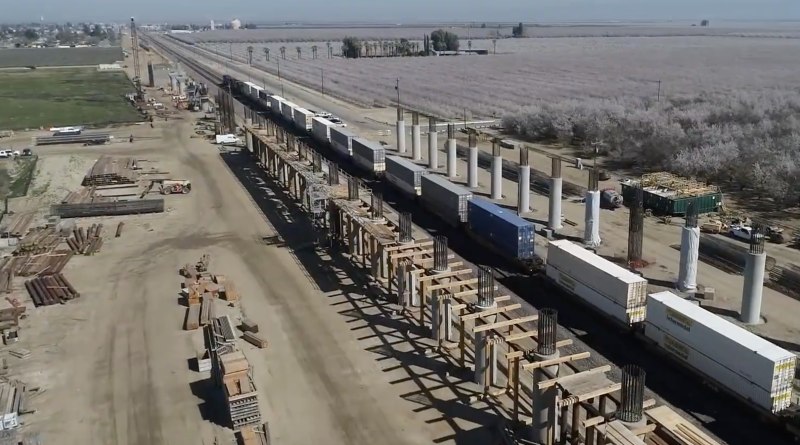
In his final State of the State address, Newsom boasted that California is “finally laying the tracks of the nation’s first high-speed rail system.” The state had not laid any high-speed rail track. What it had built was a railhead — a logistics depot to receive and store materials. “High-speed rail track, as it’s defined, has not been laid yet,” confirmed High-Speed Rail Inspector General Ben Belnap.
Six months after Newsom’s claim, the authority told CBS it was committed “to begin laying high-speed rail track by the end of the year” — 2026.
The authority’s procurement webpage now lists the train contract award date as “to be determined.” Records indicate roughly four years between signing a contract and having trains ready for testing. The original plan called for prototype trains in 2028 and passenger service by 2033. The authority’s latest timeline shows service starting as late as September 2034.
In August 2026, the authority posted its first public acknowledgment that the train procurement has changed. The order was cut in half — from six trainsets to three, with options for 19 more carrying “no guarantee.” The revised terms require delivery by February 2030. The authority is also now considering a “lease-purchase financing structure” — meaning the state may not buy the trains outright at all.
The notice also removes federal “Buy America” requirements for the initial trainsets — the domestic-preference rules that generally require trains to be assembled in the United States from American-made components. The authority said the change “reduces schedule risk” following the withdrawal of federal funding.
Inspector General Belnap warned in a July 2026 review that the authority “will exhaust its current funding resources as soon as December 2027 if it does not secure financing” — a $9.5 billion funding gap over five years. Borrowing to close that gap could add $3.6 billion to $6.6 billion in interest costs not included in the project’s cost estimate.
The inspector general also found the authority “obscured basic facts about the project” by not clearly disclosing that the schedule had slipped from 2032–2033 to as late as September 2034. The authority disputed the findings, saying they reflect “differences in interpretation rather than gaps in information.” The inspector general’s office stood by its findings.
U.S. Senator Adam Schiff criticized the Trump administration for cutting federal funding while acknowledging “it’s critical that taxpayer dollars are spent responsibly and with full transparency and oversight.” He said he’s engaged with transportation agencies “to understand the challenges that remain for the project.”
Senator Alex Padilla said “the Trump Administration has always had it out for California” and that President Trump “chose to cancel funding that supports good-paying jobs and strengthens economic growth.”
Republican State Senator Tony Strickland said “we wasted billions of dollars” and called for “more oversight.” Democratic Assembly Transportation Committee Chair Lori Wilson said “I am concerned” and that “Californians deserve an answer” about why the trains haven’t been purchased. Democratic State Senator Dave Cortese, chair of the Senate Transportation Committee, said his committee would “continue to look into it.”
None could explain why the state hasn’t bought the trains.
The Breakdown
- California voters approved high-speed rail in 2008 to connect San Francisco and Los Angeles in under three hours with trains reaching 220 mph. The current plan covers only a 171-mile Central Valley segment between Merced and Bakersfield.
- A federal grant signed under the Biden administration required California to execute a trainset contract by December 31, 2024. California missed the deadline.
- After the Trump administration pulled $4 billion in funding citing the missed deadline, California sued. In court filings, the state promised to award the contract by December 1, 2025. It missed that deadline too and dropped the lawsuit two days before Christmas with no public explanation.
- Multiple sources say CEO Ian Choudri changed the trainset specifications shortly after taking over in 2024, forcing procurement delays. The authority has not publicly acknowledged the missed deadlines or explained the delays.
- The train order was cut from six trainsets to three, with delivery required by February 2030. Federal “Buy America” requirements were removed. The contract award date is listed as “to be determined.”
- The inspector general warns the authority will run out of money by December 2027 without securing $9.5 billion in additional funding, which could add up to $6.6 billion in interest costs. The service start date has slipped to as late as September 2034.
What This Means for You
California voters approved this project in 2008 and entrusted elected officials — governors, legislators, and the appointed authority board they oversee — to deliver it. Sixteen years and $15 billion later, no high-speed rail track has been laid, and the state can’t say when it will buy the trains or finish even the reduced Central Valley segment.
The inspector general’s warning that the project may run out of money by December 2027 means voters will likely be asked to authorize more funding — either through new bonds, budget allocations controlled by the legislature and governor, or both — for a project whose leaders have twice missed their own deadlines and have not publicly explained why. That’s the question worth asking before any more money goes in: who’s accountable when promises aren’t kept, and why should voters trust the next set of promises?
This also matters for how you judge the two U.S. senators representing California in Washington — Schiff and Padilla both defended the project and criticized the Trump administration’s funding cut, but neither explained why the state failed to meet the conditions it had agreed to under the Biden administration. A voter deciding whether those senators are fighting for accountability or just fighting for funding should know the difference.
What to Watch
Start with the most uncomfortable question first: why did two different administrations — one Democratic, one Republican, one friendly to California and one openly hostile — both conclude this project wasn’t meeting its commitments? The federal compliance review that found “no viable path” to completion didn’t come from a political opponent; it came from the Biden administration’s Federal Railroad Administration. The Trump administration pointed to the same findings when it pulled the funding. If the problem were only partisan hostility, the Biden administration’s own review wouldn’t have raised the same red flags.
That doesn’t mean the Trump administration’s motives were pure — Newsom and Bonta may well be right that politics played a role in the timing and the rhetoric. But it does mean a voter can’t dismiss the underlying findings as fabricated. The missed deadlines are real. The lack of public explanation is real. The inspector general’s warnings are real. Those facts don’t change depending on which administration is pointing at them.
Now the financial question: the inspector general says the authority will run out of money by December 2027 without securing $9.5 billion — and borrowing that amount could add up to $6.6 billion in interest costs not included in the project’s publicly stated cost estimate. That’s real money, and it will come from somewhere. If the authority comes back to the legislature for more funding — through bonds, budget allocations, or both — ask directly whether that $6.6 billion interest burden is worth paying to finish a project whose own inspector general says its leaders “obscured basic facts” and missed their own deadlines twice. The alternative isn’t necessarily abandoning the project — it could be replacing the people running it. But voters need to know the question is on the table.
Finally, the “Buy America” requirement removal: federal domestic-preference rules generally mean trains are assembled in the United States from American-made components, including U.S. steel. Removing that requirement might speed up procurement, as the authority says — or it might mean the trains will be built elsewhere, taking jobs and industrial capacity with them. The authority hasn’t said where the trains will now be built or who will build them. If California is about to spend billions on trains that could have supported American manufacturing but won’t, that’s a trade-off voters should see clearly, not learn about later.