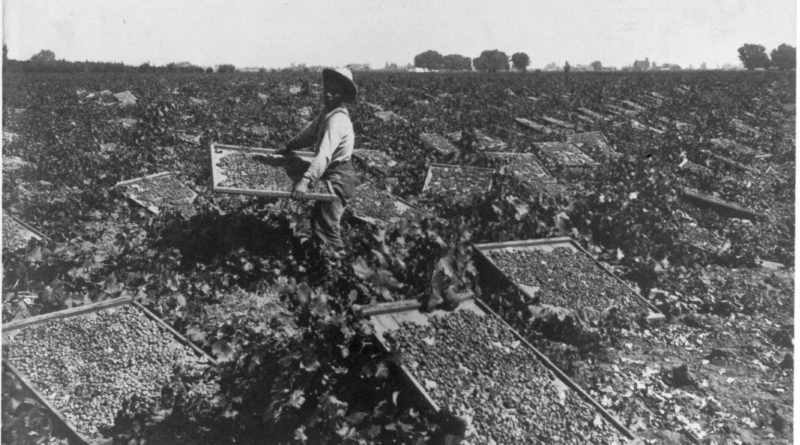
Fresno County agriculture — Photo: Miscellaneous Items in High Demand, PPOC, Library of Congress — Public domain, via Wikimedia Commons
Costa, State Ag Secretary Warn of $8.2B Trade Risk as USMCA Review Drags On
Rep. Jim Costa and California Agriculture Secretary Karen Ross gathered with Central Valley farmers Tuesday to deliver a blunt message: every day federal trade negotiators delay the USMCA review, Fresno’s farm economy risks losing billions in market share it won’t get back.
The roundtable, hosted by Farmers for Free Trade and the Fresno County Farm Bureau, centered on the six-year Joint Review of the United States-Mexico-Canada Agreement — the 2020 trade pact that allows tariff-free exports to California agriculture’s two largest customers. California shipped $8.2 billion in ag products to Canada and Mexico in 2025 under that zero-tariff framework, supporting an estimated 40,700 jobs statewide. Fresno County alone recorded $9.03 billion in agricultural production in 2024, the highest of any farm county in the nation.
“We have challenges, real challenges in front of us right now,” Costa said at the meeting. He framed reliable North American trade as “a national security issue,” not just an economic one.
Secretary Ross warned that uncertainty itself is the threat. “The longer some of these disruptions go on, the more people will find alternatives, and that is happening,” she said. Growers at the meeting — representing table grapes, almonds, pistachios, walnuts, citrus, dairy, and other crops — repeatedly emphasized that export markets, once surrendered to competitors in Peru, Chile, South Africa, Morocco, Egypt, and the European Union, are “slow and expensive to win back.”
Brian Kuehl, Executive Director of Farmers for Free Trade, put the stakes in dollar terms: “That’s what allows us to sell $8 billion a year in ag products because we can ship those to Mexico and Canada without having extra taxes put on top of that.” He noted the agreement works both ways — Mexico sends feeder cattle to U.S. ranchers, Canada sells fertilizer to U.S. farms — and that integrated North American supply chains now underpin the year-round produce availability consumers expect.
The conversation went beyond tariffs. Growers flagged alignment on pesticide residue limits, food-safety standards, dairy quota administration, and the threat of new “seasonality and regionality” provisions in trade law as the areas where clear federal rules would deliver immediate value. Participants also pointed to compounding domestic pressures: truck emissions rules affecting cross-border freight into California ports, labor and immigration policy, and a farm economy already under strain, with Fresno County producers projecting losses this year.
Costa, who represents the Fresno area in Congress, said farmers “have to be part of every trade conversation.” Ross framed continued USMCA access as essential to keeping “our food supply secure and our growers competitive.”
The Breakdown
- USMCA replaced NAFTA in 2020 and allows tariff-free trade among the U.S., Mexico, and Canada. The agreement is now in a six-year Joint Review process to decide whether to extend and strengthen it.
- California sent $4.5 billion in ag exports to Canada and $3.7 billion to Mexico in 2025 under the zero-tariff framework.
- Growers warned that prolonged uncertainty pushes foreign buyers toward competitors, and that market share lost during trade disruptions takes years and significant capital to recover.
- Beyond tariffs, participants identified alignment on pesticide standards, food safety, and dairy quota rules as the most immediate needs, and raised concerns about proposed “seasonality” provisions that would fracture year-round supply models.
What This Means for You
Fresno County’s farm economy, the nation’s largest, depends on the zero-tariff access USMCA provides. A delayed or weakened agreement threatens $8.2 billion in annual sales and the 40,700 California jobs those sales support. Growers say they need certainty to make multi-year planting, packing, and hiring decisions.
What to Watch
The $8.2 billion figure is the annual value of California ag exports under USMCA, not a one-time project cost, so the relevant question is ROI over time: how much market share and how many jobs does delay actually cost, and who absorbs it? Farmers say they do, directly. The roundtable framed this as “national security” and “food security,” but the operative dynamic is competitive positioning — every month federal negotiators spend on alignment standards or dairy quota administration is a month Peru, Chile, and Morocco spend capturing the buyers California growers are waiting to serve.
The “seasonality and regionality” provisions growers raised as a threat deserve scrutiny. If those provisions are code for protecting domestic producers from year-round import competition, the trade-off is higher consumer prices and a fragmented supply chain — a real cost-benefit question for voters weighing whether protectionism or open trade serves them better. And if Fresno County producers are already projecting losses this year before any new tariffs hit, the question is whether USMCA extension is a lifeline or whether the farm economy’s troubles run deeper than trade policy can fix. Growers told Costa and Ross that “predictable rules” are what allow capital decisions to be made at all — so why is the review taking long enough that predictability itself is now the scarce resource?