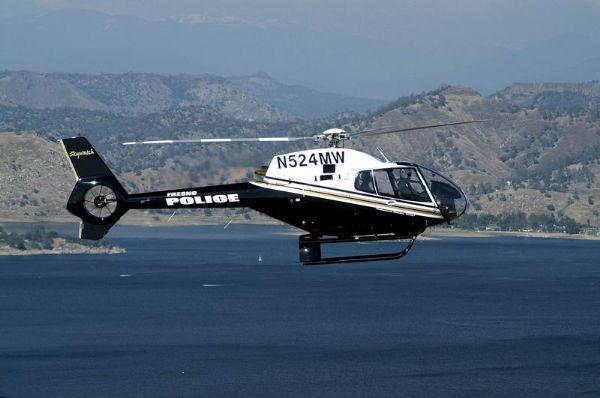
Fresno Police Department — Photo: Defiant15E at English Wikipedia — Public domain, via Wikimedia Commons
California Lawmakers Push New Limits on Police License Plate Cameras After Federal Access Concerns
California police departments, including Fresno’s, rely on thousands of automated license plate readers mounted along streets and on patrol cars — cameras that scan every passing car, read the plate, and check it against databases of stolen vehicles or wanted people. The cameras have helped solve murders and recover stolen cars. They’ve also been misused by officers to stalk people, shared illegally with federal authorities, and accessed by out-of-state police searching for abortion patients.
Now, state lawmakers are trying again to rein in how police use the technology. Senate Bill 1013, authored by Riverside Democratic Sen. Sabrina Cervantes, would limit how long police can keep the data, who can access it, and whether it gets shared beyond California’s borders. At least 39 police agencies and officers’ unions oppose the bill — the same fight that led Governor Newsom to veto a similar measure last year.
A Flock Safety camera is mounted on Olive Avenue in Fresno as of February 2026, placing the city squarely in the middle of this statewide debate.

“This bill is about one simple principle: Protecting the privacy and safety of Californians while ensuring law enforcement tools are used responsibly before it’s too late,” Cervantes told the Assembly privacy committee last month.
The technology works: At least 230 California police and sheriffs’ departments use license plate readers. Berkeley Police installed 52 Flock cameras last year and saw their robbery-solving rate climb from 34% to 49%. Tustin Police Chief Sean Thuilliez said the city’s 102 readers helped clear an innocent man and identify a murder suspect within one weekend after a woman was shot and killed in May. In that case, detectives used the cameras to rule out the victim’s ex-husband and arrest her former boyfriend at the Mexico border. He’s now charged with first-degree murder.
But the cameras also collect data on everyone who drives past — not just suspects. California officers have repeatedly broken an 11-year-old state law prohibiting them from sharing that data with federal authorities or out-of-state police. Last year, 404 Media reported that a Texas cop searched a national license plate database trying to locate a woman who had an abortion, raising fears that conservative states criminalizing abortion are accessing California’s plate data to hunt down patients or providers.
Flock Safety, the most prominent camera company, ran a pilot program that gave federal authorities access to local license plate databases — something police departments say they learned about only after the fact. “(Police departments) learned after the fact, like our advocates did,” said Tracy Rosenberg of Oakland Privacy, a supporter of the bill. “And we all said, ‘What the…’ You know, pick your four-letter word.”
Flock Safety says on its website that it doesn’t work with immigration agencies, stopped its federal pilot programs, and now disables federal data-sharing by default. “ICE does not have direct access to Flock cameras, systems or data,” the company wrote. Flock did not respond to CalMatters’ request for an interview.
The Breakdown
- SB 1013 would generally limit police to keeping license plate data for 30 days, unless it’s part of an active investigation or a search for missing people.
- The bill would ban police from signing contracts with camera companies that give federal or out-of-state police default access to the databases.
- It would add training requirements, tracking of who searches the data, and limits on who can access it.
- Last year’s version, which Newsom vetoed, would have required police to delete data within 60 days and mandated state audits with no budget to pay for them. This year’s bill makes the audit program contingent on future funding and allows data retention for missing-persons cases — addressing two of Newsom’s stated concerns.
- The bill has advanced through the Legislature with only Republicans voting against it and is now pending before the Assembly Appropriations Committee. Newsom’s press office declined to say whether he has a position on it.
What This Means for You
If you drive in Fresno — past that Flock camera on Olive Avenue, or anywhere else in the city where police have installed readers — this bill would determine how long the record of your movements stays in a database, who can search it, and whether it ends up in the hands of federal agents or out-of-state police you never consented to share it with. The Legislature’s vote on SB 1013, and Newsom’s decision whether to sign or veto it, will set the rules for how much surveillance comes with simply driving to work, the grocery store, or your child’s school.
For parents specifically, the question is whether you want a permanent record of every time your car passed a camera — where you went, when, how often — kept indefinitely and searchable by agencies you don’t know about, or whether that data should have an expiration date and stricter limits on who sees it. This is the trade-off lawmakers are deciding: more investigative power for police, or more privacy for families going about their day.
What to Watch
The opposing coalitions tell you what’s actually at stake here. Police chiefs and officers’ unions say the technology solves crimes — and they’re right, the numbers back that up. Privacy advocates on both the left and the right say it creates a surveillance net over every driver in California, with a documented history of misuse and illegal sharing — and they’re right too, the violations are on the record.
The real question this bill forces into the open: Should police be able to keep a searchable record of everywhere you drove, indefinitely, just because the technology makes it possible? A 30-day limit (this bill’s standard) assumes that if police haven’t connected your car to an active case within a month, the public’s interest in not being surveilled forever outweighs the possibility they might want that data later. Keeping it indefinitely (the current practice in many departments) assumes the opposite — that investigative flexibility always trumps privacy, even for the overwhelming majority of people who are never suspects in anything.
Newsom vetoed the 60-day version last year, citing concerns about solving cold cases and finding missing people. This year’s bill tries to address that by carving out exceptions for both — but it still forces departments to actually justify keeping the data rather than just storing everyone’s movements as a matter of course. Whether that’s a reasonable check on police power or an unacceptable barrier to solving crimes is the question Newsom will have to answer again. His decision last time suggests where he’ll land, but the documented misuse — officers stalking people, illegal federal sharing, out-of-state abortion searches — has only gotten more specific since then.
Meanwhile, U.S. Rep. Thomas Massie, a Kentucky Republican, says he’ll sponsor a federal bill to withhold money from cities and police departments that deploy Flock and similar cameras. “Don’t Flock me,” reads the meme he posted — a riff on the yellow Gadsden flag’s “Don’t Tread on Me” snake, this time wrapped around a camera. Privacy advocates and libertarian-leaning Republicans don’t agree on much, but they agree on this: ubiquitous surveillance, even in the name of public safety, crosses a line. Tracy Rosenberg of Oakland Privacy put it plainly: “We as human beings also need some camera-free space. We don’t want to be on camera every minute of every single day.”