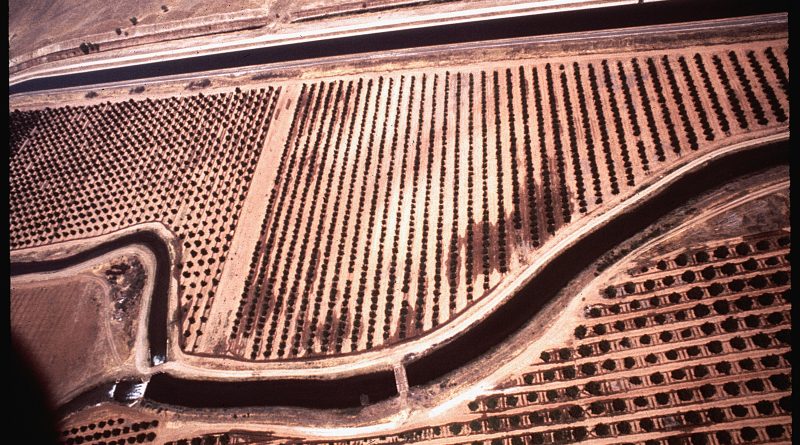
Fresno irrigation canal — Photo: Gene Daniels — Public domain, via Wikimedia Commons
As California Drafts AI Rules, Central Valley Farmers Say Over-Regulation Could Threaten Crop Yields and Water Savings
State legislators in Sacramento are writing the rules that will govern how artificial intelligence can be used across California — including on farms in the Central Valley, where AI is already cutting water use by up to 20%, reducing chemical applications by 99%, and helping growers navigate strict groundwater restrictions.
The rules being drafted will determine everything from access to data and technology infrastructure to how food moves from farms to consumers, according to Jason Giannelli, a fourth-generation Kern County farmer and chairman of the California Water Alliance, writing in an opinion piece.
“Sacramento should not move forward with broad AI laws that will have unintended consequences on California’s agriculture industry,” Giannelli wrote, arguing that excessive regulation could undermine affordability and sustainability for the state’s food supply.

Central Valley agriculture is already embedding AI into operations. Automatic spray rigs are cutting chemical use by 99%. Semi-automated platforms with smart cameras navigate orchards to collect data.
The AI Institute for Next Generation Food Systems at UC Davis, established with U.S. Department of Agriculture funding, has found that AI can help cut losses in California’s 13-million-ton tomato harvest, breed climate-resilient crop varieties, and improve quality screening in processing plants.
For water conservation — a critical issue in the Central Valley — UC Davis engineers are combining field sensors, biophysical models, and AI to recommend optimal irrigation schedules for individual sections of an orchard. Testing by the Irrigation Association and the International Center for Water Technology at Fresno State has shown that smart, weather-responsive irrigation controllers can save up to 20% more water than traditional systems.
“Every acre-foot saved is crucial for farms navigating strict groundwater restrictions,” Giannelli wrote.
UC Davis research on almond orchards shows how remote sensing can help growers apply fertilizer more precisely, protecting groundwater and cutting input costs at the same time. AI tools also enable farmers to anticipate threats including water shortages, disease, and extreme weather, and guide decisions about what and when to plant and harvest.
The new regional supercomputing center at Fresno State will help make these technologies more accessible to growers, food processors, manufacturers, researchers, and startups, providing the computing resources and technical support needed to test and deploy AI applications.
But Giannelli warned that “piling on excessive AI regulations, costly reporting requirements, new liability exposure and infrastructure restrictions” would undermine the goal of a more affordable, more sustainable food supply. He noted that Cal Poly economists working with Western Growers found that regulatory costs for specialty crop growers have surged from $109 per acre in 2005 to roughly $1,600 per acre in 2024.
The Breakdown
- State legislators are drafting rules governing AI use in California, including in agriculture — covering data access, technology infrastructure, and food supply chains.
- Central Valley farmers are already using AI for precision farming: cutting chemical use by 99%, reducing water use by up to 20%, and applying fertilizer more precisely to protect groundwater.
- The AI Institute at UC Davis (USDA-funded) and the new supercomputing center at Fresno State are helping make these tools accessible to growers and food processors.
- Regulatory costs for specialty crop growers have jumped from $109 per acre in 2005 to roughly $1,600 per acre in 2024, according to Cal Poly economists.
What This Means for You
The rules state legislators write now will determine whether Central Valley farmers can keep using AI tools that are already cutting water use and input costs — or whether new reporting requirements, liability exposure, and infrastructure restrictions will make those tools too expensive or risky to deploy.
Water conservation in the Central Valley is a vital priority, and regulatory costs for specialty crop growers have increased roughly 14-fold over the past two decades, from $109 per acre in 2005 to roughly $1,600 per acre in 2024. When you vote for state legislators, you’re voting for the people who will decide how AI regulation affects California’s agriculture industry.
What to Watch
The stated benefit of AI in agriculture — water savings, lower chemical use, more precise fertilizer application — is real, and the stated threat of over-regulation adding costs is real. But whose interests are actually driving the policy debate in Sacramento right now?
Agricultural technology companies stand to profit from AI adoption; large-scale growers have the capital to invest in smart irrigation controllers and remote sensing, while smaller operations may not. Is the push for AI-friendly regulation coming from family farmers trying to save water, or from agribusiness and tech firms trying to lock in a regulatory environment that favors consolidation and high-tech operations over traditional farming?
And what about the workers whose jobs are being displaced by semi-automated platforms and smart cameras — are they part of this conversation at all, or is the efficiency gain being measured only in water saved and costs cut, not in livelihoods lost? The opinion piece frames this as farmers versus Sacramento bureaucracy, but the real question may be which farmers, and which companies, benefit most from the rules being written right now.