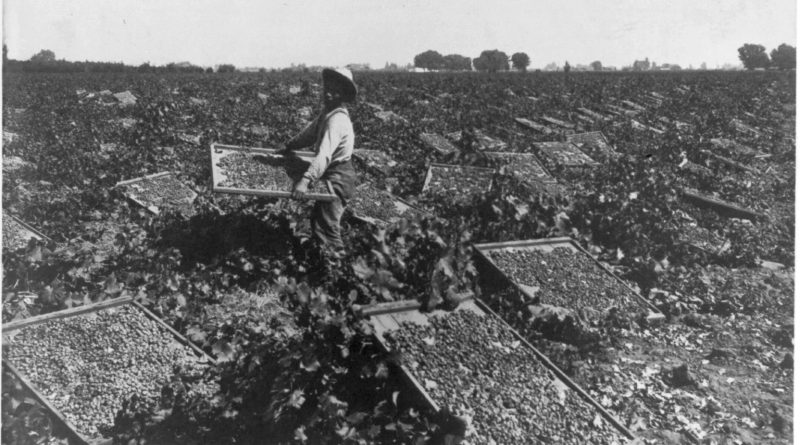
Fresno County agriculture — Photo: Miscellaneous Items in High Demand, PPOC, Library of Congress — Public domain, via Wikimedia Commons
Governor Candidates Clash Over Water, Regulations at Fresno Debate
Seven people running for governor spent two hours on stage at Fresno State last week promising to fix California agriculture. They agreed on exactly one thing: the system is broken. What to do about it? That’s where it got ugly.
The Maddy Institute and more than 30 farm groups hosted the forum. Water dominated. So did regulation. Energy costs came up. Every candidate pitched directly to growers, farmworkers, and rural communities — then delivered completely opposite plans.
Democrat Xavier Becerra opened by calling it a crisis. “The very people who pick the crops that feed us can’t afford to go to the grocery store and buy what they need,” he said. He promised to declare a state of emergency to speed housing construction and freeze utility and insurance rates while the state investigates what’s driving prices up.
On water, Becerra said he’d negotiate with federal officials instead of suing them — a shift from his time as attorney general, when he sued the first Trump administration more than 100 times. “We cannot be engaged in a federal-state fight when you’ve got farmers who have to every day worry about where they’re going to get their water,” he said.
Republican Riverside County Sheriff Chad Bianco went the other direction. “Cost of living is predominantly because of regulations and taxes — end of story,” he said. He promised to eliminate regulations “on Day 1 through 10,” calling them tools “meant to control you and put you out of business.”
Bianco rejected the idea of working with the Democratic legislature. “The California Legislature has broken California. Why would I work with them?” he said. “They better figure out how to work with me, because I’m going to expose what they’ve been doing for the last 20 years.”
Republican Steve Hilton, the former Fox News host now backed by President Trump, delivered the sharpest attack. “Every single Democrat on this stage today should start with an apology for what their party has done to this area and this industry,” he said, citing what he called stolen water, regulation increases, and farmworker pay cuts.
Hilton proposed replacing vehicle registration fees — which can hit $1,000 for a new car — with a flat $71 fee. He also called for rolling back regulations he says are driving up grocery prices and pushing farms out of California. On water, he said the state needs to “abandon the climate dogma” and pledged to “delete the biological assessments” at the State Water Resources Control Board.
Democrats on stage didn’t defend the regulatory status quo. San Jose Mayor Matt Mahan called out the California Environmental Quality Act directly, saying recent reforms haven’t gone far enough. “We poked a lot of holes in it, but it still leaves open far too much litigation, too much process, hundreds of pages of paperwork, years to comply,” he said.
Mahan said the only way to build water storage, energy grid upgrades, or large infrastructure is to “fundamentally reform CEQA.” He argued current laws have made it “difficult for us to do anything in the state.”
Former Rep. Katie Porter acknowledged the regulatory load has become unsustainable but emphasized accountability. “The touchstone ought to be getting paid what you’re promised and being safe in the workplace,” she said. “If we can’t show that a law is doing one of those two things, it should be up on the chopping block potentially.”
Porter also pointed to California’s agricultural overtime law as a failure. She cited a UC Berkeley study showing farmworkers are earning less since the regulation took effect. “That’s a regulation that — however well intended it may or may not have been — does not work,” she said, adding that farm activity is moving to Arizona and across the border because of it.
Former Los Angeles Mayor Antonio Villaraigosa called for a moratorium on farming regulations and California Air Resources Board regulations. “This is an existential election for these communities, because they’re dying on the vine in no small part because of that overregulated environment they have to operate in,” he told Agri-Pulse.
Water policy split the stage. Bianco called for “massive dams.” Hilton said environmental policy itself is the barrier. Democrats pushed for a mix of infrastructure, efficiency improvements, and better coordination with farmers — generally agreeing on streamlining permits for water projects, building on Gov. Gavin Newsom’s legislative package that moved the Sites Reservoir project forward.
The proposed Delta Conveyance Project — Newsom’s plan to tunnel water through the Sacramento-San Joaquin Delta — drew skepticism across the board. Hilton called it “a completely ridiculous project,” comparing it to high-speed rail. Porter said the state can’t “spend 20 years talking about the Delta tunnel and not doing the 100 shuffle-ready water projects that could have improved the situation already.” Mahan said it’s “not something I’m for today,” despite backing it earlier in his career.
Mahan described compliance costs for farms increasing 13 times over the past two decades due to “layer after layer” of monitoring, reporting, and permits. He said the governor’s most powerful tool is appointment power over the 3,000 people who run state agencies. “I will get them out from behind their desks in Sacramento, down here on the ground level to reform our regulatory environment to make it work,” he said.
Two candidates — billionaire climate investor Tom Steyer and Rep. Eric Swalwell — skipped the forum. Steyer held a separate town hall in Fresno on Tuesday. Swalwell’s campaign website says he would stabilize property insurance “by shifting climate-disaster costs from homeowners to corporate polluters” and pledges to end utility rate hikes.
The Breakdown
- The Maddy Institute and more than 30 agriculture groups hosted the forum at Fresno State to press gubernatorial candidates on affordability, water, and agricultural policy.
- Republican candidates promised sweeping deregulation — Bianco said he’d eliminate regulations in his first ten days, Hilton proposed a flat $71 vehicle registration fee to replace fees that can exceed $1,000.
- Democratic candidates acknowledged the regulatory system is straining agriculture but emphasized targeted reforms over wholesale rollback — Mahan called for fundamental CEQA reform, Porter said regulations that don’t ensure pay or safety should be “on the chopping block.”
- Water policy divided the stage: Republicans pushed for massive dam construction and eliminating environmental restrictions, Democrats emphasized infrastructure plus efficiency and farmer coordination.
- The Delta Conveyance Project drew opposition or skepticism from candidates across parties.
- Porter cited a UC Berkeley study showing California’s agricultural overtime law is causing farmworkers to earn less, not more, since it took effect.
What This Means for You
You’re voting for governor in 2026. This forum laid out where the candidates actually stand on water, regulation, and the cost of doing business in agriculture — issues that shape everything from grocery prices to whether farms stay in California or leave.
The divide isn’t subtle. Republicans promise to gut regulations and build dams. Democrats promise to reform the system without dismantling it. Which approach you think will work — or which risks you’re willing to take — is the call you’ll make at the ballot box.
Water is the clearest test case. Every candidate agrees the state needs more of it. Whether that means eliminating environmental protections entirely, building massive new dams, reforming the permit process, or all of the above depends on who wins. So does whether the state keeps suing the federal government over water or sits down to negotiate.
What You Can Do
You can register to vote or check your registration status at registertovote.ca.gov.
What to Watch
Trump’s endorsement of Hilton likely consolidates Republican voters in the top-two primary, avoiding a scenario where two Republicans split the vote and both advance. That means the general election is more likely to be a Democrat-versus-Republican contest rather than an intra-party fight.
Porter’s acknowledgment that the agricultural overtime law is failing farmworkers — backed by a UC Berkeley study showing they’re earning less since it took effect — raises a real question: when does a party admit a signature policy didn’t work? That study exists. The candidates who supported the law now have to explain whether they’d keep it, fix it, or scrap it. Watch whether that conversation happens before the primary or gets buried until after.
Becerra’s promise to negotiate with federal officials on water instead of suing them is a reversal from his attorney general tenure. Whether that’s a genuine shift or campaign positioning becomes clear the first time there’s a conflict. Agriculture gets caught in the middle either way.
Villaraigosa called this “an existential election” for farming communities. He’s not exaggerating the stakes — he’s describing what happens when the cost structure makes it cheaper to farm anywhere but California. The question isn’t whether the regulatory system needs reform. Every candidate on that stage agrees it does. The question is whether the state reforms it or loses the industry instead.