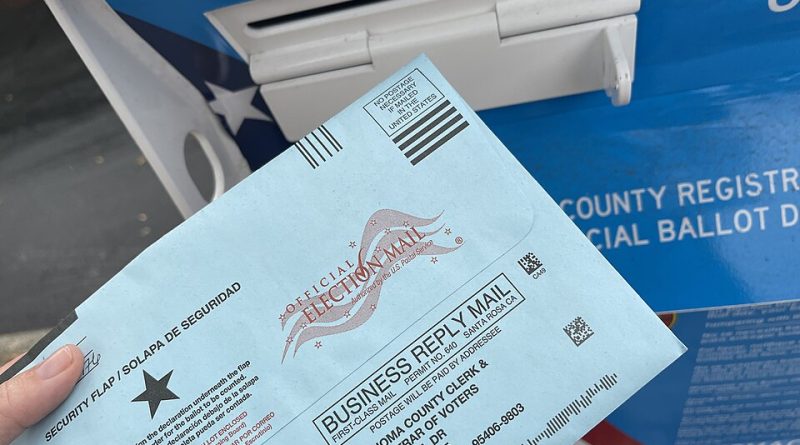
California Midterm Elections: What's on Your Ballot November 3 — Photo: Missvain — CC BY 4.0, via Wikimedia Commons
California Midterm Elections: What’s on Your Ballot November 3
California voters head to the polls Tuesday, November 3, to decide races that could flip control of the U.S. House of Representatives and to vote on contentious ballot measures including a billionaire tax and mandatory voter ID.
Polls open at 7am and close at 8pm. Mail ballots must be postmarked by election day.
The stakes are national. Republicans hold a four-seat majority in the House. Several California races — reshaped by new district maps voters approved last year in Proposition 50 — could determine which party controls Congress.

The Breakdown
- Proposition 50’s Impact: California voters approved this 2025 ballot measure to temporarily suspend the state’s nonpartisan redistricting commission and redraw congressional maps to make Republican strongholds competitive for Democrats. The measure was pitched as retaliation after seven Republican-led states redrew their own maps to secure GOP seats. It expires in 2030.
- Central Valley Race (22nd District): Republican David Valadao faces Democratic challenger Randy Villegas in what is now one of the state’s most contentious races after redistricting. Villegas is hammering Valadao on cost of living, healthcare, and Trump’s immigration crackdowns — a key issue for the area’s immigrant farm-working communities.
- Governor’s Race: Democrat Xavier Becerra leads Republican Steve Hilton by 27 points, according to a recent Emerson poll. Hilton is attacking Becerra over crime, homelessness, and California’s $5.95-per-gallon gas prices (national average: $4.22). Becerra is tying Hilton to Trump, who is deeply unpopular in California.
- Proposition 40 — Billionaire Tax: A one-time tax on about 200 of California’s wealthiest residents to fund healthcare and education. Opponents have spent $152 million to defeat it; supporters raised $33 million. Google cofounder Sergey Brin gave $102 million against it. Governor Newsom, Becerra, and Hilton all oppose it. Senator Bernie Sanders and Rep. Ro Khanna support it.
- Propositions 41 and 42: These measures would nullify Proposition 40 if voters approve them.
- Proposition 39 — Voter ID: Would require government-issued ID to vote. Supporters claim it counters fraud; studies show fraudulent voting is nearly nonexistent in the U.S. Critics say ID requirements create obstacles for citizens who don’t hold driver’s licenses or other government documents, and that safeguards are already in place.
What This Means for You
Your vote on November 3 decides who represents the Central Valley’s 22nd District in Congress — a race that could tip the balance of the entire House. It also decides whether California’s wealthiest residents pay a one-time tax for schools and healthcare, and whether you’ll need a government-issued ID to vote in future elections.
The congressional map you’re voting under exists because California voters approved Proposition 50 last year — a partisan redistricting plan Governor Newsom pitched as necessary retaliation. That decision made your district more competitive and made this election matter more nationally.
What You Can Do
Vote by 8pm on Tuesday, November 3, or postmark your mail ballot by that date. Polls are open 7am to 8pm.
What to Watch
Who actually benefits from Proposition 50’s redrawn maps? Democrats say it levels the playing field after Republican states gerrymandered their own districts. Republicans call it the same partisan manipulation California claims to oppose. Voters approved it last year — the measure suspends the nonpartisan process until 2030.
On Proposition 40, follow the money. Opponents outspent supporters approximately five-to-one, with a single billionaire — Sergey Brin — putting up more than the entire “yes” campaign raised. When the wealthiest 200 people in California can spend $152 million to defeat a tax on themselves, and the governor who proposed redistricting as “necessary retaliation” joins them in opposing it, whose interests does that serve?
Proposition 39 raises a simpler question: do you trust the safeguards already in place, or do you want an ID requirement that studies show stops almost no fraud but does stop some citizens from voting? The material doesn’t say which citizens are most likely to lack ID — that’s the data worth demanding before you decide.