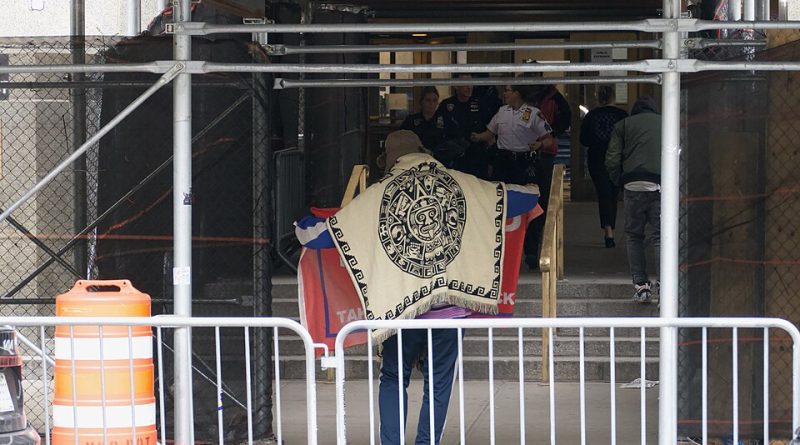
Federal Voter-Fraud Charges Target 28 California Residents; Defendants, Families Say Arrests Were Confusing, Excessive — Photo: SWinxy — CC BY-SA 4.0, via Wikimedia Commons
Federal Voter-Fraud Charges Target 28 California Residents; Defendants, Families Say Arrests Were Confusing, Excessive
Federal authorities charged 28 lawful permanent residents across California on Monday with voter-fraud crimes as part of what the Trump administration called “Operation Protect the Vote” — a statewide sweep the Justice Department said was necessary to root out noncitizen voting ahead of next month’s midterm elections.
The charges include fraudulent voter registration and making false statements on naturalization applications. At least four of the 28 people charged are from San Diego County, according to federal officials.
At the federal courthouse in downtown Los Angeles late Monday, several of those arrested said they had no memory of registering to vote, as prosecutors accused them of doing. Ana Domínguez, 60, a Long Beach resident and native of El Salvador, is charged with fraudulently registering to vote in July 2006 and lying about it in her March 2026 naturalization paperwork. She said she has no recollection of registering and has never voted.
“If I would have committed all those frauds about voting registration and whatever they’re saying, since 2006, wouldn’t you imagine that I would have been voting all these other years?” Domínguez said after her release. Federal authorities’ own presentation alleged that 23 of the 28 people charged had voted; Domínguez was not one of them.
Another defendant — Omar Muñoz, 72, a Belize-born lawful permanent resident arrested at his Commerce home before dawn — is charged with fraudulently registering in September 2019, voting in 2020, twice in 2022, and again in 2024, plus lying on his citizenship application. His arrest, captured by photographers in images transmitted around the world, involved helicopters, at least eight vehicles, and agents from multiple agencies descending on his residential cul-de-sac in full tactical gear.
Muñoz’s wife, Esmeralda, 70, called it “a show for them,” telling reporters the government arrived with camera crews and news helicopters. “Seriously? All these people just to come for an elderly person,” she said she told a federal agent. Muñoz, who said he came to the U.S. legally in 1975 and is recovering from recent surgeries including cervical surgery and a double knee replacement, told reporters: “They could have sent me a letter saying report to the court.”
His daughter, Lliani Orantes, a nurse born in the U.S., said her father was pulled out of the family home “like he was a dog” as part of what she described as “a political ploy, an example used for the operation.” She said the family is trying to determine whether Muñoz could have been confused with younger relatives of the same name, including a U.S.-born son who is a registered voter.
José Antonio Bañuelos-Díaz, 42, a Mexican national and West Adams resident, appeared in court wearing a reflective vest with the name of a landscaping company, blue jeans, and boots with the American flag on them. He had been on his way to work when he was arrested.
All four defendants who appeared in court Monday were released on personal recognizance without supervision and are set for a preliminary hearing November 9. In every case, the federal prosecutor said the government was not seeking detention. The defendants spoke only to acknowledge they reviewed and understood the charges; their deputy federal public defenders did not respond to a request for comment.
Trent McCotter, the acting deputy attorney general at the Justice Department, said during a news conference in Los Angeles that “this causes real damage to real elections and real damage to American citizens.” Bill Essayli, the top federal prosecutor in Los Angeles, said the cases represent strong federal work to ensure noncitizens aren’t negating the votes of eligible U.S. voters — a problem he said California officials have refused to recognize. Essayli dismissed the idea that those charged may have been unaware of what they were doing: “You have to go out of your way to register to vote; it’s not something that just happens to you.”
California Attorney General Rob Bonta said voting illegally is wrong and “one-off, isolated incidents” of it should be prosecuted, but denied there is widespread voter fraud in the state. He called 28 cases out of 23 million registered voters in California “a drop in the bucket” and said he’d be watching how the cases play out in court. “We’ll see what the facts show, and whether they’ll have to drop charges or whether they’ll be able to prosecute,” he said.
Governor Gavin Newsom posted on X seeking to undermine the Justice Department’s announcement, writing: “WOW. First Assistant Bill just admitted in front of the press that not all of those arrested today may have voted.”
Rick Hasen, director of the Safeguarding Democracy Project at UCLA School of Law, wrote in a blog post that many instances of noncitizens registering to vote are a result of administrative error or confusion on the part of the immigrant, not intentional criminality. “We know from past experience that sometimes people register to vote accidentally, as when there is a mistake at the DMV,” he wrote. “There is only a crime if the government can prove willful violations of federal law.”
The arrests are part of a broader Trump administration effort. The Justice Department said it has charged 113 people in 20 states with illegal voting and illegal registration offenses over the last seven weeks. The department also sued California last week to prevent it from counting mail ballots from people the federal government identified as “likely” noncitizens — a list of 20,000 names on a password-protected thumb drive given to California officials with a 48-hour deadline to review. California Secretary of State Shirley Weber said the administration provided no evidence to support the claim those individuals are noncitizens.
The Justice Department also sent a letter Friday warning that state election officials who knowingly process ballots cast by noncitizen voters risk becoming “aiders and abettors to a federal crime.” The letter, from McCotter, was addressed to the Los Angeles County Counsel’s office and copied to Weber and Los Angeles County Registrar Dean Logan. Logan said his office is focused on conducting a fair and secure election and that “it is best for this to be addressed in court.”
Voter registration and public records showed at least two individuals who shared the names of defendants were registered to vote as Republicans, two as Democrats, two as supporters of the Peace and Freedom Party, and three with no party preference chosen. Esmeralda Muñoz said that when her family talks politics, Omar has been a vociferous supporter of Trump.
Domínguez said she’s been a lawful permanent resident since the late 1980s and applied for U.S. citizenship this year. As part of the application process, she told an immigration agent that the only people registered to vote in her household were her husband, who previously became a U.S. citizen, and her daughter, who was born in the country. She said she has been waiting on the citizenship ceremony, “but it never came through.” Instead, she was arrested Monday when she was about to leave for work as an administrative assistant. She showed bruises on her wrists from the handcuffs. “I never, ever in my entire life … thought this would ever happen to me,” she said.
The Breakdown
- The Justice Department charged 28 lawful permanent residents in California with fraudulent voter registration and making false statements on naturalization applications. At least four are from San Diego County.
- The charges are part of “Operation Protect the Vote,” a Trump administration sweep targeting alleged noncitizen voting ahead of the November 3 midterm elections. The Justice Department says it has charged 113 people in 20 states over the last seven weeks.
- Several defendants said they have no memory of registering to vote. One defendant’s family said they are investigating whether he was confused with a younger relative of the same name who is a U.S. citizen and registered voter.
- The arrests involved significant federal resources — helicopters, multiple vehicles, tactical gear — and were coordinated with camera crews and news media.
- All four defendants who appeared in court Monday were released without detention or supervision and are scheduled for a preliminary hearing November 9.
- The Justice Department also sued California last week to block the state from counting mail ballots from 20,000 people the federal government says are “likely” noncitizens, and warned election officials they could be prosecuted as “aiders and abettors” if they knowingly process ballots from noncitizens.
- California officials say the state has 23 million registered voters, making 28 charges “a drop in the bucket,” and that the federal government has provided no evidence to support its claims of widespread fraud.
What This Means for You
Federal authorities have charged 28 lawful permanent residents with voter-fraud crimes, while several defendants say they have no memory of registering to vote and at least one family is investigating whether their relative was confused with a younger person of the same name. Rick Hasen, director of the Safeguarding Democracy Project at UCLA School of Law, wrote that many instances of noncitizens registering to vote are a result of administrative error or confusion, and “there is only a crime if the government can prove willful violations of federal law.” The cases will be decided in court.
What to Watch
The Justice Department’s claims rest on proof that each defendant knowingly and willfully violated the law — not that a DMV error or confusion put their name on a voter roll. Rick Hasen, the UCLA election-law expert, said there is only a crime “if the government can prove willful violations of federal law.” The material does not state what evidence prosecutors have beyond registration records and naturalization paperwork — no testimony from the defendants admitting intent, no documentation of them actually voting in person, no record of them checking a citizenship box they knew was false. What would confirm the government’s case: witness testimony, signed documents, or other proof the defendants understood they were not citizens and registered anyway. What would undercut it: DMV records showing automatic registration, evidence of language barriers or confusion, or records showing the defendants never voted.
The federal government gave California a 48-hour deadline to review a password-protected thumb drive with 20,000 names it says are likely noncitizens, then sued when the state didn’t comply. California says the administration provided no evidence those people are actually noncitizens. The Justice Department is asking a court to force California to set aside those ballots and verify citizenship status before counting them — in time for the November 3 election, 18 days away. What would settle this: the actual citizenship records behind the 20,000 names, which the material does not state the Justice Department has made public or verified independently.
The government deployed helicopters, multiple agencies, tactical gear, camera crews, and news helicopters to arrest a 72-year-old man recovering from surgeries including cervical surgery and a double knee replacement for an alleged voter-registration offense — an action his family called “a show” and “a political ploy.” Bill Essayli, the top federal prosecutor, said “you have to go out of your way to register to vote; it’s not something that just happens to you,” but Rick Hasen wrote that DMV errors are a known cause of accidental registration. The material does not state whether the Justice Department investigated each defendant’s case individually before the arrests or relied on database matches. What would show whether these cases are solid or rushed: the actual evidence files, including whether prosecutors have proof of intent for each defendant or are working backward from registration records.
One defendant’s family is investigating whether he was confused with a younger U.S.-born relative of the same name who is a registered voter. The material does not state whether the Justice Department checked for name overlaps, birthdate mismatches, or other identity issues before filing charges. What would rule that out: documentation showing the registration record matches the defendant’s exact birthdate, address history, and Social Security number, not just a shared name.