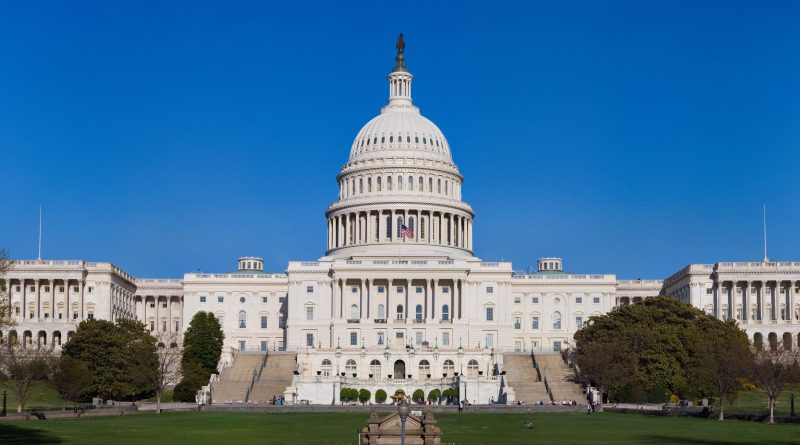
United States Capitol building — Photo: Noclip — Public domain, via Wikimedia Commons
Federal Officials Threaten States With Fines, Prison Over Voter-Roll Access
Homeland Security Secretary Markwayne Mullin warned state election officials on Friday that they could face fines, loss of federal grant funding, and even prison time if they refuse to hand over voter registration data to the federal government or comply with new election-security mandates ahead of November’s midterm elections.
Speaking from the White House complex one day after President Donald Trump’s primetime address on election security, Mullin said the Department of Homeland Security had identified what it claims are more than 250,000 noncitizens registered to vote across California, New Jersey, Nevada, and Pennsylvania. He did not explain how DHS arrived at those figures or provide a state-by-state breakdown, saying only that the department checked public voter records.
“If these states want a grant and they want to be reimbursed to run federal elections, they’re going to have to implement security [measures],” Mullin said. “We need to make sure that individuals who are legally able to vote are voting.”
He added that if election officials ignore federal directives after being given “the information they need to secure their elections,” they “can also be held accountable by fines, by penalties, and even, depending on how far it goes, prison time.”
Mullin urged states to participate in DHS’s SAVE program, a federal database historically used to verify immigration benefits but recently overhauled by the Trump administration to check voter rolls for noncitizens. A federal judge blocked the expanded use of that database earlier this year over concerns about privacy law violations and the risk of wrongly purging eligible voters — the system has been shown to flag newly naturalized citizens as noncitizens.
The Justice Department has already sued more than two dozen states to compel them to turn over voter files, but courts have thrown out those lawsuits across the board, ruling that DOJ lacks a compelling reason for the data. Mullin acknowledged the limits, saying “I obviously can’t force the states,” and said DHS would instead rely on public records requests to obtain voter roll information.
California Gov. Gavin Newsom responded to Mullin’s threats on social media: “Try us. California has free, fair, and secure elections and we will fight for them.”
Newsom’s office said it had “no idea” where DHS’s claim about California came from. Sen. Alex Padilla (D-Calif.) questioned the department’s methods and said the allegations were “built on sham numbers that no one should trust,” adding that DHS’s lack of transparency “raises serious questions about whether it violated state law to obtain California’s voter registration records and federal privacy law.”
Mullin also threatened noncitizens with prosecution if DHS determines they voted. “If you’re illegal and attempted to vote, or you tried to vote illegally for someone else, we will find you, and we will charge you,” he said, citing penalties of up to five years in prison and $250,000 in fines.
Research shows noncitizen voting is exceedingly rare. A study of the 2016 election by the Brennan Center for Justice found officials referred about 30 cases of suspected noncitizen voting for investigation or prosecution. A 2024 review by the American Immigration Council of the right-wing Heritage Foundation’s database turned up 68 cases of noncitizen voting since the 1980s. An analysis by the Bipartisan Policy Center of elections between 1999 and 2023 found only 77 instances of noncitizen voting, each of which was investigated by authorities.
Election security experts called Mullin’s threats hollow. David Becker, executive director of the Center for Election Innovation and Research, said there is no significant pool of federal grant money appropriated, “so this threat has no teeth for any state. None of them are expecting any significant federal funds for elections.” He added that 15 courts — six of whose judges were appointed by Trump — have confirmed that the federal government cannot legally demand access to states’ sensitive voter data.
Brendan Fischer, director of strategic investigations at the Campaign Legal Center, said there is “plenty of reason to be suspicious of the claims from the administration” and “every reason for voters to have confidence in our elections.”
The Breakdown
- DHS claims it found more than 250,000 noncitizens on voter rolls in California, New Jersey, Nevada, and Pennsylvania by checking public records, but has not explained its methodology or provided a breakdown by state.
- Mullin threatened to withhold federal election grant funding from states that don’t comply with new election-security mandates, including scrubbing voter rolls through DHS’s SAVE database and updating election systems.
- He warned that state election officials who refuse to comply could face fines, penalties, and prison time.
- The SAVE database’s expanded use for checking voter rolls was blocked by a federal judge over privacy violations and concerns that it wrongly flags naturalized citizens as noncitizens.
- More than a dozen courts have ruled against the Justice Department’s demand for state voter roll data, finding the federal government is not entitled to it under federal law.
- Multiple studies have found noncitizen voting is extremely rare — a review of elections between 1999 and 2023 found only 77 instances, each investigated by authorities.
What This Means for You
The administration is claiming widespread noncitizen voting exists, but research shows it’s exceedingly rare, and courts have repeatedly ruled the federal government doesn’t have the legal authority to force states to hand over voter data.
Meanwhile, political candidates, scholars and journalistic operations can legally buy that very same information at state and county discretion.
California voters will cast ballots in November’s midterm elections under systems this administration is publicly challenging.
If you’re registered to vote in California or any other state targeted by these federal demands, the threat of wrongful purges — removing eligible voters from the rolls based on a database that election officials say is error-prone — is not hypothetical.
Past uses of this system have flagged naturalized citizens as noncitizens.
What You Can Do
What do you think? Should the requested voter information be shared? It is it an overreach? Leave a comment below and let us know. And make sure to share your thoughts with state and county officials.
What to Watch
The administration is claiming it found more than 250,000 noncitizens on voter rolls in four states, but has not made its methodology public. Election officials in California say they have no idea where the claim came from.
The system DHS wants states to use — the SAVE database — has been blocked by a federal judge over privacy violations and a documented pattern of wrongly flagging naturalized citizens as noncitizens.
Noncitizen voting is documented to be exceedingly rare — 77 cases in nearly 25 years of elections, according to one bipartisan study.
The administration is threatening to withhold federal grant money from states that don’t comply, but election experts say there is no significant pool of federal election funding appropriated, meaning the threat may have no teeth. Fifteen courts have already ruled the federal government cannot legally demand voter roll data.
If the administration tries to follow through on these threats, expect more lawsuits — and more rulings against the federal government.