
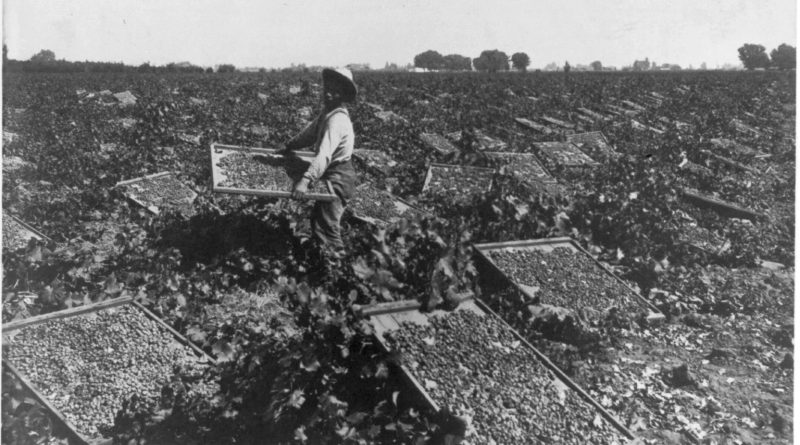
Fresno County agriculture — Photo: Miscellaneous Items in High Demand, PPOC, Library of Congress — Public domain, via Wikimedia Commons
Valley Farmers Push USMCA Extension as $8.2B in Exports Hang in Balance
Central Valley growers are looking at a bottom line that hinges on what happens next with the United States-Mexico-Canada Agreement. A Tuesday roundtable at the Fresno County Farm Bureau — featuring Rep. Jim Costa, California Food and Agriculture Secretary Karen Ross, and producers representing table grapes, almonds, pistachios, walnuts, citrus, dairy, and processed tomatoes — made the case for extending and strengthening the trade pact as its six-year Joint Review moves forward.
The numbers frame the stakes: California shipped $8.2 billion in agricultural products to Canada and Mexico in 2025 under USMCA’s tariff-free structure, supporting an estimated 40,700 jobs statewide. Fresno County alone recorded $9.03 billion in agricultural production in 2024, making it the top-producing farm county in the United States. According to Farmers for Free Trade Executive Director Brian Kuehl, zero-tariff access is what makes those sales possible in the first place. “That’s what allows us to sell $8 billion a year in ag products because we can ship those to Mexico and Canada without having extra taxes put on top of that,” Kuehl said.
USMCA took effect in 2020, replacing the North American Free Trade Agreement. The current Joint Review will determine whether the agreement continues beyond its initial term. Costa, who represents the Fresno area, framed the issue as both economic and strategic. “American agriculture is a national security issue,” Costa said. Ross, speaking for the state agriculture department, pointed to the risk of market share loss: “The longer some of these disruptions go on, the more people will find alternatives, and that is happening.”

The two-hour discussion, moderated by Costa, Ross, and Kuehl, centered on the need for certainty. Growers described making planting, packing, labor, and capital decisions on multi-year horizons — decisions that require predictable market access. Several participants noted that market share, once lost to competitors in Peru, Chile, South Africa, Morocco, Egypt, and the European Union, is slow and expensive to reclaim. Consumers in all three countries now expect year-round availability that depends on an integrated North American supply chain, participants said.
Beyond tariff lines, the conversation turned to regulatory alignment: maximum residue levels, sanitary and phytosanitary standards, protection of common food names, and administration of Canada’s dairy tariff-rate quotas. Specialty crop representatives raised concerns about proposals to introduce seasonality and regionality standards into trade remedy law, warning that such provisions would fracture the year-round supply model California growers and importers have built. Others highlighted compounding domestic pressures — truck emissions rules affecting cross-border freight into California ports, labor and immigration policy, and a farm economy already under strain, with Fresno County producers projecting losses this year.
If negotiations stall or a trade war develops, Canada and Mexico could impose retaliatory tariffs. “If we get into a trade war, Canada will put tariffs on our products, and that will drive down the competitiveness of U.S. ag products,” Kuehl said. The trade pact also supports imports critical to U.S. agriculture, including feeder cattle from Mexico and fertilizer from Canada.
The Breakdown
- USMCA, which replaced NAFTA in 2020, allows tariff-free trade among the U.S., Mexico, and Canada and is now under a six-year Joint Review to determine whether it continues.
- California exported $8.2 billion in agricultural products to Canada ($4.5B) and Mexico ($3.7B) in 2025 under USMCA, supporting an estimated 40,700 jobs statewide.
- Fresno County recorded $9.03 billion in agricultural production in 2024, the highest of any U.S. farm county, with Canada and Mexico among its most important customers.
- Valley growers are advocating for the agreement’s extension and for regulatory alignment on issues like pesticide residue levels, food-safety standards, and Canada’s dairy quota administration.
- If the agreement lapses or tariffs are imposed, producers risk losing market share to competitors in South America, Africa, and Europe — losses that are slow and costly to reverse.
What This Means for You
The USMCA Joint Review is a federal decision — Congress and the President will determine whether the agreement continues. Rep. Costa, who represents Fresno, is advocating for extension; his position on trade policy directly affects whether Valley farmers retain tariff-free access to two of their largest markets. California exports $8.2 billion in agricultural products to Canada and Mexico under the current agreement, supporting an estimated 40,700 jobs statewide. Fresno County growers are already projecting losses this year. When you vote for federal representatives, their stance on trade agreements like USMCA shapes whether Valley agriculture can compete.
What You Can Do
The USMCA Joint Review is ongoing at the federal level. Contact Rep. Jim Costa’s office to make your position on the agreement known. You can also contact your U.S. Senators through their Washington offices to weigh in on trade policy as negotiations continue.
What to Watch
The $8.2 billion export figure and the 40,700 jobs estimate come from Farmers for Free Trade’s own fact sheet, prepared by Trade Partnership Worldwide — an interested party presenting the case for extension. The material does not state what methodology was used to calculate job figures or whether any independent analysis supports that estimate, so treat it as an advocacy claim, not a settled baseline.
The larger question: what happens when a farm economy under strain asks for certainty from a trade agreement that comes up for review every six years? Growers say they need predictability to make multi-year capital and planting decisions. If the agreement is extended, the next review cycle arrives in six years. If it lapses or if tariffs are imposed, you’re watching how quickly market share shifts to competitors in Peru, Chile, and elsewhere — and whether growers can win it back, a process participants described as slow and expensive.